

The monstrous black hole at the center of the Milky Way galaxy—now of Nobel Prize fame—is proving yet again to be stranger than fiction. New research from scientists at the Center for Astrophysics | Harvard & Smithsonian (CfA), and the Center for Interdisciplinary Exploration and Research in Astrophysics (CIERA) at Northwestern University has revealed that the supermassive black hole at the center of the Milky Way galaxy is not spinning much, providing more evidence that it is unlikely to have a jet. The paper is published in The Astrophysical Journal Letters.
Supermassive black holes like SgrA*—the monstrous black hole at the center of the Milky Way galaxy—are characterized by just two numbers: mass and spin, but have a critical influence on the formation and evolution of galaxies. According to Dr. Avi Loeb, Frank B. Baird Jr. Professor of Science at Harvard and CfA astronomer, and co-author on the research, “black holes release a huge amount of energy that removes gas from galaxies and therefore shapes their star formation history.”
While scientists know that the mass of central black holes has a critical influence on their host galaxy, measuring the impact of their spin isn’t easy. As Loeb puts it, “The effect of black hole spin on the orbits of nearby stars is subtle and difficult to measure directly.”
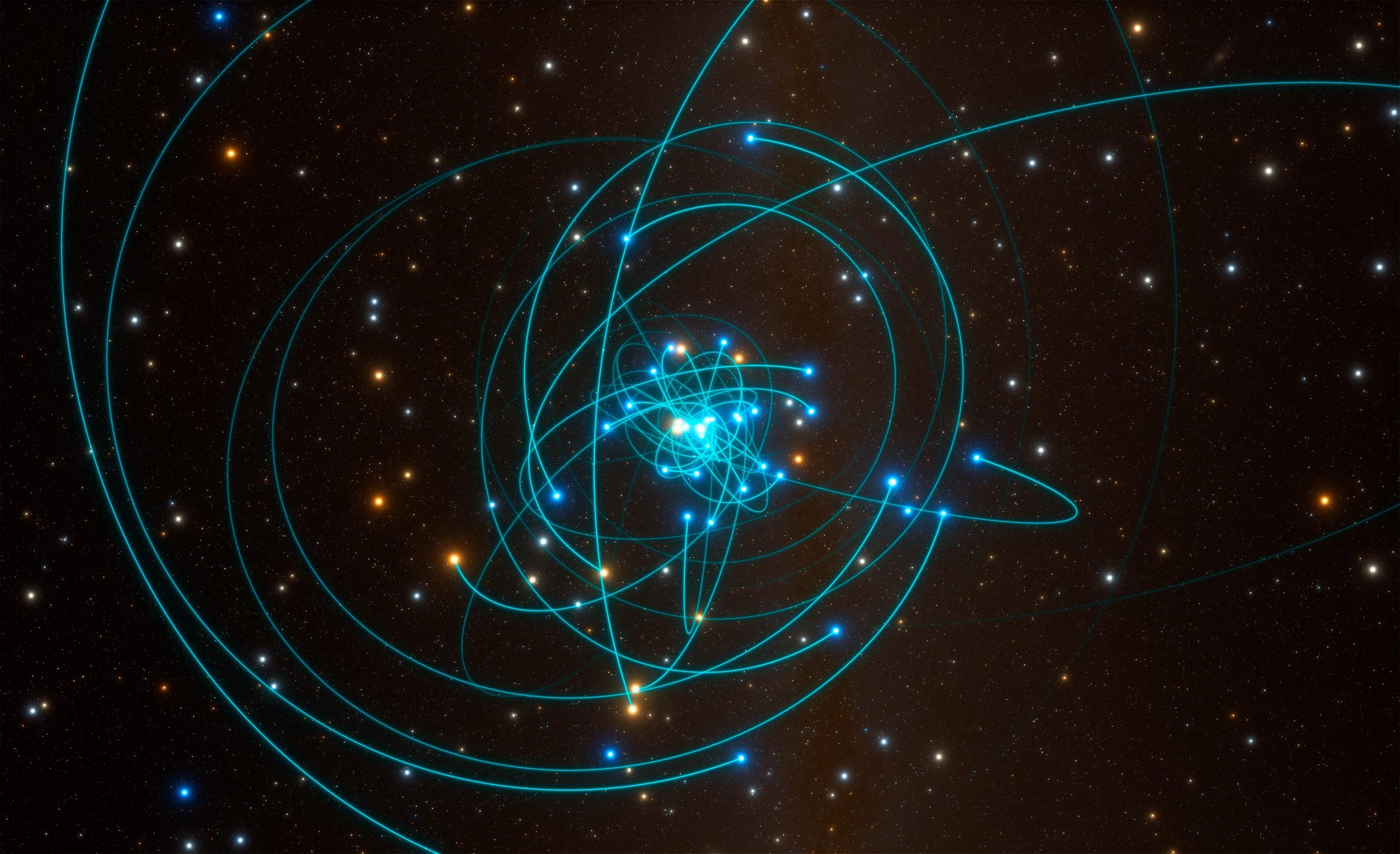
To get a better understanding of how SgrA* has impacted formation and evolution of the Milky Way, Loeb and Dr. Giacomo Fragione, of CIERA, studied instead the stellar orbits and spatial distribution of S-stars—the closest stars orbiting SgrA* and traveling at a speed of up to a few percent of the speed of light—to constrain, or place limits on the spin of the black hole. “We concluded that the supermassive black hole in the center of our galaxy is spinning slowly,” said Fragione. “This can have major implications for the detectability of activity in the center of our galaxy and the future observations of the Event Horizon Telescope.”
The S-stars appear to be organized into two preferred planes. Loeb and Fragione showed that if SgrA* had a significant spin, the preferred orbital planes of the stars at birth would become misaligned by the present time. “For our study, we used the recently discovered S-stars to show that the spin of the black hole SgrA* must be smaller than 10 percent of its maximal value, corresponding to a black hole spinning at the speed of light,” said Loeb. “Otherwise, the common orbital planes of these stars would not stay aligned during their lifetime, as seen today.”
The results of the research also point to another important detail about SgrA*: it is unlikely to have a jet. “Jets are thought to be powered by spinning black holes, which act as giant flywheels,” said Loeb, with Fragione adding, “Indeed there is no evidence of jet activity in SgrA*. Upcoming analysis of data from the Event Horizon Telescope will shed more light on this issue.”
The find was published just days before the announcement of the 2020 Nobel Prize in Physics, which was awarded in part to scientists Reinhard Genzel and Andrea Ghez for their ground-breaking research which demonstrated that SgrA* is a black hole. “Genzel and Ghez monitored the motion of stars around it,” said Loeb. “They measured its mass but not its spin. We have derived the first tight limit on SgrA*’s spin,” adding that the find wouldn’t be possible without Genzel and Ghez’s original Nobel Prize-winning work.
This work was supported in part by a CIERA Fellowship at Northwestern University, and Harvard’s Black Hole Initiative, which is funded by grants from the John Templeton Foundation and the Gordon and Betty Moore Foundation.
Reference: “An Upper Limit on the Spin of SgrA* Based on Stellar Orbits in Its Vicinity” by Giacomo Fragione and Abraham Loeb, 1 October 2020, The Astrophysical Journal Letters.
DOI: 10.3847/2041-8213/abb9b4
Never miss a breakthrough: Join the SciTechDaily newsletter.
Follow us on Google and Google News.
17 Comments
It’s NOT a black hole – it’s a SUN so heavy that light itself cannot escape its gravitationally pull.
Do the math mate – a star capable of holding a GALAXY worth of stars in its orbit would be more than heavy enough to produce a gravitational pull that light itself can’t escape.
It’s a fact.
You mean just like the Sun is not a star but a huge Jupiter hot enough to emit light ?
Isn’t a sun so massive that light can’t escape a black hole?
nice topic
You the Man Jack!
First off, galaxies don’t necessarily have a super massive black hole at their center, they can exist without them, so it isn’t the black hole that holds galaxies together. Stars within galaxies which lack a central supermassive black hole continue to orbit their host galaxy’s common barycenter.
Also, black holes are real. Whether or not there is a true singularity behind the event horizon we may not yet be able to determine. But the evidence is strong that black holes do exist.
is a light leap year a universal constant that occurs once every 4 earth years and hiw many miles longer is the light leap year then the light year ?
A light💡 year is smaller than a leap year
Dear sir, thanks for your nice co-operatin,
Is this article talking about quantum-mechanical spin, or ordinary non-quantum rotation, like the rotation of the earth? I think you must mean the latter, because I never heard of quantum-mechanical spin described as “spinning slowly.” In that case, shouldn’t you be talking about “rotating slowly” rather than “spinning slowly”?
Did I read this right, calculations show spin is at most 10% of maximum spin which is the speed of light? So the max spin might be 10% of speed of light? Doesn’t seem very slow to me!
… I bet that the gravity field is twisted like “einen Strudel” that morphs into “eine Brezel”…
How would top spin behave in one of favorite models we see for a gravity by Albert…
Jacks stupid😬
Dear sir, thank you so much for your nice co-operatin,
Dear sir, thank you so much for your nice co-operatin!
Hello sir welcome to our at my online marketing business income money good luck Thanks Khasru Bhuiyan
Hello sir good morning sir, welcome to our at my online marketing business income money good luck Thanks Khasru Bhuiyan