
Close Menu
    Facebook X (Twitter) Instagram
    SciTechDaily
    • Biology
    • Chemistry
    • Earth
    • Health
    • Physics
    • Science
    • Space
    • Technology
    Facebook X (Twitter) Pinterest YouTube RSS
    SciTechDaily
    Home»Science»Researchers Use “Artificial Grammars” to Show Building Blocks of Language Evolved 30–40 Million Years Ago
    Science

    Researchers Use “Artificial Grammars” to Show Building Blocks of Language Evolved 30–40 Million Years Ago

    By University of WarwickOctober 21, 20201 Comment4 Mins Read
    Facebook Twitter Pinterest Telegram LinkedIn WhatsApp Email Reddit
    Share
    Facebook Twitter LinkedIn Pinterest Telegram Email Reddit
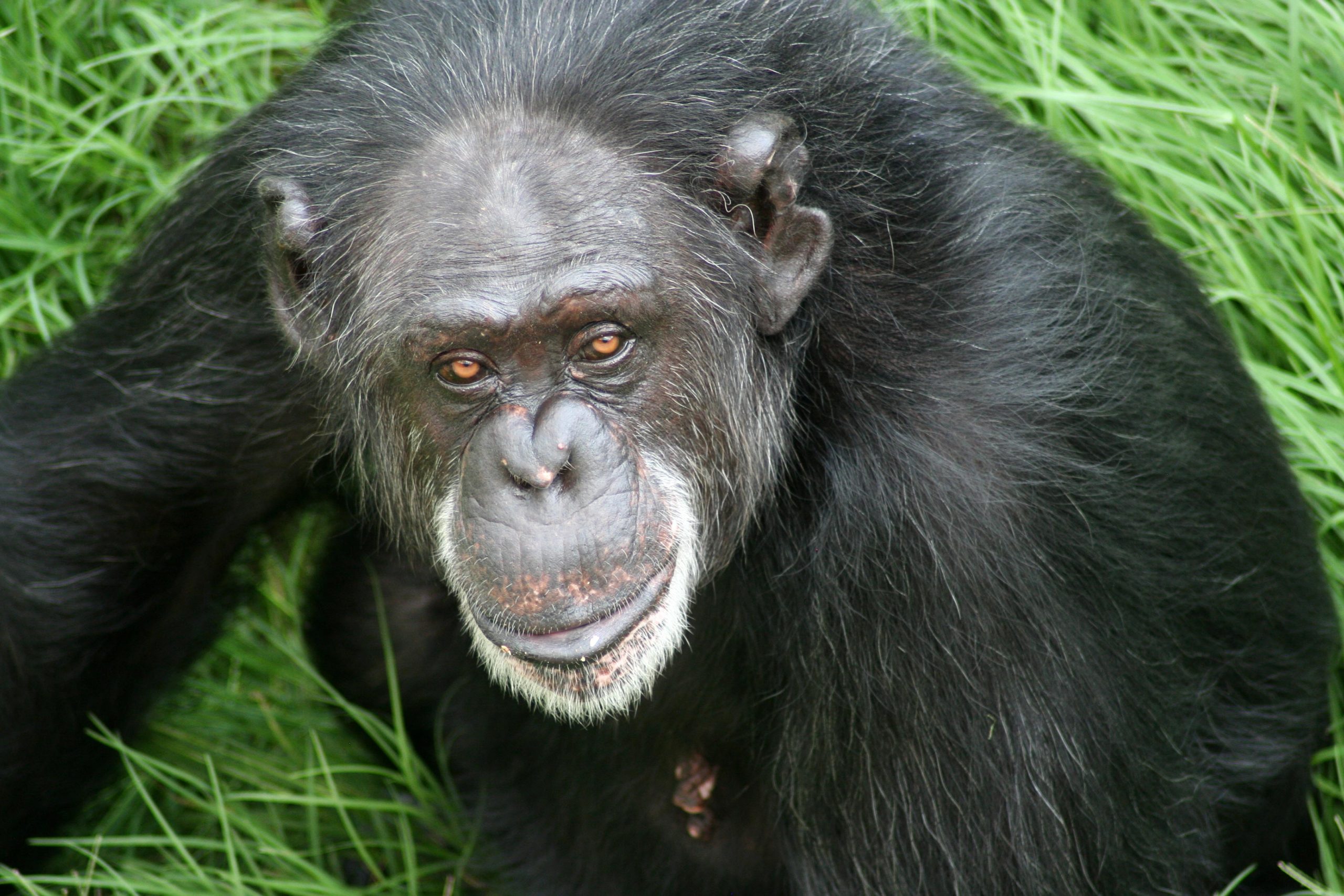
    Chimpanzee Angie
    Chimpanzee Angie was studied at the National Center for Chimpanzee Care in Texas. Credit: University of Warwick
    • Language is one of the most powerful tools available to humanity, and determining why and when language evolved is central to understand what it means to be human
    • Being able to track relationships between words in a sentence, both next to one another and across a sentence, is foundational to language processing. This ability was examined in monkeys, apes, and humans by researchers from the University of Warwick and University of Zurich.
    • Apes and monkeys were able to track relationships between sounds the same way as humans, showing that this ability predates the evolution of language itself by at least 30-40 million years
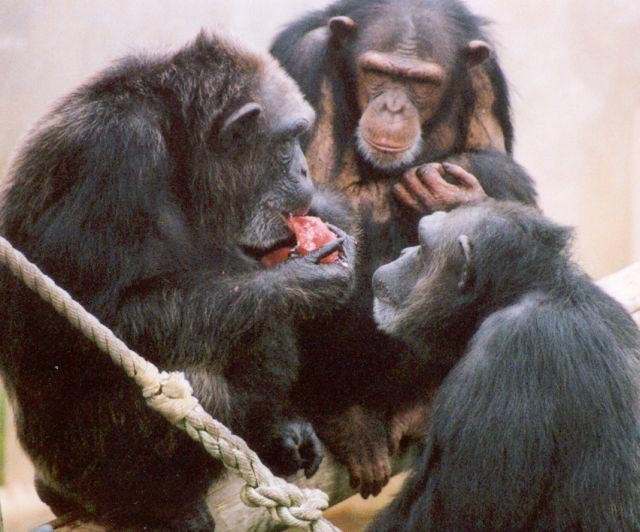
    Chimpanzees Jane Tash and Nina
    Chimpanzees Jane Tash and Nina were studied at the National Center for Chimpanzee Care in Texas. Credit: University of Warwick

    The capacity for language is built upon our ability to understand combinations of words and the relationships between them, but the evolutionary history of this ability is little understood. Now, researchers from the University of Warwick have managed to date this capacity to at least 30-40 million years ago, the last common ancestor of monkeys, apes, and humans.

    Across the globe, humanity flourishes by sharing thoughts, culture, information, and technology through language — an incredibly complex method of communication used by no other species. Determining why and when it evolved is, therefore, crucial to understanding what it means to be human.

    In the paper, “Non adjacent dependency processing in monkeys, apes, and humans,” published today in the journal Science Advances, an international consortium of researchers, led by Professor Simon Townsend at the University of Warwick, made a crucial advance in our understanding of when a key cognitive building block of language may have evolved.

    Chimpanzees Taffy and Maxi
    Chimpanzees Taffy and Maxi were studied at the National Center for Chimpanzee Care in Texas. Credit: University of Warwick

    Being able to process relationships between words in a sentence is one of the key cognitive abilities underpinning language, whether those words are next to one another, known as an ‘adjacent dependency’, or distant to one another, known as a ‘non-adjacent dependency’. For example, in the sentence “the dog who bit the cat ran away” we understand that is it the dog who ran away rather than the cat, thanks to being able to process the relationship between the first and last phrases.
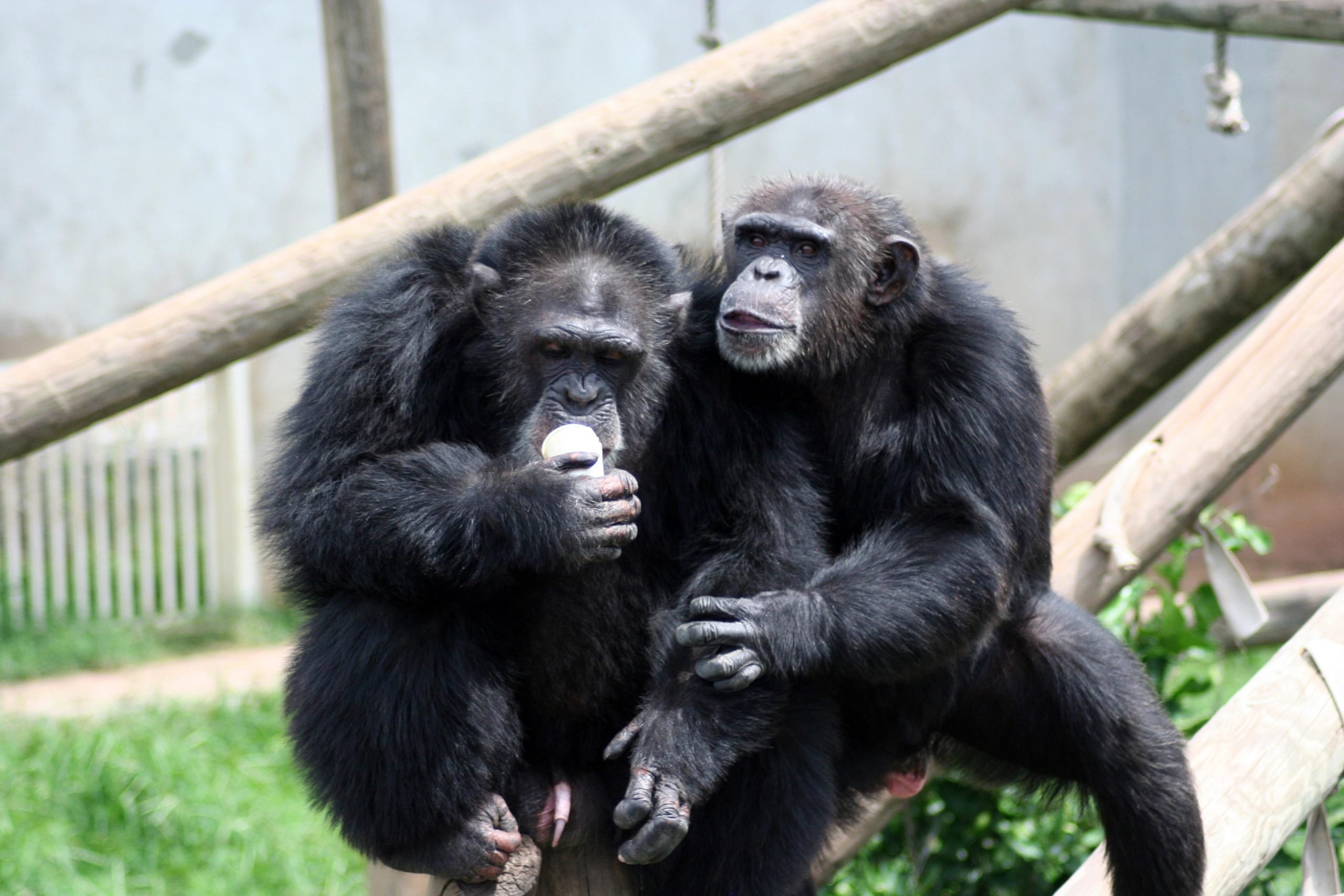
    Chimpanzees Tina and Martin
    Chimpanzees Tina and Martin were studied at the National Center for Chimpanzee Care in Texas. Credit: University of Warwick

    Dr. Stuart Watson, who carried out this work at the University of Zürich, explains: “Most animals do not produce non-adjacent dependencies in their own natural communication systems, but we wanted to know whether they might nevertheless be able to understand them.”
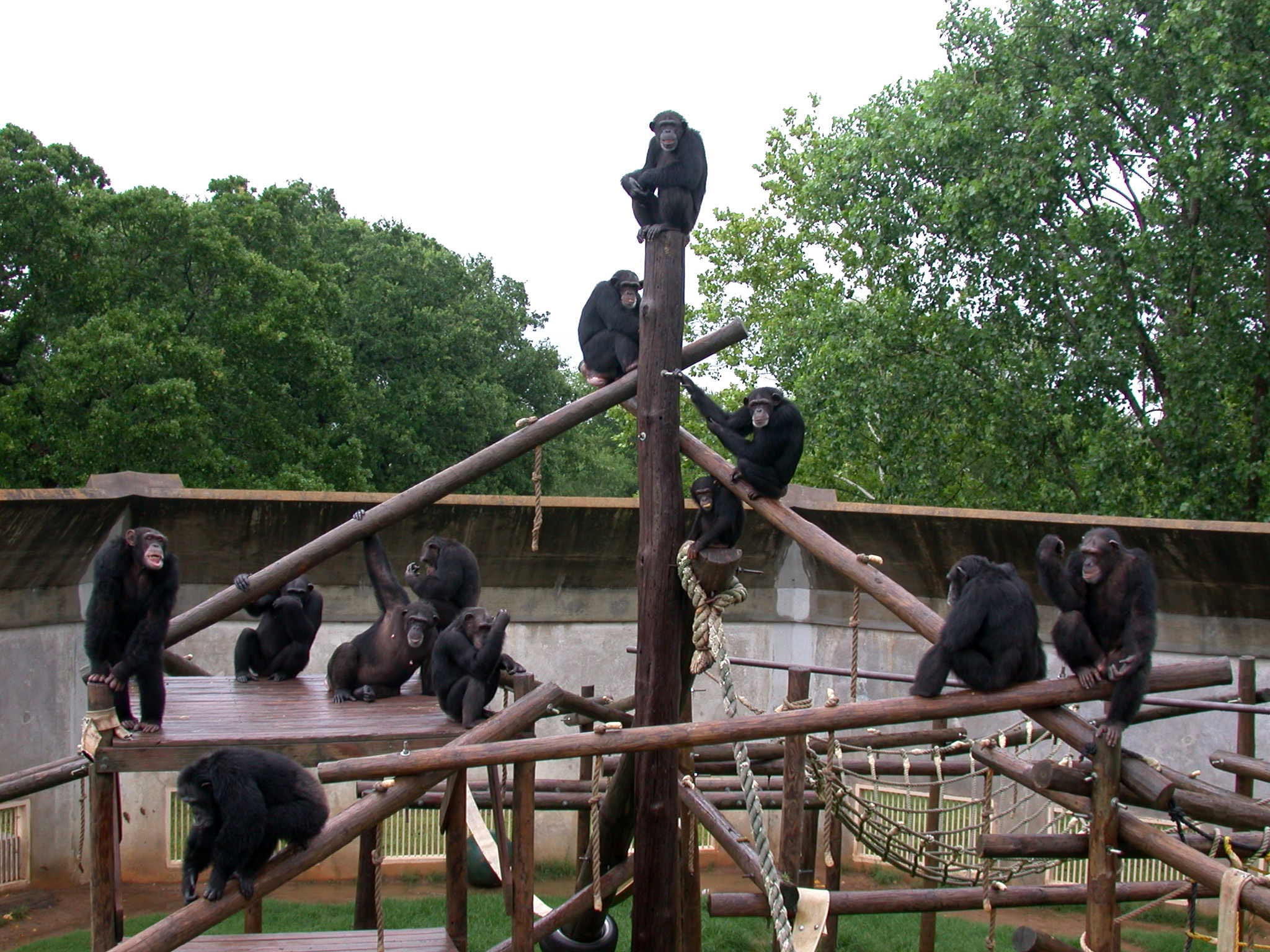
    Chimpanzee Corral
    Chimpanzee Corral, who was studied at the National Center for Chimpanzee Care in Texas. Credit: University of Warwick

    The research team used a novel experimental approach for their experiments: They created “artificial grammars” in which sequences made up of meaningless tones instead of words were used to examine the abilities of subjects to process the relationships between sounds. This made it possible to compare the ability to recognize non-contiguous dependencies between three different primate species, even though they do not share a common language. The experiments were carried out with common marmosets (a Brazilian monkey), chimpanzees, and humans.

    Chimpanzee Judumi
    Chimpanzee Judumi was studied at the National Center for Chimpanzee Care in Texas. Credit: University of Warwick

    The researchers found that all three species were readily able to process the relationships between both adjacent and non-adjacent sound elements. Non-adjacent dependency processing is, therefore, widespread in the primate family.

    The implications of this finding are significant, says Professor Townsend, “This indicates that this critical feature of language already existed in our ancient primate ancestors, predating the evolution of language itself by at least 30 – 40 million years.”

    Reference: “Nonadjacent dependency processing in monkeys, apes, and humans” by Stuart K. Watson, Judith M. Burkart, Steven J. Schapiro, Susan P. Lambeth, Jutta L. Mueller and Simon W. Townsend, 21 October 2020, Science Advances.
    DOI: 10.1126/sciadv.abb0725

    Never miss a breakthrough: Join the SciTechDaily newsletter.
    Follow us on Google and Google News.

    Behavioral Science Evolution Language University of Warwick
    Share. Facebook Twitter Pinterest LinkedIn Email Reddit

    Related Articles

    Primates Change Their “Accent” in Shared Territory to Avoid Conflict

    Screams of “Joy” Are Often Mistaken for “Fear” When Heard Out of Context

    Chimpanzee Lip-Smacks Help Trace the Evolution of Human Speech Back to Ancient Ancestors

    Distinctive Primal Acoustics of the Human Scream

    Old World Monkeys Vocalizations May Be More Sophisticated Than Previously Realized

    Researchers Link Dyslexia Gene Variants to Consonant Use Across Populations

    New Linguistic Analyses Dates Dravidian Language Family

    Body Language Is a Better Indicator of Intense Emotions Than Facial Expressions

    Disease Mapping Methods Indicate That Indo-European Languages Originated From Anatolia

    1 Comment

    1. kamir bouchareb st on October 22, 2020 3:06 am

      very good

      Reply
    Leave A Reply Cancel Reply

    • Facebook
    • Twitter
    • Pinterest
    • YouTube

    Don't Miss a Discovery

    Subscribe for the Latest in Science & Tech!

    Trending News

    Scientists Break 50-Year-Old Bottleneck To Supercharge Cancer Drug Production

    Popular Weight-Loss Drug Wegovy Linked to Sudden Vision Loss

    Extraordinary Fossil Reveals Fatal Duel Between Ocean Titans 80 Million Years Ago

    “Super Bizarre” – Neuroscientists Discover That Adult Brain Is Filled With Millions of “Silent Synapses”

    Simple Brain Training Cuts Dementia Risk Decades Later, Study Finds

    A Simple Injection Could Help the Heart Heal Itself After a Heart Attack

    Scientists Just Discovered a Hidden Freshwater World Beneath the Great Salt Lake

    Why Your Daily Shower Could Be Worsening the Water Crisis

    Follow SciTechDaily
    • Facebook
    • Twitter
    • YouTube
    • Pinterest
    • Newsletter
    • RSS
    SciTech News
    • Biology News
    • Chemistry News
    • Earth News
    • Health News
    • Physics News
    • Science News
    • Space News
    • Technology News
    Recent Posts
    • Scientists Discover Plants Can “Count” – and May Be Smarter Than We Thought
    • New Study Challenges the Idea That We Stop Psychologically Growing After 30
    • Primordial Magnetic Fields May Solve One of Cosmology’s Biggest Mysteries
    • Scientists Propose a Radical New Method To Find Alien Life
    • New Research Reveals Ancient Mars May Have Been Warm, Wet – and Possibly Alive
    Copyright © 1998 - 2026 SciTechDaily. All Rights Reserved.
    • Science News
    • About
    • Contact
    • Editorial Board
    • Privacy Policy
    • Terms of Use

    Type above and press Enter to search. Press Esc to cancel.