
Close Menu
    Facebook X (Twitter) Instagram
    SciTechDaily
    • Biology
    • Chemistry
    • Earth
    • Health
    • Physics
    • Science
    • Space
    • Technology
    Facebook X (Twitter) Pinterest YouTube RSS
    SciTechDaily
    Home»Science»Body Language Is a Better Indicator of Intense Emotions Than Facial Expressions
    Science

    Body Language Is a Better Indicator of Intense Emotions Than Facial Expressions

    By SciTechDailyDecember 3, 2012No Comments3 Mins Read
    Facebook Twitter Pinterest Telegram LinkedIn WhatsApp Email Reddit
    Share
    Facebook Twitter LinkedIn Pinterest Telegram Email Reddit
    body-language-facial-cues
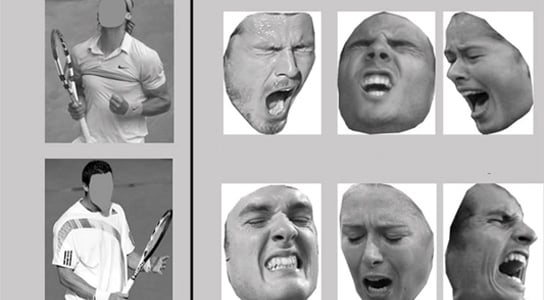
    Without body cues, it’s hard to tell if these tennis champs are winners or losers. Credit: H. Aviezer et al., Science

    Intense emotional experiences are more easily read in body language than in watching facial expressions. Facial clues in most studies rely on a set of stylized, recognizable expressions, which don’t reflect the expressions that people make in the real world.

    The scientists published their findings in the journal Science. Hillel Aviezer, a neuropsychologist at the Hebrew University of Jerusalem, and lead author, suggests that when emotions get extreme, like when people are undergoing fleeting peaks of intense pain, joy, grief, or anger, these could look surprisingly similar, at least on their faces.

    However, most people aren’t confused whether someone they see is experiencing grief or joy. To figure out how people distinguish the difference, the scientists showed photos of professional tennis players to 45 Princeton University students, randomly divided into three groups of 15. Each tennis player had won or lost an important match. The participants rated the players’ facial expressions from negative to positive, on a scale of 1 to 9, with 5 marking a neutral point. One group looked at full-body photos, one looked only at the players’ bodies while the last group looked at only their heads. Only the last group had trouble making the right identification, indicating that facial expressions alone didn’t give the participants enough cues.

    The images were then doctored, switching the winning player’s head with those of the losers. Participants still labeled the winners or losers according to the players’ posture, not their facial expressions. In subsequent interviews, researchers learned that whether hands were open or clenched were more important in determining whether a player was deemed a winner than facial cues.

    Yet, in another experiment that asked 20 participants to state whether they would use body language, facial expressions, or both to evaluate emotion, 80% believed that they could judge the full-body photos by facial expression alone. That underscores the bias toward facial expressions and how little we credit body language.

    In a further experiment using photos of people in high-intensity situations, from funerals to orgasms, without body language to provide context, viewers struggled to correctly read facial expressions.

    The results of this study could possibly help people that have difficulty recognizing facial expressions. “Maybe we should zoom out from isolated faces when we teach people how to read emotion, looking at what’s happening in the surroundings, then body and then the face,” states Aviezer.

    Reference: “Body Cues, Not Facial Expressions, Discriminate Between Intense Positive and Negative Emotions” by Hillel Aviezer, Yaacov Trope and Alexander Todorov, 30 November 2012, Science.
    DOI: 10.1126/science.1224313

    Never miss a breakthrough: Join the SciTechDaily newsletter.
    Follow us on Google and Google News.

    Behavioral Science Body Language Language Neuroscience Psychology
    Share. Facebook Twitter Pinterest LinkedIn Email Reddit

    Related Articles

    Making (and Breaking) Eye Contact Repeatedly Makes Conversation More Engaging

    Screams of “Joy” Are Often Mistaken for “Fear” When Heard Out of Context

    Answer Quickly to Be Believed – Pausing Before Replying Decreases Perceived Sincerity

    How Does Our Brain Separate the Factual From the Possible?

    Infant Brain Circuitry Shaped by Language Exposure

    Writing by Hand Makes Kids Smarter – Here’s Why

    Brain Regions Associated With the Successful Spread of Ideas Identified

    Curing Boredom

    Searching for a More Accurate Classification of the Dimensions of Psychopathology

    Leave A Reply Cancel Reply

    • Facebook
    • Twitter
    • Pinterest
    • YouTube

    Don't Miss a Discovery

    Subscribe for the Latest in Science & Tech!

    Trending News

    Scientists Warn That This Common Pet Fish Can Wreck Entire Ecosystems

    Scientists Make Breakthrough in Turning Plastic Trash Into Clean Fuel Using Sunlight

    This Popular Supplement May Interfere With Cancer Treatment, Scientists Warn

    Scientists Finally Solved One of Water’s Biggest Mysteries

    Could This New Weight-Loss Pill Disrupt the Entire Market? Here’s What You Should Know About Orforglipron

    Earth’s Crust Is Tearing Open in Africa, and It Could Form a New Ocean

    Breakthrough Bowel Cancer Trial Leaves Patients Cancer-Free for Nearly 3 Years

    Natural Compound Shows Powerful Potential Against Rheumatoid Arthritis

    Follow SciTechDaily
    • Facebook
    • Twitter
    • YouTube
    • Pinterest
    • Newsletter
    • RSS
    SciTech News
    • Biology News
    • Chemistry News
    • Earth News
    • Health News
    • Physics News
    • Science News
    • Space News
    • Technology News
    Recent Posts
    • College Student Identifies Bizarre New Carnivorous Dinosaur Three Times Older Than T. rex
    • The Most Effective Knee Arthritis Treatments Aren’t What You Expect
    • Scientists Develop Bioengineered Chewing Gum That Could Help Fight Oral Cancer
    • Popular Weight-Loss Drugs Found To Cut Heart Attack and Stroke Risk
    • After 37 Years, the World’s Longest-Running Soil Warming Experiment Uncovers a Startling Climate Secret
    Copyright © 1998 - 2026 SciTechDaily. All Rights Reserved.
    • Science News
    • About
    • Contact
    • Editorial Board
    • Privacy Policy
    • Terms of Use

    Type above and press Enter to search. Press Esc to cancel.