
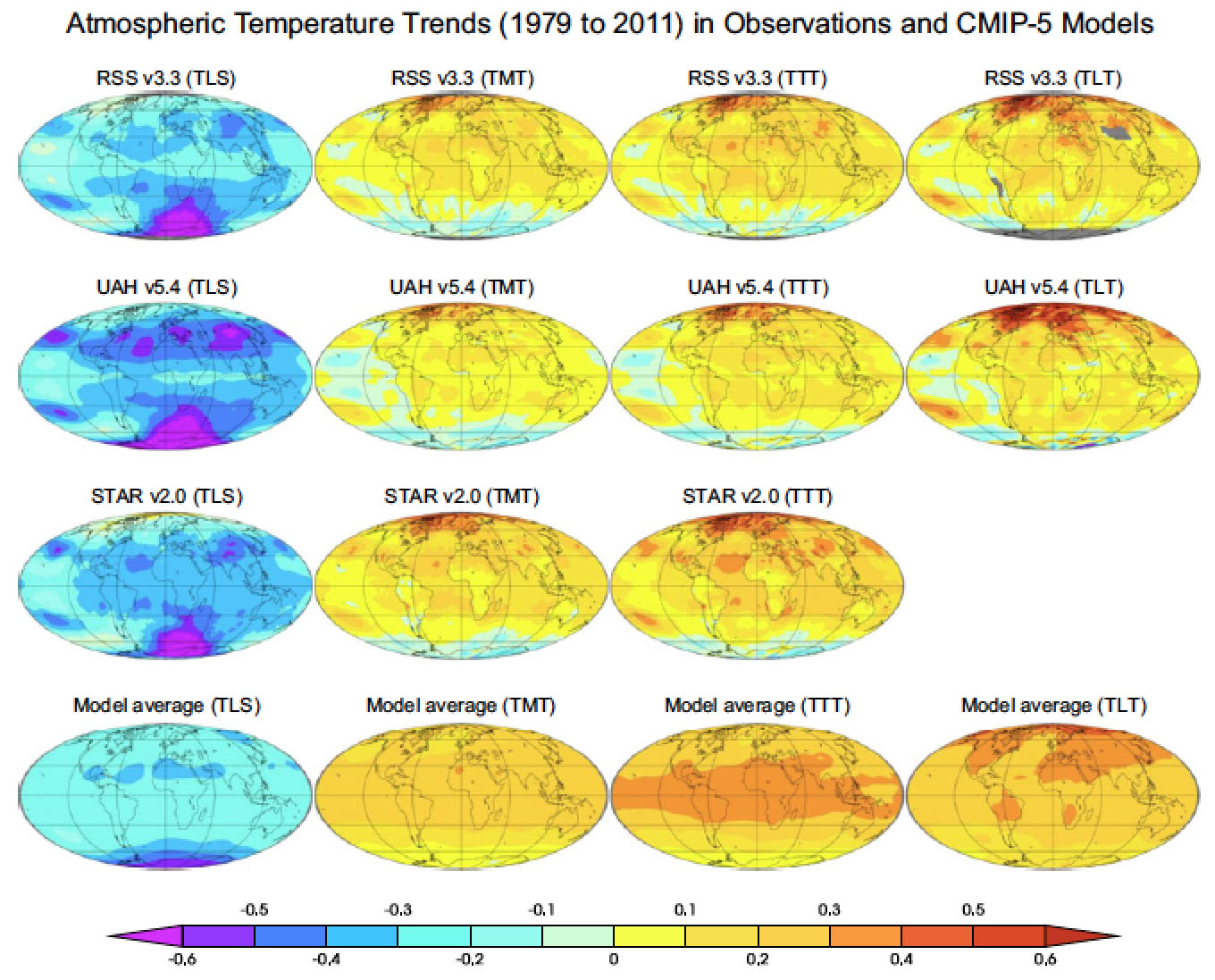
Comparing 20 of the latest climate models against 33 years of satellite data has led the scientists of a newly published study to believe, with a high degree of certainty, that human activities are linked to climate change.
New research shows some of the clearest evidence yet of a discernible human influence on atmospheric temperature.
Published online in the November 29 early edition of the Proceedings of the U.S. National Academy of Sciences, the study compared 20 of the latest climate models against 33 years of satellite data. When human factors were included in the models, they followed the pattern of temperature changes observed by satellite. When the same simulations were run without considering human influences, the results were quite different.
“We can only match the satellite record when we add in human influences on the atmosphere,” said Michael Wehner, a research scientist at Lawrence Berkeley National Laboratory (Berkeley Lab) Computational Research Division and a co-author of the article, which involved colleagues from 16 other organizations and was led by Benjamin Santer, an atmospheric scientist at Lawrence Livermore National Laboratory (LLNL).
Because the differences were so marked between models run with and without human influences, “we can conclude that these differences are unlikely to be due to natural causes with a high degree of certainty. In fact, in statistical terms, we are far more certain of this finding than we are of the existence of the Higgs-Boson,” said Wehner.
The new climate model simulations analyzed by the team will form the scientific backbone of the upcoming 5th assessment of the Intergovernmental Panel on Climate Change, which is due out in 2014.
The goal of the study was to determine whether previous findings of a “discernible human influence” on tropospheric and stratospheric temperature were affected by current uncertainties in climate models and satellite data. (The troposphere is the lowest portion of the Earth’s atmosphere. The stratosphere sits just above the troposphere, between six and 30 miles above the Earth’s surface.)
To help eliminate the influence of naturally occurring climate variability, the team ran two different kinds of models: Models that included historical and projected increases in carbon dioxide and “aerosols,” such as smoke and dust, and one without. The second set of models acted as a sort of baseline that allowed researchers to filter out the effects of phenomena such as the El Niño/Southern Oscillation and the Pacific Decadal Oscillation. This “noise” can obscure the “signal” scientists are searching for in satellite data and models. Using this information, researchers were able to distinguish the clearest signal yet linking human factors to satellite-observed temperature changes between 1979 and 2011.
Analyzing geographical patterns of atmospheric temperature change over the 33-year period of satellite observations, researchers found that the lower stratosphere cools markedly in both observations and computer models. This cooling is primarily a response to the human-caused depletion of stratospheric ozone, due mostly to the once-widespread use of chlorofluorocarbons (CFCs) in spray can propellants and coolants, among other uses.
The observations and model simulations also show a common pattern of large-scale warming of the lower troposphere, with the largest warming over the Arctic, and muted warming (or even cooling) over Antarctica. Tropospheric warming is mainly driven by human-caused increases in well-mixed greenhouse gases, primarily carbon dioxide.
“It’s very unlikely that purely natural causes can explain these distinctive patterns of temperature change,” said LLNL’s Santer. “No known mode of natural climate variability can cause sustained, global-scale warming of the troposphere and cooling of the lower stratosphere.”
Reference: “Identifying human influences on atmospheric temperature” by Benjamin D. Santer, Jeffrey F. Painter, Carl A. Mears, Charles Doutriaux, Peter Caldwell, Julie M. Arblaster, Philip J. Cameron-Smith, Nathan P. Gillett, Peter J. Gleckler, John Lanzante, Judith Perlwitz, Susan Solomon, Peter A. Stott, Karl E. Taylor, Laurent Terray, Peter W. Thorne, Michael F. Wehner, Frank J. Wentz, Tom M. L. Wigley, Laura J. Wilcox and Cheng-Zhi Zou, 29 November 2012, Proceedings of the U.S. National Academy of Sciences.
DOI: 10.1073/pnas.1210514109
Wehner’s work was supported by the Regional and Global Climate Modeling Program and the Earth System Modeling Program of the Office of Biological and Environmental Research in the Department of Energy Office of Science.
Other contributors to the study, outside Berkeley Lab and LLNL, include researchers from Remote Sensing Systems of Santa Rosa; the Centre for Australian Weather and Climate Research, Melbourne, Australia; the Canadian Centre for Climate Modeling and Analysis, Victoria, Canada; the National Oceanic and Atmospheric Administration (NOAA) Geophysical Fluid Dynamics Laboratory, Princeton; the University of Colorado, Boulder; the Massachusetts Institute of Technology, Cambridge; the U.K. Met. Office Hadley Centre, Exeter, U.K.; the Centre National de la Recherche Scientifique, Toulouse, France; North Carolina State University; the National Climatic Data Center, Asheville; the National Center for Atmospheric Research, Boulder; the University of Adelaide, South Australia; the University of Reading, U.K.; and the Center for Satellite Applications and Research, Camp Springs.
Never miss a breakthrough: Join the SciTechDaily newsletter.
Follow us on Google and Google News.
5 Comments
What if smoking would be prohibited??
How much result would that have??
Good it will reduce greenhouse gases that cause global warming
Yeah.. and let us ban wildfires (US) and bush fires.. or is that included in “smoking”???
To my mind we need to educate the worst polluters, even of their own countries, or will we continue to ship coal by the shipload to China??..
My concerns are .. and yes, I did see the words “global warming” slip in to the article, and anthropomorphic is now termed “human activities”. “Projected” also concerns me.
Sinking money in to growing trees to lock in the CO2, and then having them burned, does not make sense.. .. and build houses with wood and not frame in steel, is also another solution.
Let science be science.. we only have satellite data for the past 30 years.. how long does climate change take. We dont cook on fire anymore, and if we light a bonfire in the back garden, we have a visit from the fire brigade.
It’s good and fine but how climate affect the weather condition.
But Naomi how about factors affecting human activities is just the same.