
Close Menu
    Facebook X (Twitter) Instagram
    SciTechDaily
    • Biology
    • Chemistry
    • Earth
    • Health
    • Physics
    • Science
    • Space
    • Technology
    Facebook X (Twitter) Pinterest YouTube RSS
    SciTechDaily
    Home»Earth»Grand Canyon Thought to Be 65 Million Years Older Than Previous Estimates
    Earth

    Grand Canyon Thought to Be 65 Million Years Older Than Previous Estimates

    By SciTechDailyDecember 3, 2012No Comments3 Mins Read
    Facebook Twitter Pinterest Telegram LinkedIn WhatsApp Email Reddit
    Share
    Facebook Twitter LinkedIn Pinterest Telegram Email Reddit
    grand-canyon-arizona-age
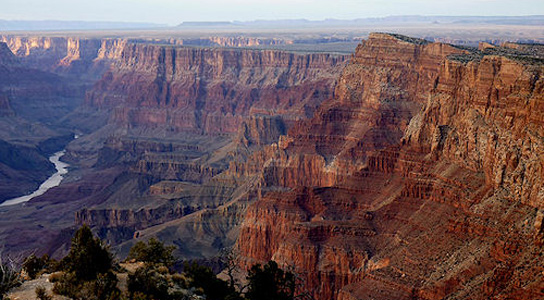
    New analysis suggests the Grand Canyon formed about 70 million years ago during the late Cretaceous Period. Credit: Photo by Flickr/MarkusNL

    A new analysis of the mineral grains from the bottom of the Grand Canyon indicates that it was formed about 70 million years ago, during the late Cretaceous Period, a time when dinosaurs roamed the Earth.

    The scientists published their findings in the journal Science. This new research pushes back the date for the formation of the Grand Canyon in Arizona by more than 60 million years, states Rebecca Flowers, from the Colorado University at Boulder. The team used dating methods that exploited the radioactive decay of uranium and thorium atoms to helium atoms in apatite, a phosphate mineral.
    grand-canyon-view
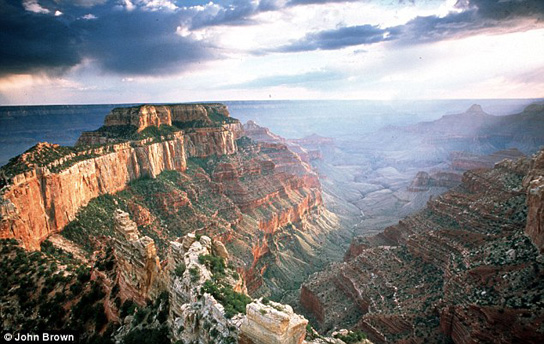
    Credit: Photo by John Brown

    The helium atoms were locked in the mineral grains as they cooled, and moved closer to the surface during the Grand Canyon’s formation, Flowers continues. Temperature variations at shallow levels beneath the Earth’s surface are influenced by topography and the thermal history recorded by these grains allowed the team to infer how much time had passed since there was any significant natural excavation.

    A variety of data suggests that the Grand Canyon has a complicated history, and that the entire modern-day canyon might not have been carved at the same time. Different canyon segments could have evolved separately, coalescing into its current structure.

    In 2008, Flowers and her colleagues showed that parts of the Grand Canyon had developed 55 million years ago. The canyon is over 1.6 km (1 mile) deep, 451  km (280 miles) in length, and 29 km (18 miles) wide in certain places. It was probably carved in large part by an ancestral waterway of the Colorado River, flowing in the opposite direction millions of years ago.

    When temperatures of the apatite grains are higher than 70˚C (158˚F), no helium is retained in it whereas if temperatures are below 30˚C (86˚F), all of the helium is retained. This technique allowed the scientists to detect variations in the thermal structure at shallow levels of the Earth’s crust. The variations are induced by the topography of the region, allowing the researchers to constrain to a timeframe when the Grand Canyon was incised.

    The scientists analyzed the spatial distribution of helium atoms near the margin of individual apatite crystals. This gave them additional information about whether the rocks had a rapid cooling or slow cooling history.

    Many conventional models have put the Grand Canyon’s age at 5 million to 6 million years, however, conflicting information has caused uncertainty in many estimates.

    Reference: “Apatite 4He/3He and (U-Th)/He Evidence for an Ancient Grand Canyon” by R. M. Flowers and K. A. Farley, 29 November 2012, Science.
    DOI: 10.1126/science.1229390

    Never miss a breakthrough: Join the SciTechDaily newsletter.
    Follow us on Google and Google News.

    Dating Earth Science Geology
    Share. Facebook Twitter Pinterest LinkedIn Email Reddit

    Related Articles

    Arctic Sea Ice Loss is Impacting Atlantic Ocean Water Circulation System

    Yale Researchers Find a Soft Spot in the Nazca Plate

    Temperature of Ancient Seas May Shape Global Climate

    New Research Reveals Earth’s Inner Core Was Formed 1 – 1.5 Billion Years Ago

    Flat-Slab Subduction in South America Mirrors Formation of Rocky Mountains

    NASA Study Provides New Estimates for the Global Water Cycle

    New Calculations Challenge Assumptions about Rigid Lithosphere

    Unusual Indian Ocean Earthquakes May Signal Tectonic Breakup

    Defects in Mantle Rocks Slow Down the Passage of Seismic Waves

    Leave A Reply Cancel Reply

    • Facebook
    • Twitter
    • Pinterest
    • YouTube

    Don't Miss a Discovery

    Subscribe for the Latest in Science & Tech!

    Trending News

    Your Blood Pressure Reading Could Be Wrong Because of One Simple Mistake

    Astronomers Stunned by Ancient Galaxy With No Spin

    Physicists May Be on the Verge of Discovering “New Physics” at CERN

    Scientists Solve 320-Million-Year Mystery of Reptile Skin Armor

    Scientists Say This Daily Walking Habit May Be the Secret to Keeping Weight Off After Dieting

    New Therapy Rewires the Brain To Restore Joy in Depression Patients

    Giant Squid Detected off Western Australia in Stunning Deep-Sea Discovery

    Popular Sugar-Free Sweetener Linked to Liver Disease, Study Warns

    Follow SciTechDaily
    • Facebook
    • Twitter
    • YouTube
    • Pinterest
    • Newsletter
    • RSS
    SciTech News
    • Biology News
    • Chemistry News
    • Earth News
    • Health News
    • Physics News
    • Science News
    • Space News
    • Technology News
    Recent Posts
    • Key Magic Mushroom Ingredient Increases Laziness and Reduces Aggression
    • Researchers Solve 15-Year Mystery Behind Cancer-Causing Gut Toxin
    • One of the World’s Most Popular Weedkillers May Be Fueling Deadly Superbugs
    • Scientists Create Laser “Whirlpools” That Spin Tiny Cells Without Touching Them
    • Scientists Discover “Hidden” Materials That Could Transform Clean Energy and Batteries
    Copyright © 1998 - 2026 SciTechDaily. All Rights Reserved.
    • Science News
    • About
    • Contact
    • Editorial Board
    • Privacy Policy
    • Terms of Use

    Type above and press Enter to search. Press Esc to cancel.