
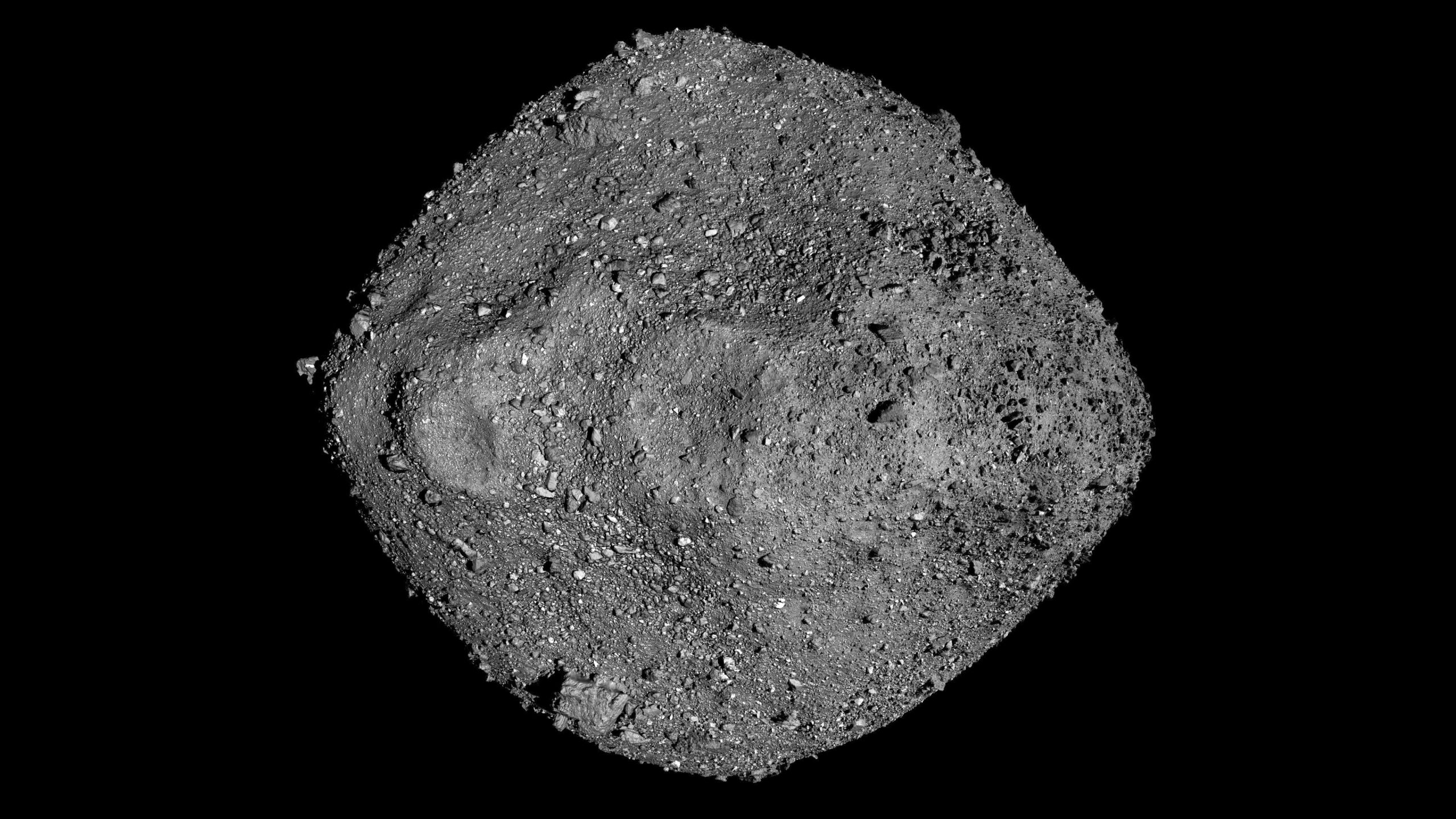
NASA’s OSIRIS-REx mission revealed that surface regeneration on asteroid Bennu occurs in 10,000 to 100,000 years due to rapid thermal fractures, with more insights expected when the mission returns a sample in 2023.
Recently, scientists from NASA’s OSIRIS-REx mission discovered that surface regeneration occurs on asteroids far more quickly than on Earth. By analyzing high-resolution images of rock fractures on asteroid Bennu taken by the OSIRIS-REx spacecraft, the researchers discovered that the Sun’s heat fractures rocks on Bennu in only 10,000 to 100,000 years. With the use of this knowledge, scientists will be able to better predict the time it takes boulders on asteroids like Bennu to fragment into smaller pieces, some of which may eject into space while others may remain on the asteroid’s surface.
Although tens of thousands of years might sound pretty slow, “we thought surface regeneration on asteroids took a few millions of years,” said Marco Delbo, senior scientist at Université Côte d’Azur, CNRS, Observatoire de la Côte d’Azur, Laboratoire Lagrange, Nice, France, and lead author of a paper published in June 2022 in the journal Nature Geoscience. “We were surprised to learn that the aging and weathering process on asteroids happens so quickly, geologically speaking.”
Although landslides, volcanoes, and earthquakes may abruptly alter the Earth’s surface, most changes occur gradually. Over millions of years, water, wind, and temperature changes slowly erode rock to create new surfaces. For instance, if you hiked into the Grand Canyon, you would see distinct rock layers; the top layers tend to be the youngest rocks, dating around 270 million years old, and the layers at the bottom of the canyon are the oldest, about 1.8 billion years old. The Colorado River has been chiseling away at rocks in the Grand Canyon for 5 million to 6 million years, according to the U.S. National Park Service.
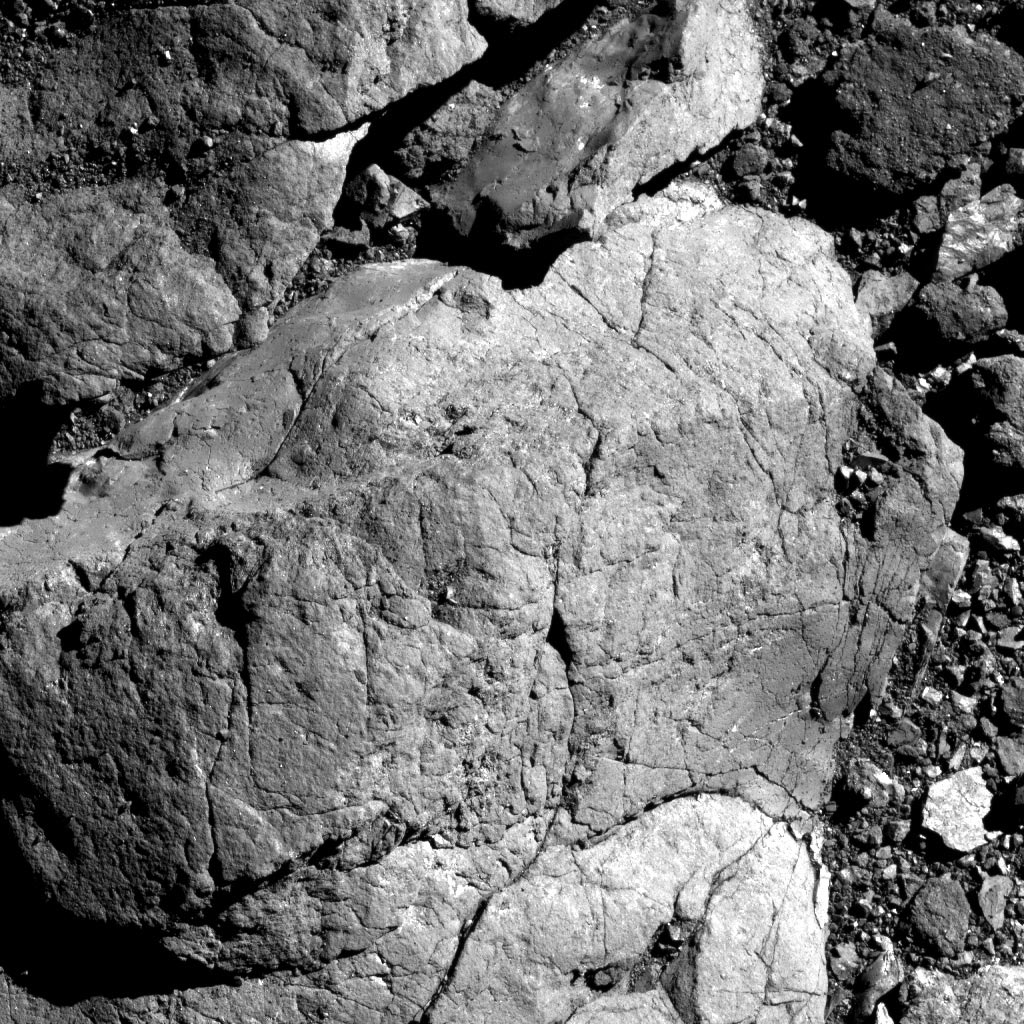
How Thermal Fractures Develop on Bennu
Rapid temperature changes on asteroid Bennu create internal stress that fractures and breaks down rocks, comparable to how a cold glass breaks under hot water. On Bennu, the Sun rises every 4.3 hours. At the equator, daytime highs can reach almost 260°F (about 127°C), and nighttime lows plummet to nearly minus 10°F (about minus 23°C).
OSIRIS-REx scientists spotted cracks in the rocks in spacecraft images from the first surveys of the asteroid. All of the fractures seemed to point in the same direction, “a distinct signature that temperature shocks between the day and the night could be the cause,” said Delbo.
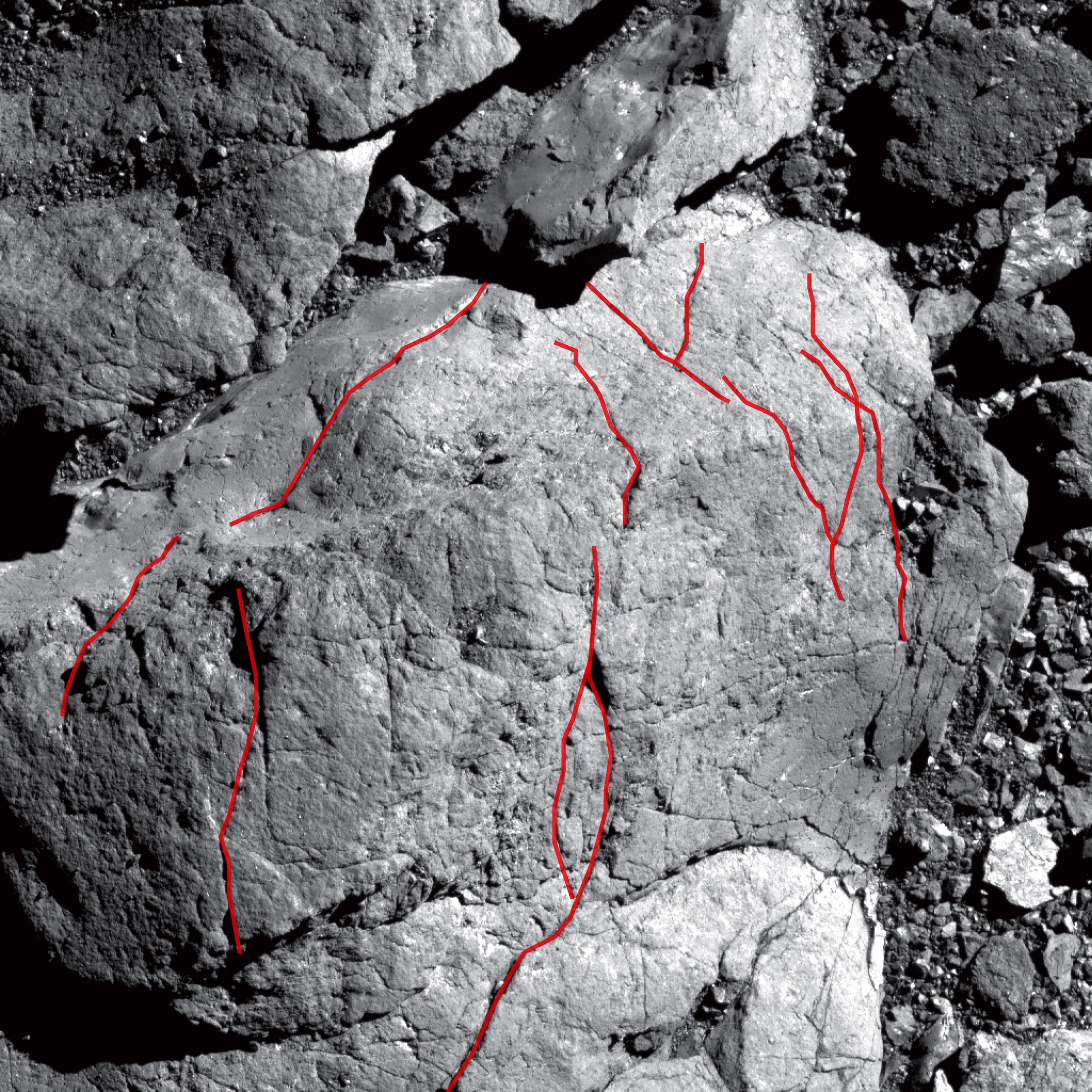
Delbo and his colleagues measured the length and angles of more than 1,500 fractures in OSIRIS-REx images by hand: some shorter than a tennis racket, others longer than a tennis court. They found the fractures predominantly align in the northwest-southeast direction, indicating they were caused by the Sun, which is shown here to be the primary force changing Bennu’s landscape.
“We were surprised to learn that the aging and weathering process on asteroids happens so quickly, geologically speaking.” Marco Delbo
“If landslides or impacts were moving boulders faster than the boulders were cracking, the fractures would point in random directions,” said Delbo.
The research team used a computer model and their fracture measurements to calculate the 10,000- to 100,000-year timeframe for thermal fractures to propagate and split rocks.
Comparing Bennu’s Weathering to Earth and Mars
“The thermal fractures on Bennu are quite similar to what we find on Earth and on Mars in terms of how they form,” said Christophe Matonti, a co-author of the paper at Université Côte d’Azur, CNRS, Observatoire de la Côte d’Azur, Géoazur, Sophia-Antipolis, Valbonne, France. “It is fascinating to see that they can exist and are similar in very ‘exotic’ physical conditions [low gravity, no atmosphere], even compared to Mars.”
“Keep in mind, the topography of Bennu is young, but the rocks on the asteroids are still billions of years old and hold valuable information about the beginning of the solar system,” said Jason Dworkin, OSIRIS-REx project scientist at NASA’s Goddard Space Flight Center in Greenbelt, Maryland.
OSIRIS-REx (Origins, Spectral Interpretation, Resource Identification, Security-Regolith Explorer) will return a sample from Bennu to Earth on September 24, 2023. “We will be able to learn more details about the age of the surface when we are able to directly study the sample,” said Dworkin.
Reference: “Alignment of fractures on Bennu’s boulders indicative of rapid asteroid surface evolution” by Marco Delbo, Kevin J. Walsh, Christophe Matonti, Justin Wilkerson, Maurizio Pajola, Manar M. Al Asad, Chrysa Avdellidou, Ronald-Louis Ballouz, Carina A. Bennett, Harold C. Connolly Jr., Daniella N. DellaGiustina, Dathon R. Golish, Jamie L. Molaro, Bashar Rizk, Stephen R. Schwartz and Dante S. Lauretta, 23 May 2022, Nature Geoscience.
DOI: 10.1038/s41561-022-00940-3
Never miss a breakthrough: Join the SciTechDaily newsletter.
Follow us on Google and Google News.
4 Comments
Where did the rocks come from? Don’t rocks imply a planetary origin?
The rocks that make up the asteroids are left-overs from the formation of the solar system, that never had the chance to form larger, planet-sized bodies.
I don’t understand the comparison with the Grand Canyon sediments. The surfaces of the exposed rocks at the top have been subjected to weathering and erosion just as has those near the bottom. And each still is.
“Evolution” is a better term than “aging”. It doesn’t make the rocks older; it makes them smaller.