
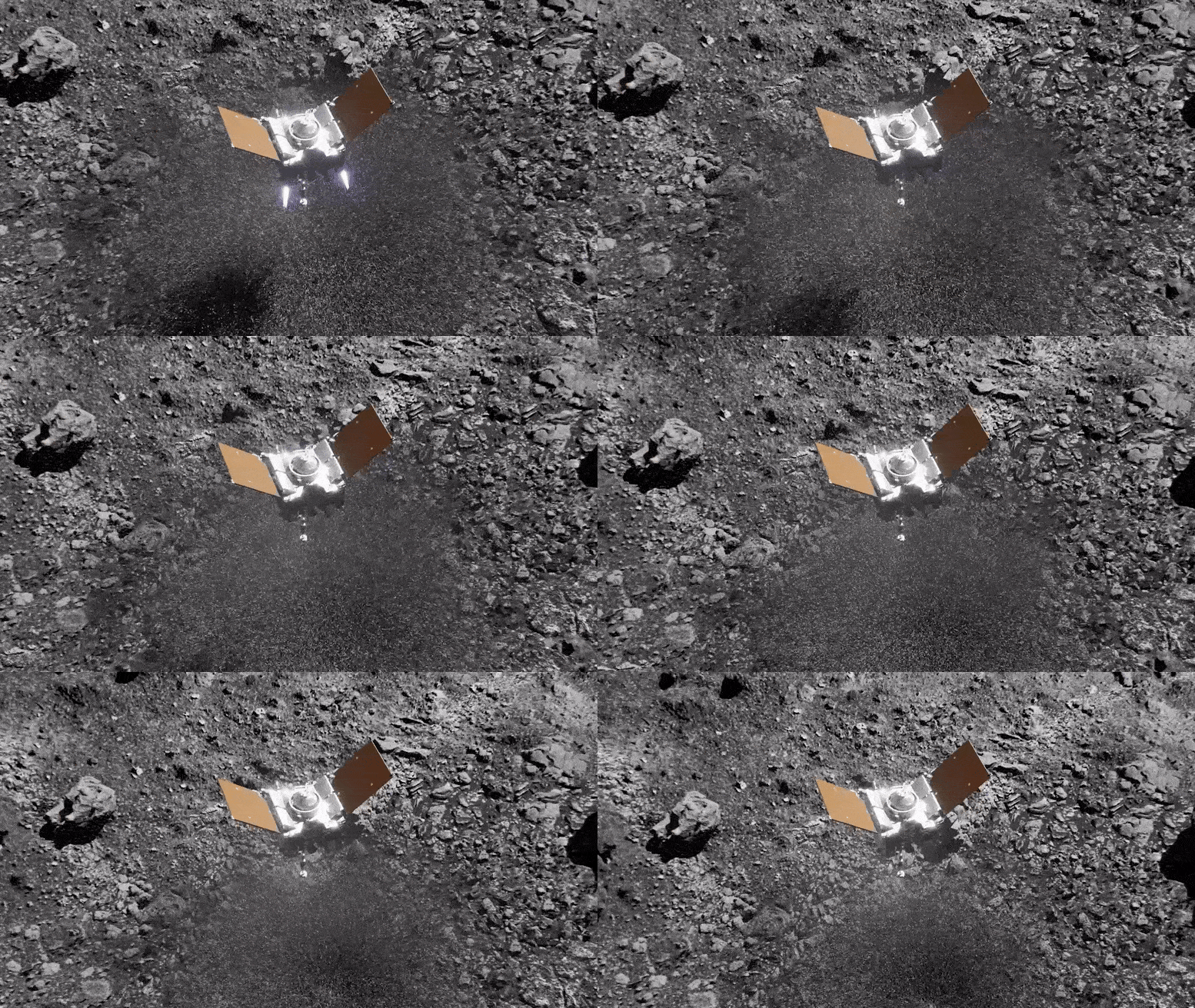
OSIRIS-REx found Bennu’s surface is loosely packed, unlike previous predictions.
Scientists have learned something astonishing after analyzing data gathered when NASA’s OSIRIS-REx spacecraft collected a sample from asteroid Bennu in October 2020. The spacecraft would have sunk into the asteroid had it not fired its thrusters to back away immediately after it grabbed its sample of dust and rock from Bennu’s surface.
“Our expectations about the asteroid’s surface were completely wrong.” Dante Lauretta, principal investigator of OSIRIS-REx
Unexpectedly, it turns out that the particles making up Bennu’s exterior are so loosely packed and lightly bound to each other that if a person were to step onto the asteroid they would feel very little resistance. It would be like stepping into a pit of plastic balls that are popular play areas for kids.
“If Bennu was completely packed, that would imply nearly solid rock, but we found a lot of void space in the surface,” said Kevin Walsh, a member of the OSIRIS-REx science team from Southwest Research Institute, which is based in San Antonio.
The latest findings about Bennu’s surface were published on July 7, 2022, in a pair of papers in the journals Science and Science Advances, led respectively by Dante Lauretta, principal investigator of OSIRIS-REx, based at University of Arizona, Tucson, and Kevin Walsh. These surprising results add to the intrigue that has gripped scientists throughout the OSIRIS-REx mission, as Bennu has proved consistently unpredictable.
First Signs of Bennu’s Unpredictable Nature
The first surprise the asteroid presented was in December 2018, when NASA’s spacecraft arrived at Bennu. The OSIRIS-REx team found a rough surface littered with boulders instead of the smooth, sandy beach they had expected based on observations from Earth- and space-based telescopes. Reasearchers also discovered that Bennu was ejecting particles of rock from its surface into space.
“Our expectations about the asteroid’s surface were completely wrong,” said Lauretta.
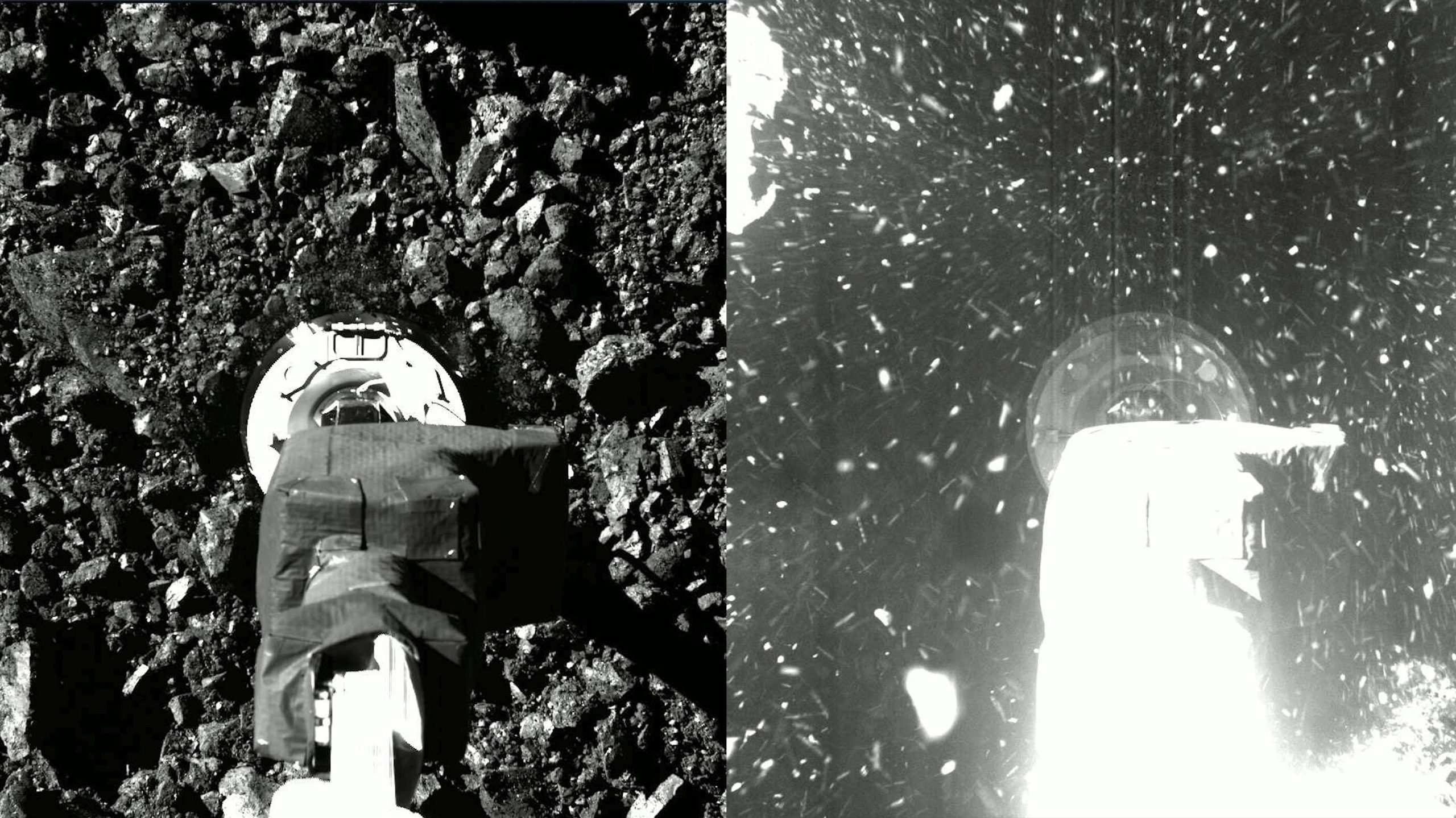
The latest clue that Bennu was not what it seemed came after the OSIRIS-REx spacecraft picked up a sample and beamed stunning, close-up images of the asteroid’s surface to Earth. “What we saw was a huge wall of debris radiating out from the sample site,” Lauretta said. “We were like, ‘Holy cow!’”
Near-Earth asteroid Bennu is a rubble pile of rocks and boulders left over from the formation of the solar system. On October 20, 2020, NASA’s OSIRIS-REx spacecraft briefly touched down on Bennu and collected a sample for return to Earth. During this event the spacecraft’s arm sank far deeper into the asteroid than expected, confirming that Bennu’s surface is loosely bound. Now, scientists have used data from OSIRIS-REx to revisit the sample-collection event and better understand how Bennu’s loose upper layers are held together. Credit: NASA’s Goddard Space Flight Center/CI Lab/SVS
Mission scientists were perplexed by the abundance of pebbles strewn about, given how gently the spacecraft tapped the surface. Even more bizarre was that the spacecraft left a big crater that was 26 feet (8 meters) wide. “Every time we tested the sample pickup procedure in the lab, we barely made a divot,” Lauretta said. The mission team decided to send the spacecraft back to take more photographs of Bennu’s surface “to see how big of a mess we made,” Lauretta said.
Researchers analyzed the volume of debris visible in before and after images of the sample site, nicknamed “Nightingale.” They also looked at acceleration data collected during the spacecraft’s touch down. This data revealed that as OSIRIS-REx touched the asteroid it experienced the same amount of resistance – very little – a person would feel while squeezing the plunger on a French press coffee carafe. “By the time we fired our thrusters to leave the surface we were still plunging into the asteroid,” said Ron Ballouz, an OSIRIS-REx scientist based at the Johns Hopkins Applied Physics Laboratory in Laurel, Maryland.
Ballouz and the research team ran hundreds of computer simulations to deduce Bennu’s density and cohesion based on spacecraft images and acceleration information. Engineers varied the surface cohesion properties in each simulation until they found the one that most closely matched their real-life data.

Now, this precise information about Bennu’s surface can help scientists better interpret remote observations of other asteroids, which could be useful in designing future asteroid missions and for developing methods to protect Earth from asteroid collisions.
Understanding the Risks of Asteroids Like Bennu
It’s possible that asteroids like Bennu — barely held together by gravity or electrostatic force — could break apart in Earth’s atmosphere and thus pose a different type of hazard than solid asteroids. “I think we’re still at the beginning of understanding what these bodies are, because they behave in very counterintuitive ways,” said Patrick Michel, an OSIRIS-REx scientist and director of research at the Centre National de la Recherche Scientifique at Côte d’Azur Observatory in Nice, France.
References:
“Spacecraft sample collection and subsurface excavation of asteroid (101955) Bennu” by D. S. Lauretta, C. D. Adam, A. J. Allen, R.-L. Ballouz, O. S. Barnouin, K. J. Becker, T. Becker, C. A. Bennett, E. B. Bierhaus, B. J. Bos, R. D. Burns, H. Campins, Y. Cho, P. R. Christensen, E. C. A. Church, B. E. Clark, H. C. Connolly, M. G. Daly, D. N. DellaGiustina, C. Y. Drouet d’Aubigny, J. P. Emery, H. L. Enos, S. Freund Kasper, J. B. Garvin, K. Getzandanner, D. R. Golish, V. E. Hamilton, C. W. Hergenrother, H. H. Kaplan, L. P. Keller, E. J. Lessac-Chenen, A. J. Liounis, H. Ma, L. K. McCarthy, B. D. Miller, M. C. Moreau, T. Morota, D. S. Nelson, J. O. Nolau, R. Olds, M. Pajola, J. Y. Pelgrift, A. T. Polit, M. A. Ravine, D. C. Reuter, B. Rizk, B. Rozitis, A. J. Ryan, E. M. Sahr, N. Sakatani, J. A. Seabrook, S. H. Selznick, M. A. Skeen, A. A. Simon, S. Sugita, K. J. Walsh, M. M. Westermann, C. W. V. Wolner and K. Yumoto, 7 July 2022, Science.
DOI: 10.1126/science.abm1018
“Near-zero cohesion and loose packing of Bennu’s near-subsurface revealed by spacecraft contact” by Kevin J. Walsh, Ronald-Louis Ballouz, Erica R. Jawin, Chrysa Avdellidou, Olivier S. Barnouin, Carina A. Bennett, Edward B. Bierhaus, Brent J. Bos, Saverio Cambioni, Harold C. Connolly, Marco Delbo, Daniella N. DellaGiustina, Joseph DeMartini, Joshua P. Emery, Dathon R. Golish, Patrick C. Haas, Carl W. Hergenrother, Huikang Ma, Patrick Michel, Michael C. Nolan, Ryan Olds, Benjamin Rozitis, Derek C. Richardson, Bashar Rizk, Andrew J. Ryan, Paul Sánchez, Daniel J. Scheeres, Stephen R. Schwartz, Sanford H. Selznick, Yun Zhang and Dante S. Lauretta, 7 July 2022, Science Advances.
DOI: 10.1126/sciadv.abm6229
NASA’s Goddard Space Flight Center provides overall mission management, systems engineering, and the safety and mission assurance for OSIRIS-REx. Dante Lauretta of the University of Arizona, Tucson, is the principal investigator. The university leads the science team and the mission’s science observation planning and data processing. Lockheed Martin Space in Littleton, Colorado, built the spacecraft and provides flight operations. Goddard and KinetX Aerospace are responsible for navigating the OSIRIS-REx spacecraft. OSIRIS-REx is the third mission in NASA’s New Frontiers Program, managed by NASA’s Marshall Space Flight Center in Huntsville, Alabama, for the agency’s Science Mission Directorate Washington.
Never miss a breakthrough: Join the SciTechDaily newsletter.
Follow us on Google and Google News.
15 Comments
Not sure what justifies the assumption that loose dust on the surface means there isn’t any solid core underneath the dust.
” This data revealed that as OSIRIS-REx touched the asteroid it experienced the same amount of resistance – very little – a person would feel while squeezing the plunger on a French press coffee carafe.” – What a stupid analogy. How many people do you think can relate to that?
only the french cogffie drinkers I would suspect.know whats about.. I like the one where it refers to a plastic ball pit for kids. much better.. Make me want to send my kids off to space to play on it for a afewdaysthe pools areclosed it’s not hot as hell in space is it? only on reentry I would guess. whos got a rocket they csan barrow for the trip?
🙋♂️ (and I live in Alabama)
Very interesting article, I don’t understand the plunger comparison but thanks for trying.
This truly fascinating article and its accompanying illustrations & video provided me with an important new insight into the inhabitants of the asteroid belt. I’m avidly awaiting results from the upcoming Psyche mission. Thanks!
The fragments in the photos look angular and dark in color. Like a mass of broken up anthracite coal. Were any studies attempted on the composition of these fragments? Could they be soft and organic like some coals?
So much money spent on finding dust. What a waste..this money could have gone to find quantum medicine which will be the future
Actually, it doesn’t look like there was very much dust (fine-grained mineral matter). Mostly coarse rock fragments that look to be very light weight…low density.
“quantum medicine” doesn’t exist and even if it did it’s not something we can “find” like a seashell on the beach.
Medicine is entirely biochemical reactions that are well-explained by electron interactions. Yes, electrons obey Quantum Electrodynamics, but that’s not relevant for figuring out biochemistry.
Great shots of an unknown..good to know for future landing attempts. Maybe you can shoot a dart like item during future flights before a touch down to save the vehicle from sinking into surface? Keep up the great science and sharing…
Presumably then, it d does not have much of a gravity, very little solid core , fascinating.
As I was reading this article I thought about the same thing that Tony said, shoot a dart attached to some measuring device so we can know know exactly how deep this outer layer is and take samples from inside as well. Praying it’s just a s*** load of small fragments. And won’t cause to much destruction if and when it decides to make contact. Good jobs to all you Scientists involved. Keep up the good work. You are appreciated.
It is dead. Fact.
I like to read space news! Jbm