
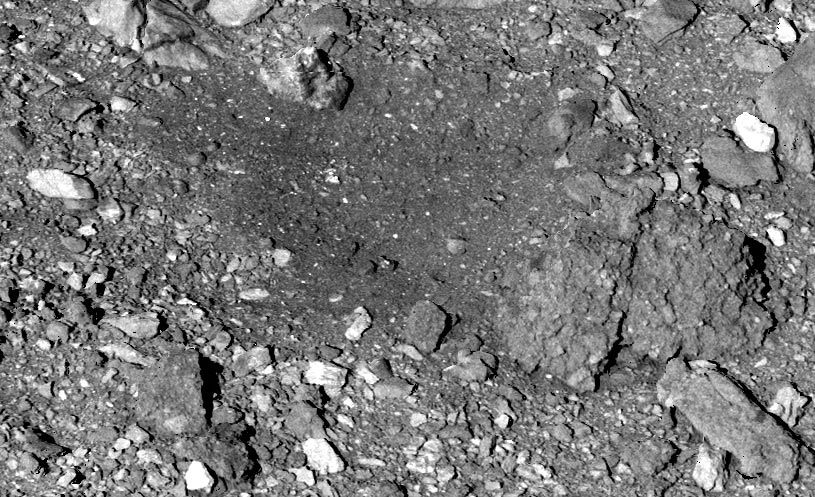
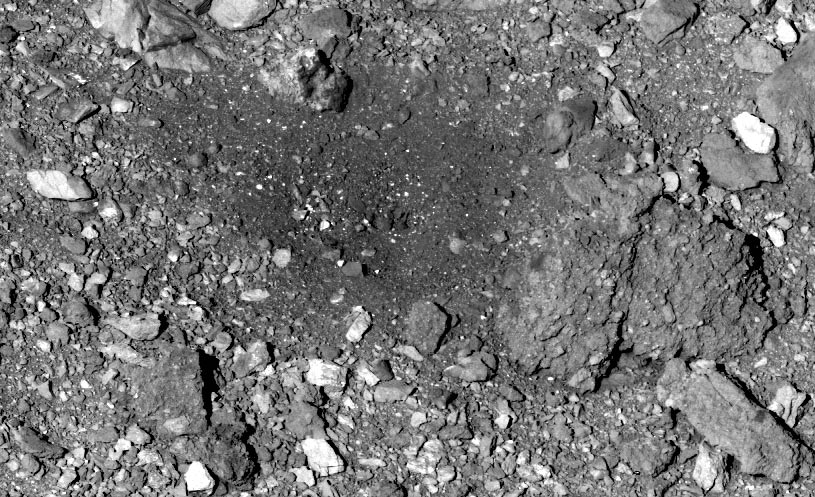
Like boot prints on the Moon, NASA’s OSIRIS-REx spacecraft left its mark on asteroid Bennu. Now, new images — taken during the spacecraft’s final fly-over on April 7, 2021 — reveal the aftermath of its historic encounter with the asteroid.
The spacecraft flew within 2.3 miles (3.7 km) of the asteroid — the closest it has been since the Touch-and-Go, or TAG, sample collection event on October 20, 2020. During TAG, the spacecraft’s sampling head sunk 1.6 feet (48.8 centimeters) into the asteroid’s surface and simultaneously fired a pressurized charge of nitrogen gas, churning up surface material and driving some into the collection chamber. The spacecraft’s thrusters also launched rocks and dust during the maneuver to reverse course and safely back away from the asteroid.
Comparing the two images reveals obvious signs of surface disturbance. At the sample collection point, there appears to be a depression, with several large boulders evident at the bottom, suggesting that they were exposed by sampling. There is a noticeable increase in the amount of highly reflective material near the TAG point against the generally dark background of the surface, and many rocks were moved around.
Where thrusters fired against the surface, substantial mass movement is apparent. Multiple sub-meter boulders were mobilized by the plumes into a campfire ring–like shape — similar to rings of boulders seen around small craters pocking the surface.
A Massive Boulder on the Move
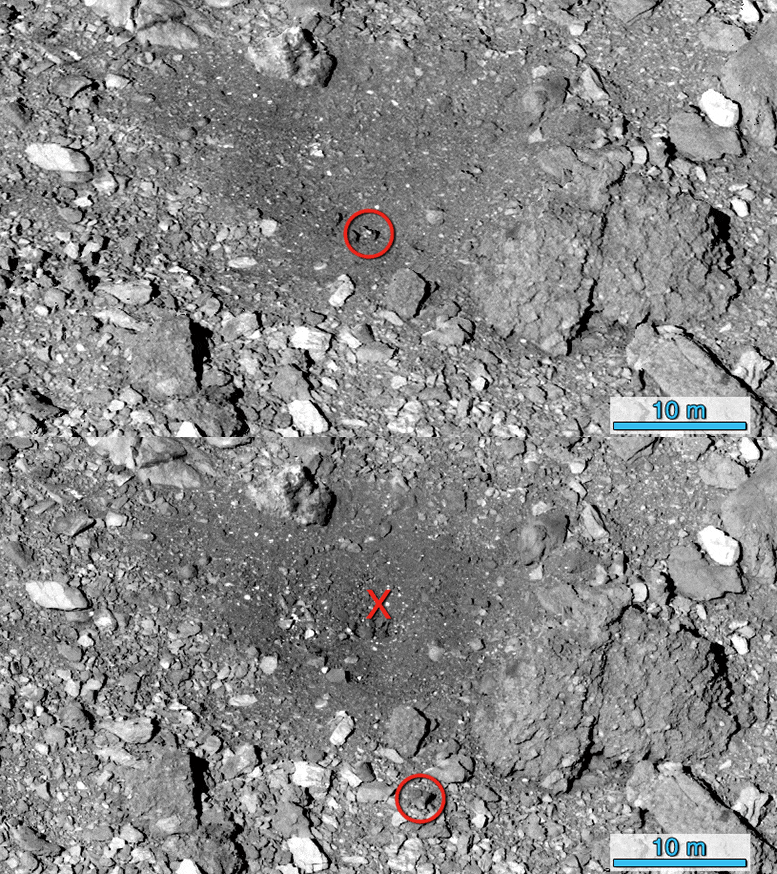
Jason Dworkin, the mission’s project scientist at NASA’s Goddard Space Flight Center in Greenbelt, Maryland, noticed that one boulder measuring 4 feet (1.25 meters) across on the edge of the sampling site seemed to appear only in the post-TAG image. “The rock probably weighs around a ton, with a mass somewhere between a cow and a car.”
Dante Lauretta, of the University of Arizona and the mission’s principal investigator, later pointed out that this boulder is likely one of those present in the pre-TAG image, but much nearer the sampling location, and estimates it was thrown a distance of 40 feet (about 12 meters) by the sample collection event.
In order to compare the before and after images, the team had to meticulously plan this final flyover. “Bennu is rough and rocky, so if you look at it from a different angle or capture it at a time when the sun is not directly overhead, that dramatically changes what the surface looks like,” says Dathon Golish, a member of the OSIRIS-REx image processing working group, headquartered at the University of Arizona. “These images were deliberately taken close to noon, with the Sun shining straight down, when there’s not as many shadows.”
“These observations were not in the original mission plan, so we were excited to go back and document what we did,” Golish said. “The team really pulled together for this one last hurrah.”
The spacecraft will remain in Bennu’s vicinity until departure on May 10, when the mission will begin its two-year return cruise back to Earth. As it approaches Earth, the spacecraft will jettison the Sample Return Capsule (SRC) that contains the sample from Bennu. The SRC will then travel through Earth’s atmosphere and land under parachutes at the Utah Test and Training Range on September 24, 2023.
Once recovered, the capsule will be transported to the curation facility at NASA’s Johnson Space Center in Houston, where the sample will be removed for distribution to laboratories worldwide, enabling scientists to study the formation of our solar system and Earth as a habitable planet. NASA will set 75% of the sample aside for future generations to study with technologies not invented yet.
The OSIRIS-REx mission is the first NASA mission to visit a near-Earth asteroid, survey the surface, and collect a sample to deliver to Earth.
Like boot prints on the Moon, NASA’s OSIRIS-REx spacecraft left its mark on asteroid Bennu. Now, new images — taken during the spacecraft’s final fly-over on April 7, 2021 — reveal the aftermath of the historic Touch-and-Go (TAG) sample acquisition event from October 20, 2020. Credit: NASA’s Goddard Space Flight Center
NASA’s Goddard Space Flight Center in Greenbelt, Maryland, provides overall mission management, systems engineering, and the safety and mission assurance for OSIRIS-REx. Dante Lauretta of the University of Arizona, Tucson, is the principal investigator, and the University of Arizona also leads the science team and the mission’s science observation planning and data processing. Lockheed Martin Space in Denver built the spacecraft and provides flight operations. Goddard and KinetX Aerospace are responsible for navigating the OSIRIS-REx spacecraft. OSIRIS-REx is the third mission in NASA’s New Frontiers Program, which is managed by NASA’s Marshall Space Flight Center in Huntsville, Alabama, for the agency’s Science Mission Directorate in Washington, D.C.
Never miss a breakthrough: Join the SciTechDaily newsletter.
Follow us on Google and Google News.
13 Comments
“The rock probably weighs around a ton, with a mass somewhere between a cow and a car.”
Is that Earth or Bennu weight?
Yeah..BFD we are dumping massive amounts of toxic materials into the ocean on our own biological bubble we call home and I’m supposed to get excited about a footprint/smudge on a sterile rock? Spare me.. the technological gains astronomically outweigh any romantic ideology to ‘LEAVE NO FOOTPRINT ‘ just sayin. Red Ked.
Exactly, now we have pollution on the moon and now mars. The beneficial purpose of the moon to earth is without saying as it relates to ocean & sea levels among other things.
⚠️ God has said in the Quran:
🔵 { O mankind, worship your Lord, who created you and those before you, that you may become righteous – ( 2:21 )
🔴 [He] who made for you the earth a bed [spread out] and the sky a ceiling and sent down from the sky, rain and brought forth thereby fruits as provision for you. So do not attribute to Allah equals while you know [that there is nothing similar to Him]. ( 2:22 )
🔵 And if you are in doubt about what We have sent down upon Our Servant [Muhammad], then produce a surah the like thereof and call upon your witnesses other than Allah, if you should be truthful. ( 2:23 )
🔴 But if you do not – and you will never be able to – then fear the Fire, whose fuel is men and stones, prepared for the disbelievers.( 2:24 )
🔵 And give good tidings to those who believe and do righteous deeds that they will have gardens [in Paradise] beneath which rivers flow. Whenever they are provided with a provision of fruit therefrom, they will say, “This is what we were provided with before.” And it is given to them in likeness. And they will have therein purified spouses, and they will abide therein eternally. ( 2:25 )
⚠️ Quran
This is a milestone symbol of hard work. So great achievement.
Bennu
Osiris
Was this named after THE PHOENIX TV show of the early 80s. ???
Most if the comments here make me sick. Good job NASA I cant wait to know what they find. R K Edwards what do you mean WE? Speak for yourself. I have not ever dumped anything toxic into anywhere. Mary really? You and R K should go out on a date. You two sound like two peas in a Leftist pod!
Why not take all garbage, waste and toxics and dead bodies and dump them in Venus. Burnt and destroyed saving earth.
Confirm you aren’t a spammer by clicking this box.
*Bot spams quran garbage and auto clicks box and submits*
Glad to see the “spam blocker” works.
Maybe consider a captcha or something?
Not that anyone reads this trash.
Spare me the tree hugger BS. Why are you reading about our space exploration gains and potential to maybe advance our species…perhaps jettison our waste lol into deep space.
If you believe any of the lies nasa is spreading, it might be proof that you need your head examined. Unbelievable 😒
😇👹🤢🤮🥱🥱🥱👎🤏💩👀💩💯💩🙈🙉🙊👈👋
Impossible seek any body even boot at the moon because there named print by god is ali and his portfolio a honourable persnality see nasa full moon pics….