
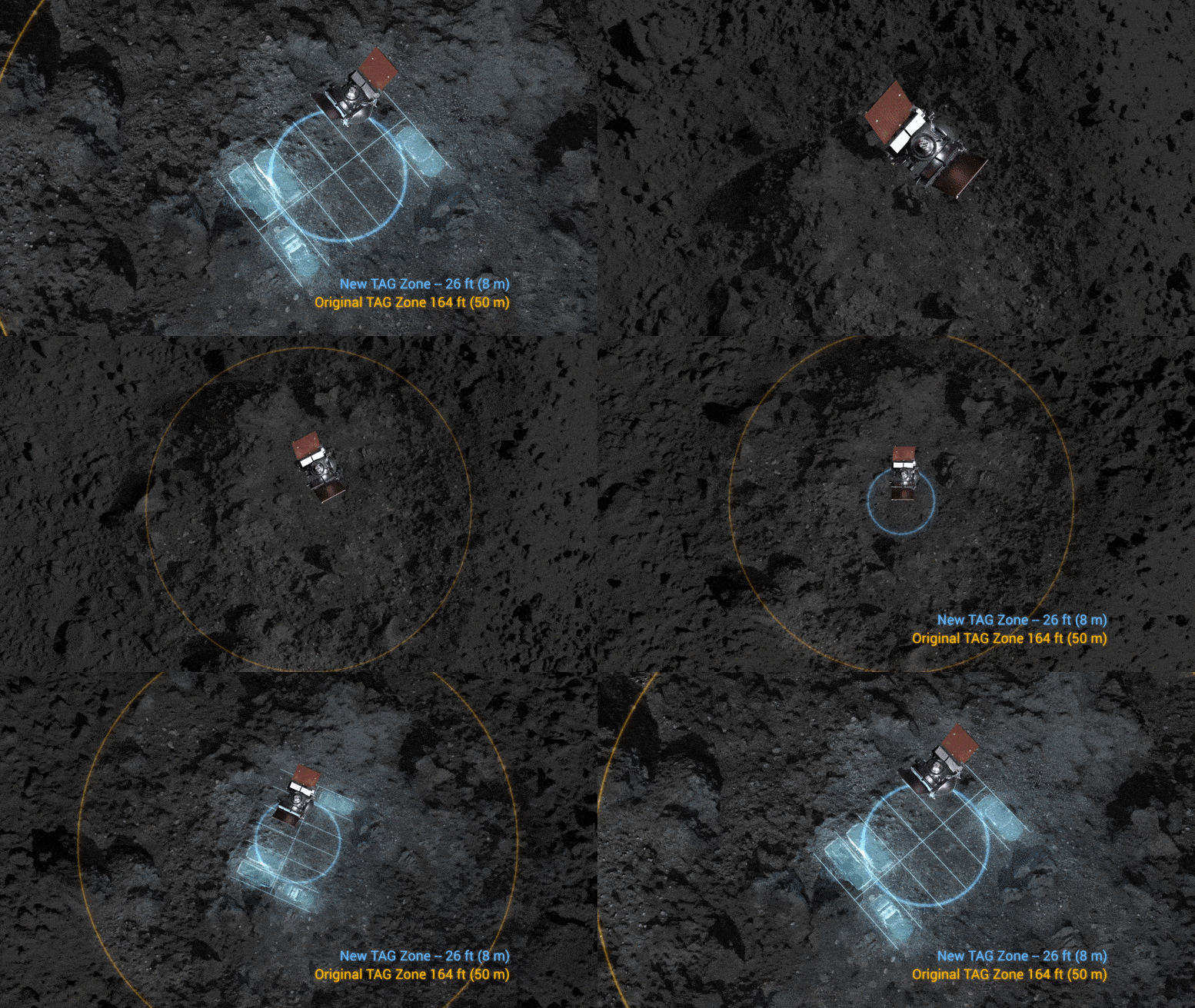
Studies show Bennu’s surface is made of low-cohesion, loosely packed rubble. Data from the OSIRIS-REx mission indicate that this composition is consistent throughout the asteroid, not just at the sampling site.
Asteroid Bennu’s surface consists of low-cohesion rubble according to data gathered during the sampling of the asteroid by the OSIRIS-REx mission. This is the finding of two new scientific studies – one each in Science and Science Advances.
According to the study in Science by Dante Lauretta and colleagues, about 250 grams of sample (9 ounces) was collected, which will be brought to Earth in 2023 for laboratory analysis.
The other study, published in Science Advances by Kevin Walsh and colleagues, analyzed the forces experienced by the spacecraft, finding that Bennu’s low gravity has resulted in a granular surface bed with weak cohesion between particles.
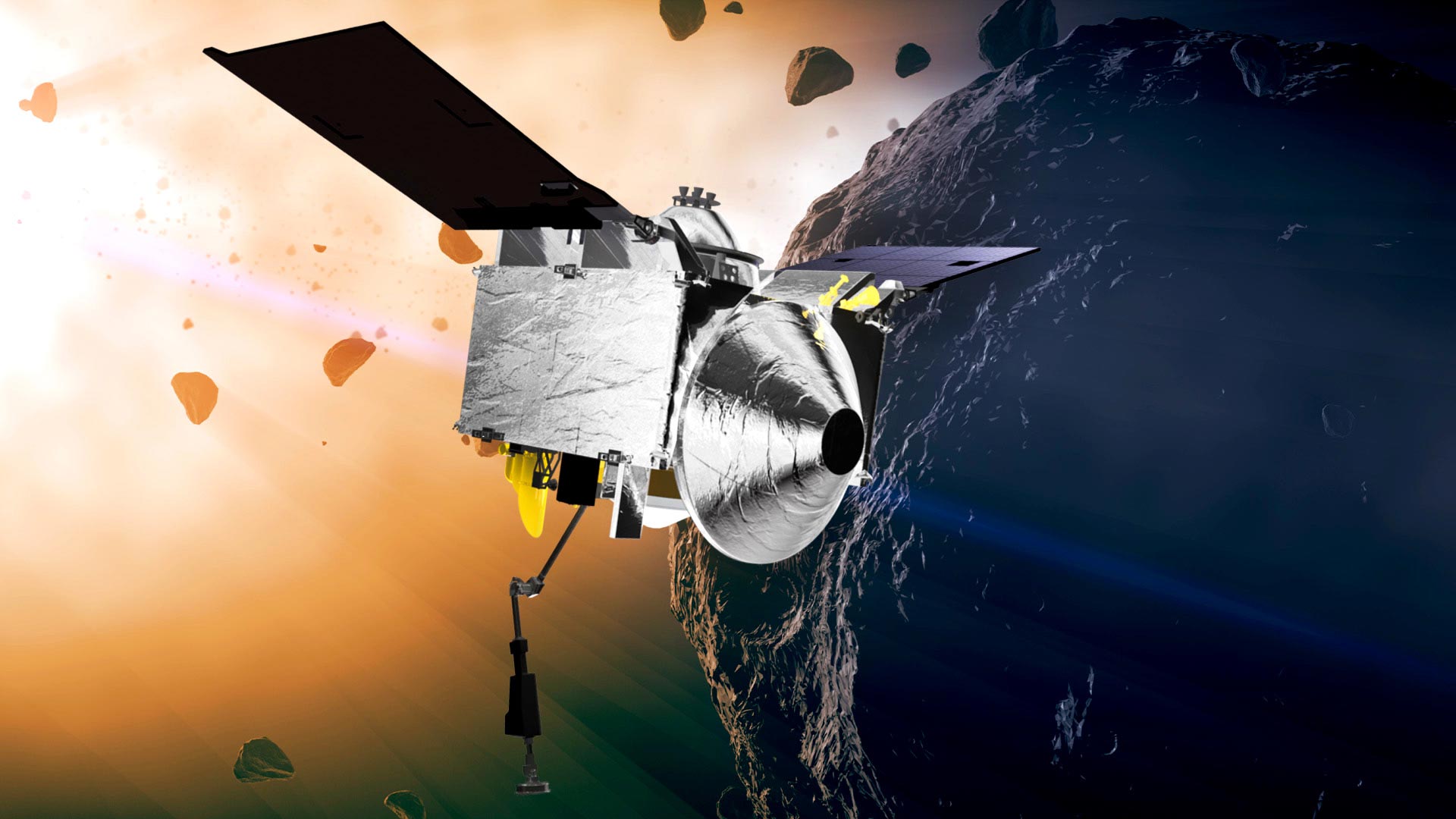
During the mission, the OSIRIS-REx (Origins, Spectral Interpretation, Resource Identification, and Security-Regolith Explorer) spacecraft spent about two years surveying Bennu, a carbonaceous rubble-pile asteroid about 500 meters (1,600 feet) in diameter. After considering the best locations to collect a sample, the mission team selected a site within a 20-meter (65-foot) crater, nicknamed Nightingale.
In October 2020, the spacecraft descended to the surface and collected the sample, Lauretta et al. note. The spacecraft’s Touch-and-Go Sample Acquisition Mechanism (TAGSAM) made contact and began sinking into the asteroid’s surface before it released a jet of nitrogen gas that mobilized sub-surface material and guided it into a collection chamber.
By analyzing imaging and spectral data taken during and after the sample’s retrieval, the team found that sub-surface material is darker and contains more fine particles than the overlying surface. The process produced a debris plume and a new 9-meter-long (30-foot-long) elliptical crater.
This is what it looks like to punch an asteroid. Last month, NASA’s robotic spacecraft OSIRIS-REx descended toward, thumped into, and then quickly moved away from the small near-Earth asteroid 101955 Bennu. This video depicts the Touch-And-Go (TAG) sampling event over a three-hour period. Credit: NASA/Goddard/University of Arizona/Lockheed Martin
Walsh et al. investigated the physical properties of the material up to 10 centimeters (4 inches) below Bennu’s surface, using images and accelerometer data. They reconstructed the forces exerted on the spacecraft in the short span of time between when it first contacted Bennu’s surface and when it released the nitrogen gas.
They found that the near-subsurface material is loosely packed and less dense than the average of the whole asteroid, with very low cohesion. The high porosity and low material strength allow dust and other small particles to move within the sub-surface of the asteroid. Spectral and thermal data gathered during the mission suggests these results apply to the whole asteroid, not just the sampling site.
References:
“Spacecraft sample collection and subsurface excavation of asteroid (101955) Bennu” by D. S. Lauretta, C. D. Adam, A. J. Allen, R.-L. Ballouz, O. S. Barnouin, K. J. Becker, T. Becker, C. A. Bennett, E. B. Bierhaus, B. J. Bos, R. D. Burns, H. Campins, Y. Cho, P. R. Christensen, E. C. A. Church, B. E. Clark, H. C. Connolly, M. G. Daly, D. N. DellaGiustina, C. Y. Drouet d’Aubigny, J. P. Emery, H. L. Enos, S. Freund Kasper, J. B. Garvin, K. Getzandanner, D. R. Golish, V. E. Hamilton, C. W. Hergenrother, H. H. Kaplan, L. P. Keller, E. J. Lessac-Chenen, A. J. Liounis, H. Ma, L. K. McCarthy, B. D. Miller, M. C. Moreau, T. Morota, D. S. Nelson, J. O. Nolau, R. Olds, M. Pajola, J. Y. Pelgrift, A. T. Polit, M. A. Ravine, D. C. Reuter, B. Rizk, B. Rozitis, A. J. Ryan, E. M. Sahr, N. Sakatani, J. A. Seabrook, S. H. Selznick, M. A. Skeen, A. A. Simon, S. Sugita, K. J. Walsh, M. M. Westermann, C. W. V. Wolner and K. Yumoto, 7 July 2022, Science.
DOI: 10.1126/science.abm1018
“Near-zero cohesion and loose packing of Bennu’s near-subsurface revealed by spacecraft contact” by Kevin J. Walsh, Ronald-Louis Ballouz, Erica R. Jawin, Chrysa Avdellidou, Olivier S. Barnouin, Carina A. Bennett, Edward B. Bierhaus, Brent J. Bos, Saverio Cambioni, Harold C. Connolly, Marco Delbo, Daniella N. DellaGiustina, Joseph DeMartini, Joshua P. Emery, Dathon R. Golish, Patrick C. Haas, Carl W. Hergenrother, Huikang Ma, Patrick Michel, Michael C. Nolan, Ryan Olds, Benjamin Rozitis, Derek C. Richardson, Bashar Rizk, Andrew J. Ryan, Paul Sánchez, Daniel J. Scheeres, Stephen R. Schwartz, Sanford H. Selznick, Yun Zhang and Dante S. Lauretta, 7 July 2022, Science Advances.
DOI: 10.1126/sciadv.abm6229
Never miss a breakthrough: Join the SciTechDaily newsletter.
Follow us on Google and Google News.