
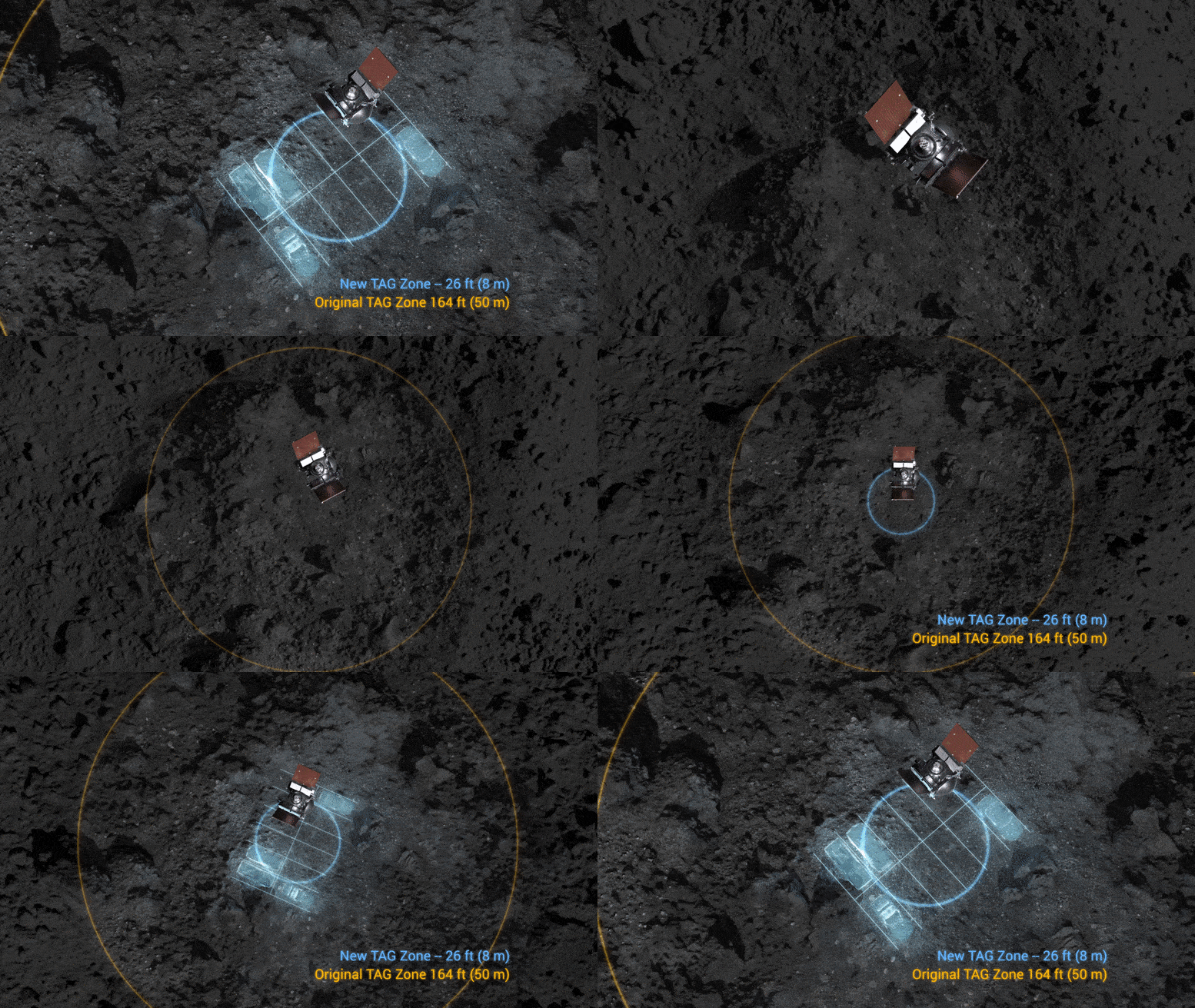
NASA’s first asteroid sample return mission, OSIRIS-REx, will make a daring attempt to “TAG” asteroid Bennu on October 20, 2020 – touch its surface and collect a sample for return to Earth.
Sample site Nightingale, the mission’s targeted touch-down spot, is only a few parking spaces wide and surrounded by building-sized boulders that pose a hazard to OSIRIS-REx. The spacecraft will carefully navigate down to the sample site with its sampling arm extended and touch Bennu’s surface for several seconds.
Upon contact, the collector head will fire a bottle of nitrogen gas to agitate loose material, which is then caught in the spacecraft’s collector head. After this brief touch, OSIRIS-REx will fire its thrusters to back away from Bennu, navigating to a safe distance from the asteroid.
The spacecraft will depart Bennu in 2021 and deliver the sample to Earth on September 24, 2023.
Video Transcript:
As we started to approach Bennu from a distance and it started to fill up the camera field of view it looked exactly like we thought it would with a few boulders sticking out.
But as we got closer we expected to see a very sandy surface with maybe a few boulders here and there, and what we saw is very little sand. And we saw these mountains, we saw boulders, we saw rocks we saw very few areas that had this sandy surface that we were expecting and that we had designed for.
We have never done this before. We’re actually going to collect a sample and bring it back down to Earth for further examination by scientists.
In order to achieve that objective, the OSIRIS-REx spacecraft has been navigating around Bennu for about the last two years studying it in great detail, and also overcoming a number of challenges that Bennu has presented.
We were looking for locations on Bennu that were 50 meters in diameter relatively flat and covered with fine-grained material. And by fine-grained material, I mean stuff that’s the size of a dime or smaller.
We realized that there were no sites on Bennu that even came close to meeting this criteria Everywhere we looked was too small and covered with boulders. So we actually had to fly a number of additional close passes over the asteroid and rethink our entire plan for grabbing the sample.
After the additional observations of Bennu, we had to downselect four sites and then go back and survey those sites even further to select the final, primary sample site.
My first impression of Nightingale is — that’s the last place I wanted to go. But as we started looking at other sites, we saw that one, this is probably one of the most sampleable sites, and two, we were overperforming in our navigation capability and our ability to contact.
Natural feature tracking works a lot like the human mind in that we pick up landmarks along the way. As we descend, we look at features on the ground we program the computer to recognize certain features. It takes a picture, says — this feature is not where I expected it to be, it’s a little bit off to the side, updates its position based on where it’s pointed, and where that feature shows up in the camera position.
The TAG event is our Touch-and-Go event, which is where we’ll actually be retrieving the sample from Asteroid Bennu.
We start with a series of maneuvers, one of them being the CheckPoint burn, which is where we’ll actually check our position and velocity in relation to the sample site.
And then the MatchPoint burn about ten minutes later, will zero out our horizontal velocity relative to the surface, and then about ten minutes after that we make contact with the TAGSAM fire the gas bottle, and then back away.
And we hope to get at least 60 grams of sample, and then we’ll be able to store that and bring it back down to Earth.
But there are several things that could go wrong and we also have to be prepared that we won’t be successful on our first try at Nightingale.
We don’t only get one shot at TAG — we actually have three nitrogen bottles onboard the spacecraft. So we can potentially do 3 TAG attempts if needed.
We go through several “What if?” scenarios and this is how we actually prepare for a lot of our contingencies.
So we’ve had to look all around the surface and identify the rocks and boulders that if the spacecraft were to tip over up to 25 degrees, it could come into contact and be damaged.
We had to develop a hazard map which we program into the computer it says — if you’re getting too close to those hazards we’ll do a wave-off, back away from the asteroid, come back, and do this another day.
Everything might work perfectly — we come down, we touch the surface just where we want to, we fire the gas bottle but the area we contact is covered in large rocks. Those rocks would prevent any fine-grained material from being stirred up and captured in the TAGSAM head.
Another similar scenario is if the TAGSAM were to touch on the edge of a boulder and become tipped up. In that case, when the gas bottle fires, much of that gas escapes out the sides not churning up the material that we want to capture
The day of TAG is going to be really exciting, but the excitement for our team doesn’t end there.
We have to verify that we have a proper sample.
First, we’re going to image the TAGSAM head by sticking it in front of one of the cameras. Then, we’re going to do a maneuver called the sample mass measurement in which we stick out the arm and spin the spacecraft in order to decide if we’ve collected enough mass to be able to stow the sample and return home, or if we have to try again.
This is the culmination of a lot of work. It’s probably one of the most exciting missions that I’ve worked on.
It is really exciting to know that we’re finally going to be able to touch the surface of an asteroid and collect a sample to return back to Earth.
Never miss a breakthrough: Join the SciTechDaily newsletter.
Follow us on Google and Google News.