
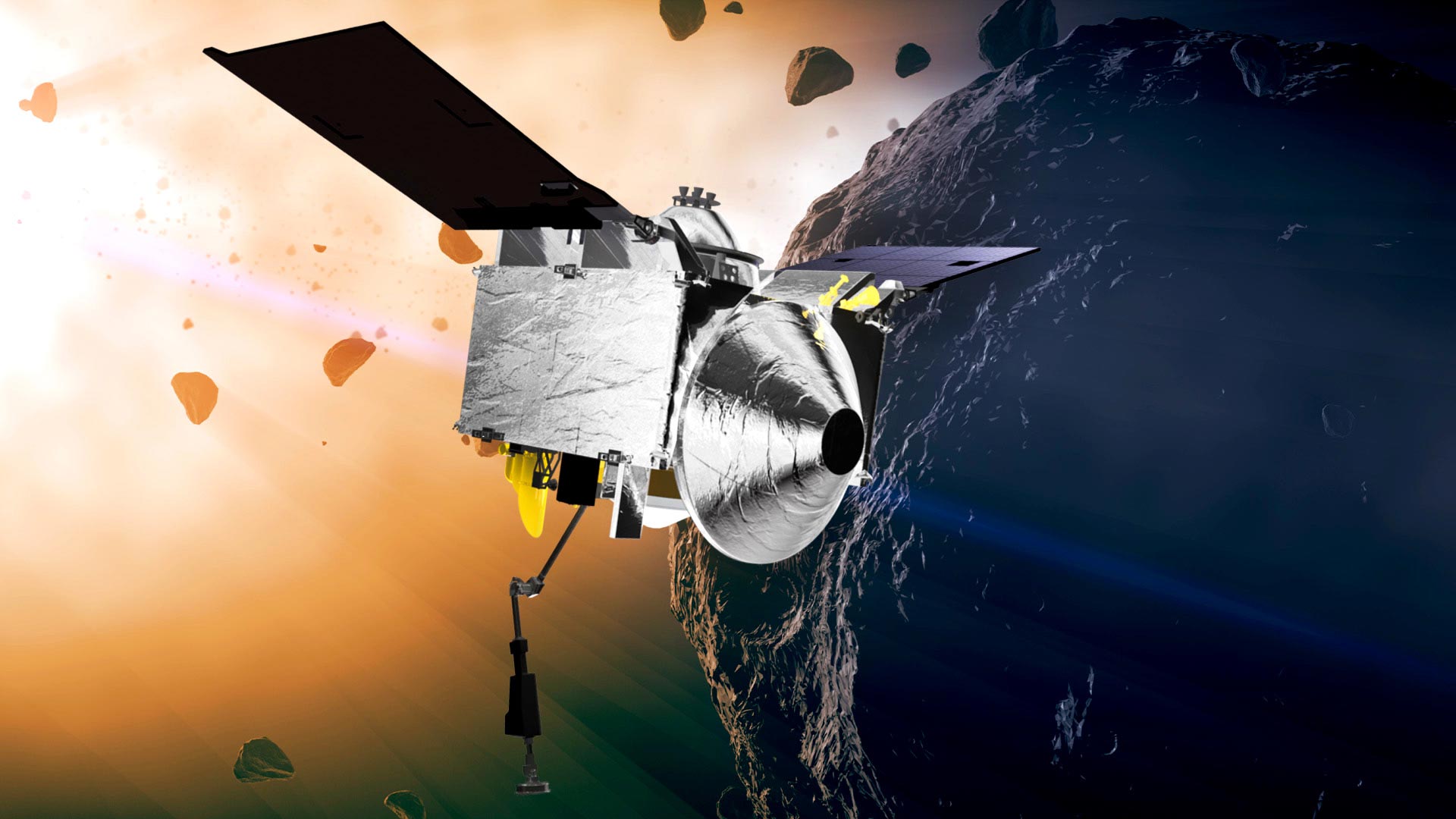
OSIRIS-REx is returning from asteroid Bennu with vital samples, concluding a mission full of challenges and groundbreaking discoveries.
After nearly five years in space, NASA’s Origins, Spectral Interpretation, Resource Identification, Security, Regolith Explorer (OSIRIS-REx) spacecraft is on its way back to Earth with an abundance of rocks and dust from the near-Earth asteroid Bennu.
On Monday, May 10, at 4:23 p.m. EDT the spacecraft fired its main engines full throttle for seven minutes – its most significant maneuver since it arrived at Bennu in 2018. This burn thrust the spacecraft away from the asteroid at 600 miles per hour (nearly 1,000 kilometers per hour), setting it on a 2.5-year cruise towards Earth.
After releasing the sample capsule, OSIRIS-REx will have completed its primary mission. It will fire its engines to fly by Earth safely, putting it on a trajectory to circle the sun inside of Venus’ orbit.
After orbiting the Sun twice, the OSIRIS-REx spacecraft is due to reach Earth on September 24, 2023. Upon return, the capsule containing pieces of Bennu will separate from the rest of the spacecraft and enter Earth’s atmosphere. The capsule will parachute to the Utah Test and Training Range in Utah’s West Desert, where scientists will be waiting to retrieve it.
“OSIRIS-REx’s many accomplishments demonstrated the daring and innovate way in which exploration unfolds in real time,” said Thomas Zurbuchen, associate administrator for science at NASA Headquarters. “The team rose to the challenge, and now we have a primordial piece of our solar system headed back to Earth where many generations of researchers can unlock its secrets.”
To realize the mission’s multi-year plan, a dozen navigation engineers made calculations and wrote computer code to instruct the spacecraft when and how to push itself away from Bennu. After departing from Bennu, getting the sample to Earth safely is the team’s next critical goal. This includes planning future maneuvers to keep the spacecraft on course throughout its journey.
“Our whole mindset has been, ‘Where are we in space relative to Bennu?’” said Mike Moreau, OSIRIS-REx deputy project manager at NASA’s Goddard Space Flight Center in Greenbelt, Maryland. “Now our mindset has shifted to ‘Where is the spacecraft in relation to Earth?’”
The navigation cameras that helped orient the spacecraft in relation to Bennu were turned off on April 9, after snapping their last images of the asteroid. With Bennu in the rearview mirror, engineers are using NASA’s Deep Space Network of global spacecraft communications facilities to steer the OSIRIS-REx by sending it radio signals. By measuring the frequency of the waves returned from the spacecraft transponder, engineers can tell how fast OSIRIS-REx is moving. Engineers measure how long it takes for radio signals to get from the spacecraft back to Earth in order to determine its location.
Exceeding Mission Expectations
The May 10 departure date was precisely timed based on the alignment of Bennu with Earth. The goal of the return maneuver is to get the spacecraft within about 6,000 miles (approximately 10,000 kilometers) of Earth in September 2023. Although OSIRIS-REx still has plenty of fuel remaining, the team is trying to preserve as much as possible for a potential extended mission to another asteroid after returning the sample capsule to Earth. The team will investigate the feasibility of such a mission this summer.
The spacecraft’s course will be determined mainly by the Sun’s gravity, but engineers will need to occasionally make small course adjustments via engine burns.
“We need to do regular corrections to bring the trajectory increasingly closer to Earth’s atmosphere for the sample release, and to account for small errors that might have accumulated since the last burn,” said Peter Antreasian, OSIRIS-REx navigation lead at KinetX Aerospace, which is based in Simi Valley, California.
The team will perform course adjustments a few weeks prior to Earth re-entry in order to precisely target the location and angle for the sample capsule’s release into Earth’s atmosphere. Coming in too low could cause the capsule to bounce out of the atmosphere like a pebble skipping off a lake; too high and the capsule could burn up due to friction and heat from the atmosphere. If OSIRIS-REx fails to release the capsule, the team has a backup plan to divert it away from Earth and try again in 2025.
Emotions Run High as Mission Phase Ends
“There’s a lot of emotion within the team about departure,” Moreau said. “I think everyone has a great sense of accomplishment, because we faced all these daunting tasks and were able to accomplish all the objectives thrown at us. But there’s also some nostalgia and disappointment that this part of the mission is coming to an end.”
OSIRIS-REx exceeded many expectations. Most recently, in the midst of a global pandemic, the team flawlessly executed the most mission’s critical operation, collecting more than 2 ounces (60 grams) of soil from Bennu’s surface.
Leading up to sample collection, a number of surprises kept the team on its toes. For example, a week after the spacecraft entered its first orbit around Bennu, on December 31, 2018, the team realized that the asteroid was releasing small pieces of rock into space.
“We had to scramble to verify that the small particles being ejected from the surface did not present a hazard to the spacecraft,” Moreau said.
Upon arrival at the asteroid, team members also were astonished to find that Bennu is littered with boulders.
“We really had this idea that we were arriving on an asteroid with open real estate,” said Heather Enos, OSIRIS-REx deputy principal investigator, based at the University of Arizona, Tucson. “The reality was a big shocker.”
To overcome the extreme and unexpected ruggedness of Bennu’s surface, engineers had to quickly develop a more accurate navigation technique to target smaller-than-expected sites for sample collection.
Scientific Surprises and Validations
The OSIRIS-REx mission was instrumental in both confirming and refuting several scientific findings. Among those confirmed was a technique that used observations from Earth to predict that the minerals on the asteroid would be carbon-rich and show signs of ancient water. One finding that proved unsuccessful was that Bennu would have a smooth surface, which scientists predicted by measuring how much heat radiated off its surface.
Scientists will use the information gleaned from Bennu to refine theoretical models and improve future predictions.
“This mission emphasizes why we have to do science and exploration in multiple ways – both from Earth and from up-close in space – because assumptions and models are just that,” Enos said.
Goddard provides overall mission management, systems engineering, and the safety and mission assurance for OSIRIS-REx. Dante Lauretta of the University of Arizona, Tucson, is the principal investigator. The university leads the science team and the mission’s science observation planning and data processing. Lockheed Martin Space in Littleton, Colorado, built the spacecraft and provides flight operations. Goddard and KinetX Aerospace are responsible for navigating the OSIRIS-REx spacecraft. OSIRIS-REx is the third mission in NASA’s New Frontiers Program, managed by NASA’s Marshall Space Flight Center in Huntsville, Alabama, for the agency’s Science Mission Directorate Washington.
Never miss a breakthrough: Join the SciTechDaily newsletter.
Follow us on Google and Google News.