
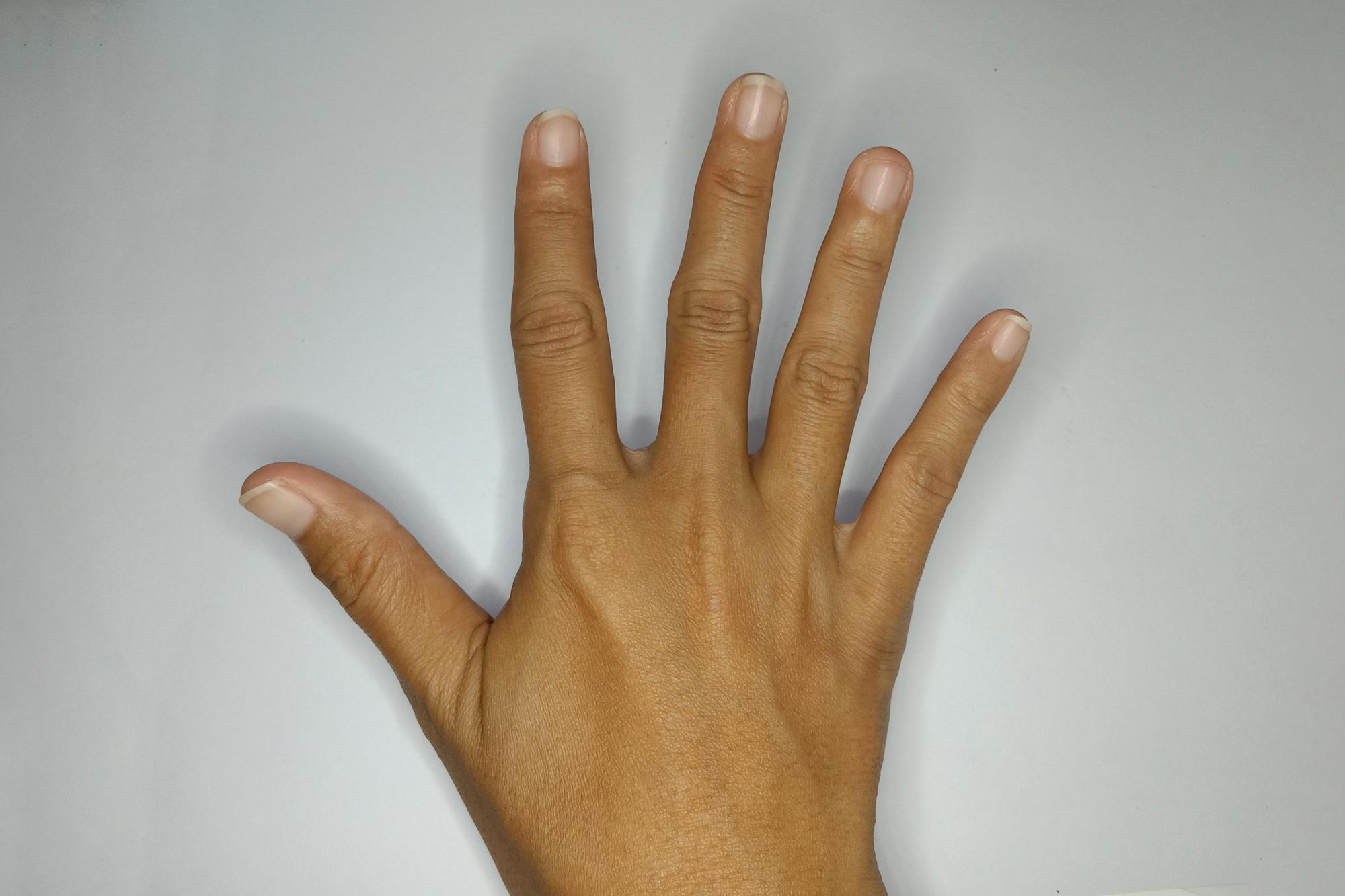
Scientists say the mystery of why humans are so right-handed may trace back to our first steps on two legs.
Why do humans overwhelmingly prefer their right hand while other primates do not? Scientists have debated that question for decades, but a new study suggests the answer may be rooted in two defining moments of human evolution: learning to walk upright and developing much larger brains.
About 90% of people worldwide are right-handed, making humans unique among primates. No other ape or monkey species shows such a strong population-wide preference for one hand. Researchers have long explored possible explanations involving genetics, brain structure, tool use, and development, yet the origins of human handedness have remained uncertain.
Now, researchers from the University of Oxford say they may have uncovered a major piece of the puzzle.
Upright Walking and Human Handedness
The study, published in PLOS Biology, was led by Dr. Thomas A. Püschel and Rachel M. Hurwitz from Oxford’s School of Anthropology and Museum Ethnography, along with Professor Chris Venditti from the University of Reading.
The team analyzed data from 2,025 individuals representing 41 monkey and ape species. Using Bayesian models that accounted for evolutionary relationships among species, the researchers tested several leading theories about how handedness evolved.
They examined possible influences including tool use, diet, habitat, body mass, social behavior, brain size, and movement patterns.
At first, humans appeared to stand completely apart from the trends seen in other primates. But when researchers added two additional factors into their models, brain size and the relative length of arms compared to legs, humans no longer looked like such an evolutionary outlier.
The arm-to-leg ratio is widely used as a marker of bipedal locomotion, or upright walking. According to the researchers, the findings suggest that larger brains and walking on two legs together may explain why humans developed such an unusually strong preference for the right hand.
How Handedness Changed Through Human Evolution
The researchers also used their models to estimate handedness in extinct human ancestors.
Their results suggest that early hominins such as Ardipithecus and Australopithecus probably showed only modest right-hand preferences, similar to those seen in modern great apes.
That changed with the emergence of the genus Homo. Species including Homo ergaster, Homo erectus, and Neanderthals appear to have developed increasingly strong right-hand preferences over time. In modern Homo sapiens, that trend eventually reached the extreme right-hand dominance seen today.
One species stood out as an exception: Homo floresiensis, the small-bodied human relative often called the “hobbit” species.
Researchers predicted that Homo floresiensis likely had a much weaker preference for the right hand. They believe this matches the species’ anatomy, which combined a relatively small brain with adaptations for both climbing and upright walking rather than fully specialized bipedal movement.
Bigger Brains May Have Strengthened Right-Hand Bias
The findings point to a two-stage evolutionary process.
First, upright walking freed the hands from locomotion, allowing them to be used more for manipulating objects and performing specialized tasks. Later, as human brains grew larger and became more complex, the tendency toward right-handedness became much stronger and eventually spread across nearly the entire population.
Dr. Thomas A. Püschel, Wendy James Associate Professor in Evolutionary Anthropology at the University of Oxford, said: “This is the first study to test several of the major hypotheses for human handedness in a single framework. Our results suggest it is probably tied to some of the key features that make us human, especially walking upright and the evolution of larger brains. By looking across many primate species, we can begin to understand which aspects of handedness are ancient and shared, and which are uniquely human.”
Why Left-Handedness Still Exists
The study also raises new questions that scientists hope to explore in the future.
Researchers still do not know exactly why left-handedness has continued to persist throughout human evolution or how human culture may have helped reinforce widespread right-handedness over time.
The team also noted that similar limb preferences in animals such as parrots and kangaroos could point to broader evolutionary patterns shared across very different species.
Reference: “Bipedalism and brain expansion explain human handedness” by Thomas A. Püschel, Rachel M. Hurwitz and Chris Venditti, 27 April 2026, PLOS Biology.
DOI: 10.1371/journal.pbio.3003771
Never miss a breakthrough: Join the SciTechDaily newsletter.
Follow us on Google and Google News.
18 Comments
How silly. You develop a theory–and an indefensible one at that, you extrapolate a fuzzy explanation from it, and you claim to have “solved” a “problem.” The evolutionary theory is the textbook example of this type of so-called science.
The study discussed was looking for correlations between handedness and a number of factors. They did NOT begin with a theory here. Evolution, like all good theories, was developed from thousands and thousands of observations and then thoroughly and VERY successfully tested, earning acceptance.
Begging your pardon, but I personally know of not a single instance in which we’ve observed the demonstrable development of a distinct new species. Nor even one in which the theory of evolution has been used to accurately predict a previously unobserved development of an exiting species that couldn’t be excluded from being genetically allowable within range of variation of that species. Evolution portrays mutations as being normal and beneficial to survival. The reality is that mutations are almost always undesirable defects and detrimental to survival. The theory of evolution has never been useful for any purpose other than to justify the type of greed, extreme nationalism, and fascism that has given birth to two world wars, so far.
Your last sentence demonstrates motivated reasoning. Even if the theory of evolution is the cause of greed, nationalism, and fascism (and it’s not), that has no bearing on whether or not it is correct. The mutation claim you make is well addressed so I won’t bother. New species of bacteria, viruses, and insects have been observed in real time.
Tripe. Confirmation bias.
How positively eugenic to support such pseudo science babble, sir fauci.
Lefties have less intelligence, scientifically dehumanized, marginalized and deemed of little “human value. Very humane and “equity driven. I wonder if you feel same about left handed blacks, Mexicans and Asians.
Sanger like 3rd Reich claim.
You, I am a proud Southpaw and find your complete lack of independent intelligence appalling!
Go back to your humane protests.
Only a fool could could defend such vile unscientific vomit!
Yep, this article made a wild connection without explaining it. Then you pinned that same behavior on the theory of evolution, without explaining. How silly indeed!
The study discussed was looking for correlations between handedness and a number of factors. They did NOT begin with a theory here. Evolution, like all good theories, was developed from thousands and thousands of observations and then thoroughly and VERY successfully tested, earning acceptance.
You could’ve saved me five minutes and just said, There’s no real reason.
specialization of the brain to give greater capability in throwing things on one side of the brain, like spears. More accurate with throwing a spear, more food. More food, evolutionally advantaged. Just needed some underlying genetic trigger that was originally recessive becoming dominate. (those things take time) Same way life specialized for chiral enzymes. Basically the brain “compartmentalized” different functions on different sides to reduce redundancy and increase processing volume for selected functions. Hunters would specialize, gatherers would want balanced ability to grab stuff.
The Coriolis Effect may explain evolutionary handedness propensity.
So does left-handedness predominate in the Southern Hemisphere? Regardless, this article does not draw any causal connection between brain size, bipedalism, or any other trait. Maybe the published paper does, but if so, this article fails to reveal the connection.
Begging your pardon, but I personally know of not a single instance in which we’ve observed the demonstrable development of a distinct new species. Nor even one in which the theory of evolution has been used to accurately predict a previously unobserved development of an exiting species that couldn’t be excluded from being genetically allowable within range of variation of that species. Evolution portrays mutations as being normal and beneficial to survival. The reality is that mutations are almost always undesirable defects and detrimental to survival. The theory of evolution has never been useful for any purpose other than to justify the type of greed, extreme nationalism, and fascism that has given birth to two world wars, so far.
Your first argument is against the theory of common descent. The theory of common descent is also very well-established, and is almost universally accepted by people who accept the theory of evolution. But it helps to know what you are arguing against. Like all theories, the theory of common descent is a product of inference, not direct observation.
Your second argument ignores the role of selection. It is true that most mutations are deleterious. In fact, the more fit we evolve to be for our survival niche, the harder it becomes to find mutations that are beneficial. But we wouldn’t have such well-refined genes unless there was some mechanism for refining them.
Your third argument is an argument from consequences. Even if it were true that the theory of evolution has never been useful, that is not its goal. A theory strives to be accurate and correct. Utility is a byproduct.
Being left-handed for writing, aiming a gun, scissors, many tools, – yet I bat or golf right-handed — I wanted to know why. This article was a nothing burger, as they say.
Title and article do not match. They did not explain right handedness at all.
I attended a conference of programmers for a recent project. I noted that all 12 programmers were left-handed.
Curious.
The failure of this research is not defining nature or nurture (learned vs. born with). Had the authors done a more competent literature review they’d realize that left or right handedness is first defined in the womb by which thumb you decide to start sucking. As in this habit of preference is something you are born with, not something you learn. And all us left-handed people reading this junk science are wondering why 10% of the population is considered irrelevant and why we’d only care about right-handed people? This paper says more about social obedience and the tyranny of the majority than it says about objective scientific observation.
I’d suggest cultural practice would reinforce any tendency to be right-handed. Which our long-lost ancestors first decided their children should eat with a spoon in the right hand, just like mummy and daddy, the left hand being used for cleaning the bum? Children copy parents.