
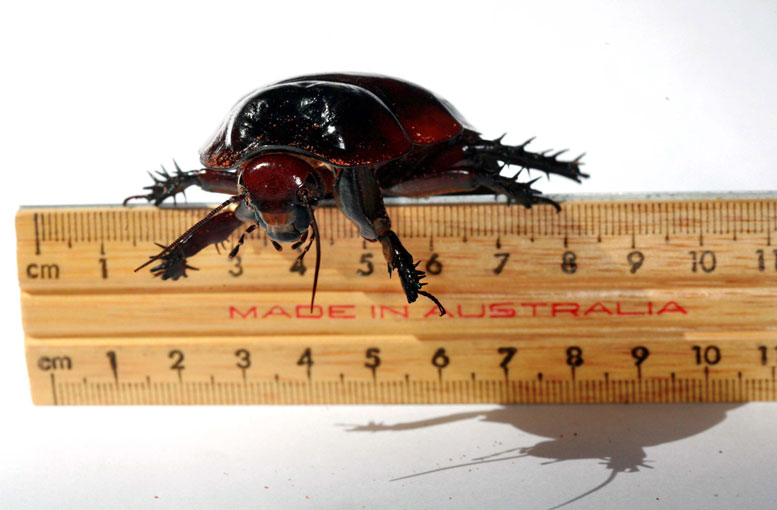
Cockroaches are so hardy, a popular joke goes, that they’ve occupied the Earth long before humans first appeared —and will probably even outlast us long after we have annihilated each other by nuclear war.
But now, researchers have used the latest in genomic data to gain the most detailed information yet of their evolutionary history.
Armed with a vast amount of genomic information, a team of researchers led by Dr. Thomas Bourguignon, now professor at the Okinawa Institute of Science and Technology, has performed the first molecular dating to gain the clearest picture yet of the biogeographical history of cockroaches.
They have traced back the key evolutionary time points of the cockroach—all the way back almost 300 million years ago when the Earth’s mass was organized into the Pangaea supercontinent.
This fossil record of cockroaches suggests that most extant families evolved during the breakup of Pangaea (which began ~200 Ma) and prior to the beginning of continental separation within Gondwana (~135 Ma).
“Our results indicate that extant cockroach families have evolved over periods of up to ~180 million years,” said Bourguignon. “Through reconstructions of the ancestral distribution of cockroaches using the known distributions of extant genera sampled in this study, we found evidence that continental breakup has had important impacts on cockroach biogeography.”
To do so, they estimated divergence times of all living cockroach families, based on the complete mitochondrial genomes of 119 cockroach species (and to help their molecular dating, compared with 13 termites, seven mantis and multiple other outgroups).
Their estimates indicate that the last common ancestor for cockroaches appeared much earlier than fossil evidence, around 235 million years ago. This was about 95 million years before the appearance of the first fossils attributed to modern cockroaches during the Cretaceous period around 140 million years ago, and before Pangaea broke up.
Since cockroaches can’t fly very far, and for the most part would be terrestrially bound, one of the more appealing aspects of the study was to compare the cockroach divergence time with the geological history of the Earth.
The authors speculate that, like riding a raft, cockroaches spread to every part of the globe through the seismic continental drifts that occurred during the transition from Pangaea. This is illustrated by many sister cockroach lineages, which diverged prior Gondwana breakup, and diversified on their respective continental plates. But, in addition, within younger cockroach lineages, they did find evidence of transoceanic dispersal in regions near Australia and Indo-Malaysia.
“We believe that our results point to an important role for vicariance (continental drift) in determining the global distributions of cockroaches,” said Bourguignon. “On a global scale, the fossil record also agrees with our hypothesis.”
The study underscores the importance of continental drift in shaping modern insect distribution, and will provide a new framework for future cockroach biogeographical research.
Reference: “Transoceanic dispersal and plate tectonics shaped global cockroach distributions: evidence from mitochondrial phylogenomics” by Thomas Bourguignon, Qian Tang, Simon Y W Ho, Frantisek Juna, Zongqing Wang, Daej A Arab, Stephen L Cameron, James Walker, David Rentz, Theodore A Evans and Nathan Lo, 2 February 2018, Molecular Biology and Evolution.
DOI: 10.1093/molbev/msy013
Never miss a breakthrough: Join the SciTechDaily newsletter.
Follow us on Google and Google News.