
Close Menu
    Facebook X (Twitter) Instagram
    SciTechDaily
    • Biology
    • Chemistry
    • Earth
    • Health
    • Physics
    • Science
    • Space
    • Technology
    Facebook X (Twitter) Pinterest YouTube RSS
    SciTechDaily
    Home»Biology»Iceman Ötzi’s DNA Reveals Health Risks and Relations
    Biology

    Iceman Ötzi’s DNA Reveals Health Risks and Relations

    By SciTechDailyMarch 7, 2012No Comments2 Mins Read
    Facebook Twitter Pinterest Telegram LinkedIn WhatsApp Email Reddit
    Share
    Facebook Twitter LinkedIn Pinterest Telegram Email Reddit
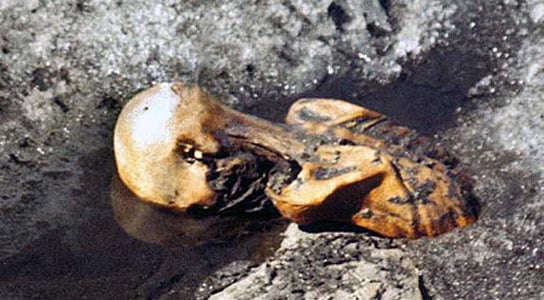
    iceman-glacier
    Iceman Ötzi from the Tyrolean Alps

    Ötzi’s DNA has finally been sequenced. An international team published the almost complete DNA of the Iceman Ötzi from the Tyrolean Alps in the journal Nature Communications.

    The Iceman’s 5,300-year-old body was discovered in 1991 by hikers near the Italian-Austrian border in the Alps. It was well preserved and has become one of the most studied cadavers. Ötzi suffered from hardened arteries and tooth cavities, had tattoos, and gorged on ibex before dying from an arrow lodged in his back.

    Albert Zink, head of the Institute for Mummies and the Iceman in Bolzano, Italy, is the leader of the new sequencing study.
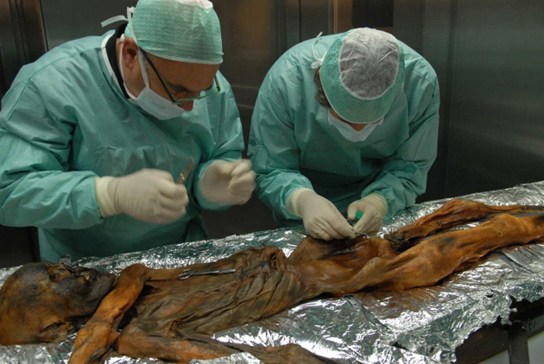
    DNA-sampling-iceman

    In 2008, researchers revealed that the complete sequence of DNA taken from Ötzi’s cellular mitochondria contained mutations not present in modern-day populations. This led to speculation that Ötzi had belonged to a people that had vanished from Europe.

    Ötzi had brown eyes, his blood type was O, and he was lactose intolerant. He had a genetic predisposition for heart disease and also had Lyme disease.

    Ötzi’s Y chromosomes possess mutations that are now only commonly found in men from Sardinia and Corsica. His nuclear genome puts his closest present-day relatives in the same area. It’s possible that Ötzi’s kind lived across Europe, before they vanished out or interbred with other groups everywhere except on those islands.

    Reference: “New insights into the Tyrolean Iceman’s origin and phenotype as inferred by whole-genome sequencing” by Andreas Keller, Angela Graefen, Markus Ball, Mark Matzas, Valesca Boisguerin, Frank Maixner, Petra Leidinger, Christina Backes, Rabab Khairat, Michael Forster, Björn Stade, Andre Franke, Jens Mayer, Jessica Spangler, Stephen McLaughlin, Minita Shah, Clarence Lee, Timothy T. Harkins, Alexander Sartori, Andres Moreno-Estrada, Brenna Henn, Martin Sikora, Ornella Semino, Jacques Chiaroni, Siiri Rootsi, Natalie M. Myres, Vicente M. Cabrera, Peter A. Underhill, Carlos D. Bustamante, Eduard Egarter Vigl, Marco Samadelli, Giovanna Cipollini, Jan Haas, Hugo Katus, Brian D. O’Connor, Marc R.J. Carlson, Benjamin Meder, Nikolaus Blin, Eckart Meese, Carsten M. Pusch and Albert Zink, 28 February 2012, Nature Communications.
    DOI: 10.1038/ncomms1701

    Never miss a breakthrough: Join the SciTechDaily newsletter.
    Follow us on Google and Google News.

    Anthropology Evolution Evolutionary Anthropology Genetics Iceman Ötzi Paleogenomicist
    Share. Facebook Twitter Pinterest LinkedIn Email Reddit

    Related Articles

    Cold Climate Adaptation: Neanderthal Genetics Shape Our Facial Features

    Scientists Discover Surprising Similarities in Stone Tools of Early Humans and Monkeys

    Ancient DNA From 1,600-Year-Old Iranian Sheep Mummy Brings History to Life

    Shocking Research Finds DNA From an Ancient, Unidentified Ancestor Was Passed Down to Humans Living Today

    Every Tooth Tells a Different Story: Revealing Genetic Relationships in Humans

    “Remarkable and Puzzling” – A New Explanation for the Origins of Human Fatherhood

    Scientists Reveal the Complex Story Behind the Beaker Phenomenon

    DNA Study Reveals Clues about Primate Evolution

    Study Provides Picture of Human Expansion From Africa

    Leave A Reply Cancel Reply

    • Facebook
    • Twitter
    • Pinterest
    • YouTube

    Don't Miss a Discovery

    Subscribe for the Latest in Science & Tech!

    Trending News

    Popular Vitamin B3 Supplements May Help Cancer Cells Survive, Scientists Warn

    Scientists Discover Strange Property of Rice and Turn It Into a Smart Material

    NASA Artemis II Skips Burn As Astronaut Captures Stunning View of Earth

    NASA’s Artemis II: Humans Just Left Earth Orbit for the First Time Since 1972

    What Causes Chronic Pain? Scientists Identify Key Culprit in the Brain

    Semaglutide Shows Surprising Mental Health Benefits in Massive 100,000-Person Study

    This Liquid Snapped Instead of Flowing and Scientists Were Shocked

    Breakthrough Alzheimer’s Drug Rewires the Brain Instead of Just Clearing Plaques

    Follow SciTechDaily
    • Facebook
    • Twitter
    • YouTube
    • Pinterest
    • Newsletter
    • RSS
    SciTech News
    • Biology News
    • Chemistry News
    • Earth News
    • Health News
    • Physics News
    • Science News
    • Space News
    • Technology News
    Recent Posts
    • AI Is Rewriting History – With Outdated Neanderthal Facts
    • Physicists Observe Matter in Two Places at Once in Mind-Bending Quantum Experiment
    • Stanford Scientists Discover Hidden Brain Circuit That Fuels Chronic Pain
    • Johns Hopkins Scientists Develop Nasal DNA Vaccine for Tuberculosis
    • New Study Reveals Why Ozempic Works Better for Some People Than Others
    Copyright © 1998 - 2026 SciTechDaily. All Rights Reserved.
    • Science News
    • About
    • Contact
    • Editorial Board
    • Privacy Policy
    • Terms of Use

    Type above and press Enter to search. Press Esc to cancel.