
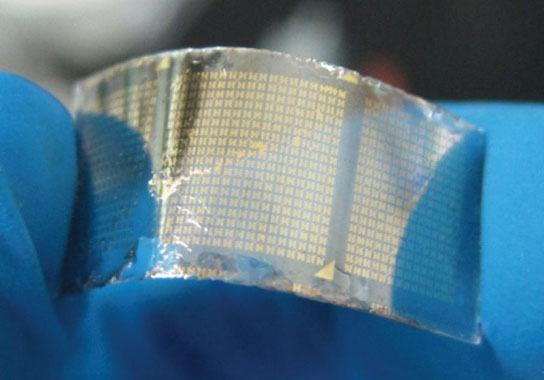
Topological insulators, such as sheets of bismuth selenide, are ultra-thin sheets of material that are transparent, flexible, and highly conductive. Scientists at the SLAC National Accelerator Laboratory are studying bismuth selenide and other topological insulators for future applications like electrodes for solar cells, sensors, and optical communications devices.
An international team of scientists with roots at SLAC and Stanford has shown that ultra-thin sheets of an exotic material remain transparent and highly conductive even after being deeply flexed 1,000 times and folded and creased like a piece of paper.
The result could open this class of unusual materials, called topological insulators, to its first practical applications: flexible, transparent electrodes for solar cells, sensors, and optical communications devices.
“It’s rare for a good conductor to be both transparent and durable as well,” said Zhi-Xun Shen of SLAC and Stanford’s Institute for Materials and Energy Sciences (SIMES).
Researchers led by Shen, Zhongfan Liu, and Hailin Peng of Peking University in China, and Yulin Chen of Oxford University in England published their results last week in the journal Nature Chemistry. Until recently, Peng and Chen were graduate students and postdoctoral researchers at Stanford and SIMES. They have continued to collaborate with Shen’s research team after being named professors at their current universities.
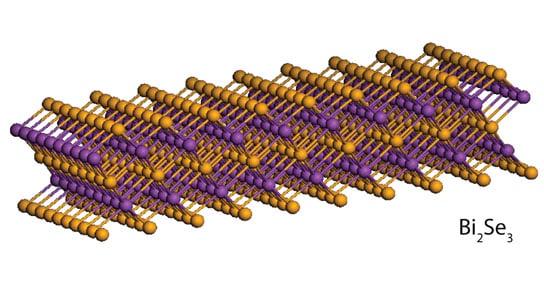
The researchers made and tested samples of a compound in which sheets of bismuth and selenium, each just one atom thick, alternate to form five-layer units. The bonds between the units are weak, allowing the overall material to flex while retaining its durability. And as a topological insulator – a new state of quantum matter – the material conducts electricity only on its surface while its interior remains insulating, an unexpected property with unknown potential for fundamental research and practical applications.
Since surface atoms dominate the structure of bismuth selenide, it is an exceptionally good electrical conductor – as good as gold. Unlike gold, however, bismuth selenide is transparent to infrared light, which we know as heat. While about half the solar energy that hits the Earth comes in the form of infrared light, few of today’s solar cells are able to collect it. The transparent electrodes on the surfaces of most cells are either too fragile or not transparent or conducting enough. The new material could get around that problem and allow cells to harvest more of the sun’s spectrum of wavelengths.
The researchers’ experiments also showed that bismuth selenide does not degrade significantly in humid environments or when exposed to oxygen treatments that are common in manufacturing.
“In addition to being a scientific success,” Chen said, “this demonstration should alert engineers and companies that topological insulators can also be important commercially.”
Peng added, “Infrared light pulses carry phone calls and data through optical fiber networks, so bismuth selenide may be useful in communications devices. This material could also improve infrared sensors common in scientific equipment and aerospace systems.”
Peng and colleagues made the bismuth selenide samples and conducted the flexing, conductivity, and transparency tests in China. The researchers confirmed that the samples were topological insulators at the Stanford Synchrotron Radiation Lightsource’s Beam Line 5-4 at SLAC.
Theorists first proposed topological insulators in 2004, and experimentalists made the first examples, using mercury telluride at very low temperatures, two years later. Guided by theory, Chen, Shen and colleagues proved in 2009 that cheaper, more abundant, and easier-to-handle bismuth telluride and similar compounds containing antimony and selenium are topological insulators at room temperature. Also in 2009, Peng, Shen, and colleagues discovered important electrical conduction behavior in bismuth selenide nanoribbons.
Reference: “Topological insulator nanostructures for near-infrared transparent flexible electrodes” by Hailin Peng, Wenhui Dang, Jie Cao, Yulin Chen, Di Wu, Wenshan Zheng, Hui Li, Zhi-Xun Shen and Zhongfan Liu, 26 February 2012, Nature Chemistry.
DOI: 10.1038/nchem.1277
Never miss a breakthrough: Join the SciTechDaily newsletter.
Follow us on Google and Google News.
3 Comments
Are there less expensive topological insulators that can be used to coat a hard surfaces?
I’m looking for a topological insulator that does not have a conducting surface, but insulates all the way through and is transparent.
Well I definitely enjoyed studying it. This tip provided by you is very helpful for proper planning.