
Close Menu
    Facebook X (Twitter) Instagram
    SciTechDaily
    • Biology
    • Chemistry
    • Earth
    • Health
    • Physics
    • Science
    • Space
    • Technology
    Facebook X (Twitter) Pinterest YouTube RSS
    SciTechDaily
    Home»Biology»Scientists Were Wrong About Human Pattern of Brain Asymmetry Being Unique
    Biology

    Scientists Were Wrong About Human Pattern of Brain Asymmetry Being Unique

    By Max Planck Institute for Evolutionary AnthropologyFebruary 15, 2020No Comments4 Mins Read
    Facebook Twitter Pinterest Telegram LinkedIn WhatsApp Email Reddit
    Share
    Facebook Twitter LinkedIn Pinterest Telegram Email Reddit
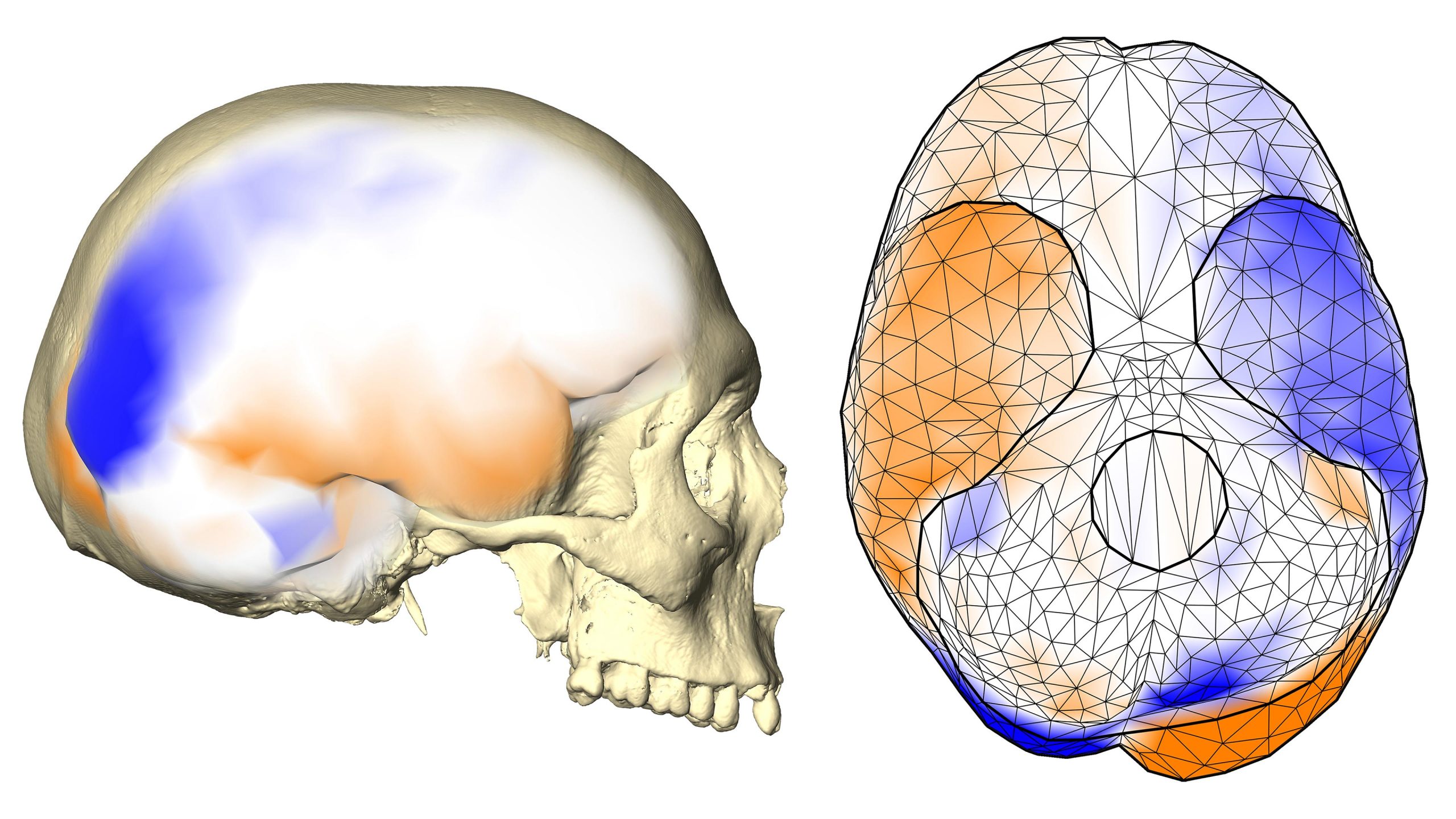
    Human Endocast
    The shared brain asymmetry pattern is visualized on a human endocast (cast of the internal bony braincase) in lateral view (left) and from the lower side (right). This pattern includes a more backwards projecting left hemisphere and a more forward projecting right hemisphere with localized larger surface areas (orange) in one hemisphere as compared to corresponding smaller regions (blue) in the other hemisphere. It also includes differential projections of the cerebellar lobes and the temporal poles. Credit: Simon Neubauer, CC BY-NC-ND 4.0

    Brain imprints on cranial bones from great apes and humans refute the long-held notion that the human pattern of brain asymmetry is unique.

    The left and right side of our brain are specialized for some cognitive abilities. For example, in humans, language is processed predominantly in the left hemisphere, and the right hand is controlled by the motor cortex in the left hemisphere. The functional lateralization is reflected by morphological asymmetry of the brain. Left and right hemispheres differ subtly in brain anatomy, the distribution of nerve cells, their connectivity, and neurochemistry. Asymmetries of outer brain shape are even visible on endocasts. Most humans have a combination of a more projecting left occipital lobe (located in the back of the brain) with a more projecting right frontal lobe. Brain asymmetry is commonly interpreted as crucial for human brain function and cognition because it reflects functional lateralization. However, comparative studies among primates are rare and it is not known which aspects of brain asymmetry are really uniquely human. Based on previously available data, scientists assumed that many aspects of brain asymmetry evolved only recently, after the split between the human lineage from the lineage of our closest living relatives, the chimpanzees.

    In a new paper, researchers from the Max Planck Institute for Evolutionary Anthropology and the University of Vienna measured the magnitude and pattern of shape asymmetry of endocasts from humans and apes. “Great ape brains are rarely available for study, but we have developed methods to extract brain asymmetry data from skulls, which are easier to access. This made our study possible in the first place,” says lead author Simon Neubauer.
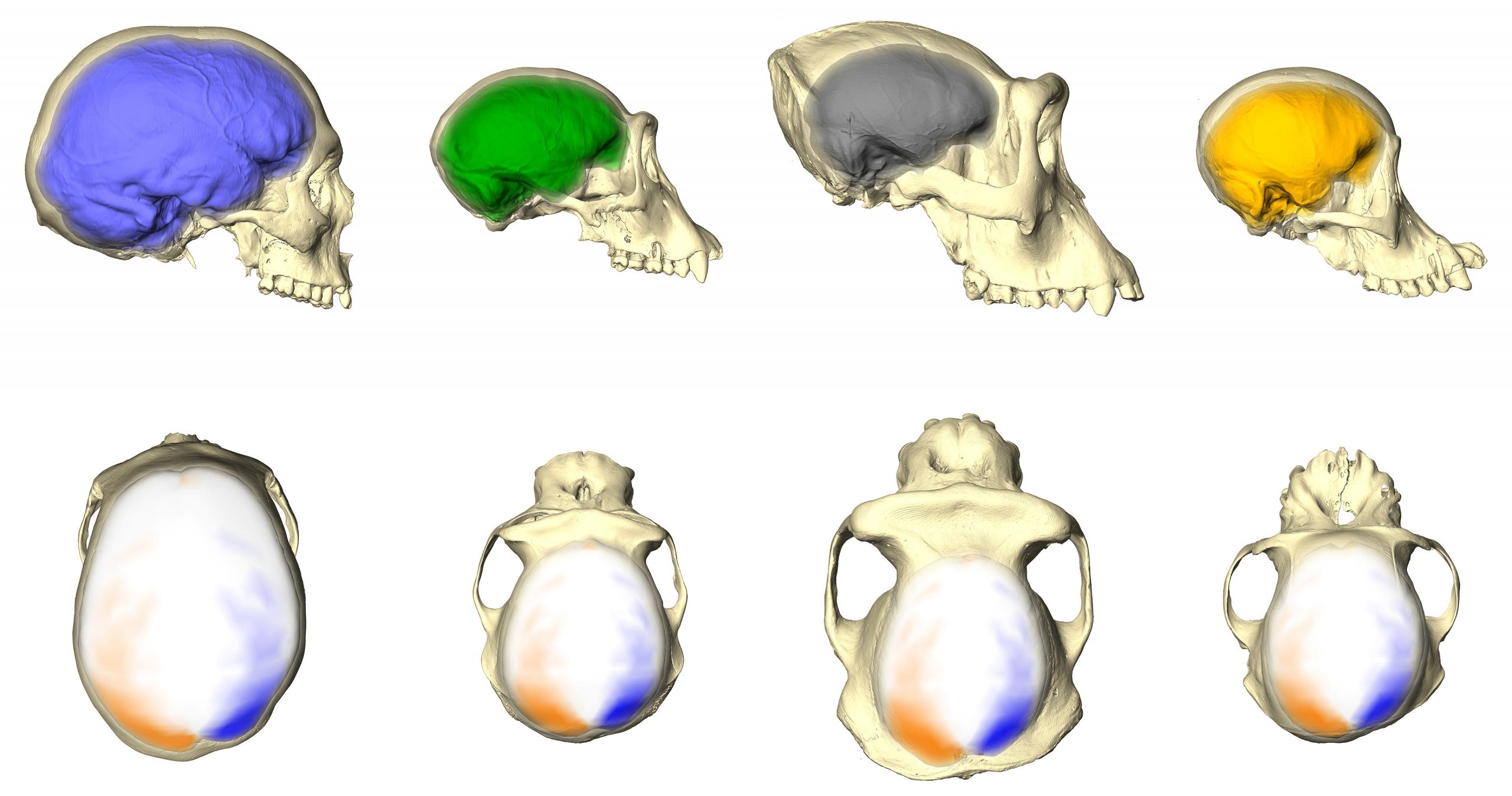
    Human, Chimpanzee, Gorilla and Orangutan Endocasts
    Humans, chimpanzees, gorillas, and orangutans (from left to right) have differently shaped endocasts and brains (see top row). But they share an asymmetry pattern, as visualized in the bottom row. This pattern includes a more backwards projecting left hemisphere and a more forward projecting right hemisphere with localized larger surface areas (orange) in one hemisphere as compared to corresponding smaller regions (blue) in the other hemisphere. Credit: Simon Neubauer, CC BY-NC-ND 4.0

    The team found that the magnitude of asymmetry was about the same in humans and most great apes. Only chimpanzees were, on average, less asymmetric than humans, gorillas, and orangutans. They also investigated the pattern of asymmetry and could demonstrate that not only humans, but also chimpanzees, gorillas, and orangutans showed the asymmetry pattern previously described as typically human: the left occipital lobe, the right frontal lobe, as well as the right temporal pole and the right cerebellar lobe projecting more relative to their contralateral parts. “What surprised us even more,” says Philipp Mitteroecker, a co-author of the study, “was that humans were least consistent in this asymmetry with a lot of individual variation around the most common pattern.” The authors interpret this as a sign of increased functional and developmental modularization of the human brain. For example, the differential projections of the occipital lobe and the cerebellum are less correlated in humans than in great apes. This finding is interesting because the cerebellum in humans underwent dramatic evolutionary changes and it seems that thereby its asymmetry was affected as well.

    The finding of a shared asymmetry pattern but greater variability in humans is intriguing for the interpretation of human brain evolution. An endocast of one of our fossil ancestors that shows this asymmetry can no longer be interpreted as evidence for human-specific functional brain lateralization without other (archaeological) data. Philipp Gunz, a co-author of the study, explains: “This shared asymmetry pattern of the brain evolved already before the origin of the human lineage. Humans seem to have built upon this morphological pattern to establish functional brain lateralization related to typical human behaviors.”

    Reference: “Evolution of brain lateralization: A shared hominid pattern of endocranial asymmetry is much more variable in humans than in great apes” by Simon Neubauer, Philipp Gunz, Nadia A. Scott, Jean-Jacques Hublin and Philipp Mitteroecker, 14 February 2020, Science Advances.
    DOI: 10.1126/sciadv.aax9935

    Never miss a breakthrough: Join the SciTechDaily newsletter.
    Follow us on Google and Google News.

    Anthropology Brain Evolution Max Planck Institute
    Share. Facebook Twitter Pinterest LinkedIn Email Reddit

    Related Articles

    How Our Big Brains and Flat Faces Evolved in Record Time

    Does Fruit Really Fuel Brain Growth? New Study Challenges Old Ideas

    Rethinking Evolution: The Surprising Truth About Newborn Brain Development

    Scientists Discover Surprising Similarities in Stone Tools of Early Humans and Monkeys

    Scientists Uncover the Gene Responsible for Human’s Big Brain

    Atlas of Australian Dragon Brain Reveals Secrets of Brain Evolution

    Mammals Evolved Big Brains After Big Disasters (Mass Extinction and Climate Change)

    Evolutionary Secrets of Fossil Brains Revealed: “Lucy” Had Ape-Like Brain, but Longer Childhood Like Humans

    Scientists Reveal the Evolution of Modern Human Brain Shape

    Leave A Reply Cancel Reply

    • Facebook
    • Twitter
    • Pinterest
    • YouTube

    Don't Miss a Discovery

    Subscribe for the Latest in Science & Tech!

    Trending News

    Even Occasional Binge Drinking May Triple Liver Damage Risk

    Liftoff! NASA’s Artemis II Launch Sends Astronauts Around the Moon for First Time in 50 Years

    Scientists Discover New Way To Eliminate “Zombie Cells” Driving Aging

    This New Quantum Theory Could Change Everything We Know About the Big Bang

    This One Vitamin May Help Protect Your Brain From Dementia Years Later

    Stopping Weight-Loss Drugs Like Ozempic Can Quickly Erase Heart Benefits

    A 500-Million-Year-Old Surprise Is Forcing Scientists to Rethink Spider Evolution

    Coffee and Blood Pressure: What You Need To Know Before Your Next Cup

    Follow SciTechDaily
    • Facebook
    • Twitter
    • YouTube
    • Pinterest
    • Newsletter
    • RSS
    SciTech News
    • Biology News
    • Chemistry News
    • Earth News
    • Health News
    • Physics News
    • Science News
    • Space News
    • Technology News
    Recent Posts
    • 12,000-Year-Old Native American Dice Rewrite the History of Gambling
    • Researchers Break a 150-Year-Old Math Law With a Surprising Donut Discovery
    • Are You Adding Too Much Salt? New Study Identifies Who’s Most at Risk
    • Scientists Finally Crack Decades-Old Mystery Behind Statins’ Painful Side Effects
    • Popular Vitamin B3 Supplements May Help Cancer Cells Survive, Scientists Warn
    Copyright © 1998 - 2026 SciTechDaily. All Rights Reserved.
    • Science News
    • About
    • Contact
    • Editorial Board
    • Privacy Policy
    • Terms of Use

    Type above and press Enter to search. Press Esc to cancel.