
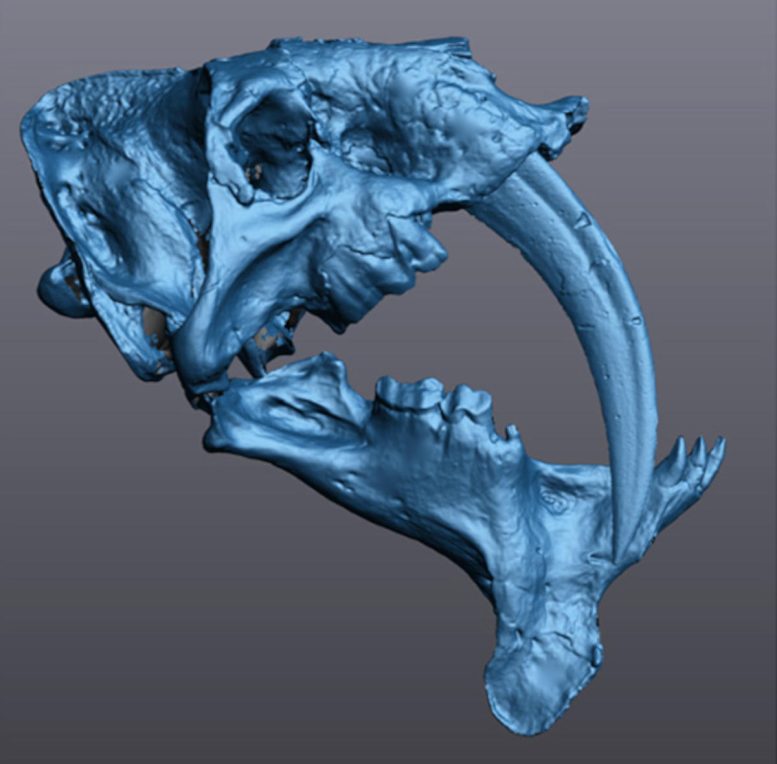
Research conducted by the University of Liège sheds new light on the mechanisms behind the bites of saber-toothed carnivores.
Narimane Chatar, a Ph.D. student at the EDDyLab of the University of Liège (Belgium) led a team of researchers to examine the biting capabilities of Smilodon, an extinct species of carnivore that is related to modern-day felines. By utilizing advanced 3D scanning and simulation techniques, the team discovered how Smilodon was able to bite effectively despite the large size of their teeth.
Throughout their evolution, ancient carnivorous mammals developed a diverse array of skull and tooth shapes. However, few have been as striking as those of the iconic saber-toothed felid, Smilodon. Other groups of mammals, such as the extinct nimravids, also evolved similar morphology, but with shorter canines, akin to those of modern-day lions, tigers, caracals, domestic cats, etc.
This phenomenon of similar morphologies appearing in different groups of organisms is known as convergent evolution; felids and nimravids are amazing examples of convergence. As there are no modern equivalents of animals with such saber-shaped teeth, the hunting method of Smilodon and similar species have remained obscure and hotly debated. It was first suggested that all saber-toothed species hunted in the same way, regardless of the length of their canines, a hypothesis that is now controversial. So the question remained … how did this variety of ‘saber-toothed cat’ hunt?
The enormous canines of the extinct saber-toothed cat Smilodon imply that this animal had to open its jaw extremely wide, 110° according to some authors, in order to use them effectively,” explains Prof. Valentin Fischer, director of the EDDyLab at ULiège. However, the mechanical feasibility and efficiency of Smilodon and its relatives to bite at such a large angle is unknown, leaving a gap in our understanding of this very fundamental question about saber-toothed predators.”
3D Simulations of Saber-Toothed Predators
Using high-precision 3D scanners and analytical methods derived from engineering, an international team of Belgian and North American scientists has just revealed how these animals probably used their impressive weapons.
Narimane Chatar, a Ph.D. student at the EDDyLab of the University of Liege and lead author of the study, collected a large amount of three-dimensional data. She first scanned and modeled the skulls, mandibles, and muscles of numerous extinct and extant species of felids and nimravids.
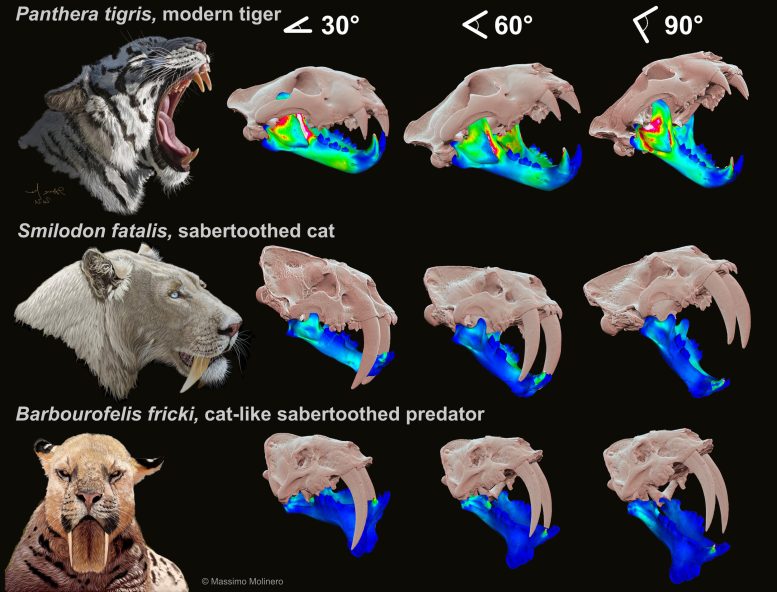
“Each species was analyzed in several scenarios: a bite was simulated on each tooth at three different biting angles: 30°, as commonly seen in extant felids, but also larger angles (60° and 90°). In total, we carried out 1,074 bite simulations to cover all the possibilities,” explains Narimane Chatar.
To do this, the young researcher used the finite element method. This is an exciting application of the finite element approach, which allows paleontologists to modify and computationally simulate different bite angles and to subject skull models to virtual stresses without damaging the precious fossil specimens,” says Professor Jack Tseng, Professor and Curator of Paleontology at the University of California, Berkeley, and co-author of the study. Our comprehensive analyses provide the most detailed insight to date into the diversity and nuances of saber tooth bite mechanics.”
One of the results obtained by the team is the understanding of the distribution of stress (pressure) on the mandible during biting. This stress shows a continuum across the animals analyzed, with the highest values measured in species with the shortest upper canines and the lowest stress values measured in the most extreme saber-toothed species. The researchers also noted that stress decreased with increasing bite angle but only in saber-toothed species. However, the way in which these animals transmitted force to the bite point and the deformation of the mandible resulting from the bite were remarkably similar across the dataset, indicating comparable effectiveness regardless of canine length.
Evolutionary Diversity in Predator Morphologies
“The results show both the possibilities and the limits of evolution; animals facing similar problems in their respective ecosystems often end up looking alike through convergent evolution. However, Narimane Chatar’s results also show that there can be several ways to be an effective killer, whether you are saber-toothed or not,” concludes Valentin Fischer.
This phenomenon, called ’many-to-one’ systems, means that distinct morphologies can result in a similar function, such as the fact that bears and cats are both efficient fishers. This multiplicity of morphologies indicates that there is no single optimal form of saber-toothed predator.
Reference: “Many-to-one function of cat-like mandibles highlights a continuum of sabre-tooth adaptations” by Narimane Chatar, Valentin Fischer and Z. Jack Tseng, 7 December 2022, Proceedings of the Royal Society B: Biological Sciences.
DOI: 10.1098/rspb.2022.1627
Never miss a breakthrough: Join the SciTechDaily newsletter.
Follow us on Google and Google News.
4 Comments
From my studies, the big cat bite is a perfection of a method to kill its prey as fast and painless as is possible. This is by a quick and decisive severing of the spinal cord on the back of the neck. This is why cats like to attack you from behind, to get right at the neck. Thus many native tribes would wear masks on the back of their heads, with 2 eyes painted on it. Makes the cat think you are watching.
Is that why Lions go for the throat to suffocate their prey? They didn’t read your studies?
I contend that Saber cats did not have a strong bite. But had a long swing of the jaw to allow full exposure of 10+ inch teeth with s stunningly sharp concave edge. The neck muscle attachments are very sturdy with a strong atlas occipital attachment. This would allow the cat to seing its head like an ice ax into the lung or gut area, causing massive damage while avoding horns or crushing hooves or feet. All the better to not be injured by the prey. The prey could be left to bleed out from paired 10” cuts a couple of feet long. No need for a strong bite. Sharks and some other preditors do this hit and wait technique. Large target areas available. This “cat” was probably more of a sneek attack not a runner, or big fighter.
Think of the smilodon as a rodeo rider.. It’s an ambush killer jumping on massive animals many times It’s size and latching on for a wild ride. The fossil record clearly shows that the kinds of bone injuries incurred by smilodon support this model..