

An Insect Bite Force Sensor System Has Been Developed by Researchers at the University of Bonn
How hard can an insect bite? Strong chewing capabilities make it simpler to successfully break tougher food and defeat adversaries. The University of Bonn’s Department of Biology has developed the forceX mobile system, which measures the biting forces of small animals, and the forceR software, which analyzes the data. This makes it possible to comprehend the evolution of biting forces, such as those of insects. The results were recently published in the journal Methods in Ecology and Evolution.
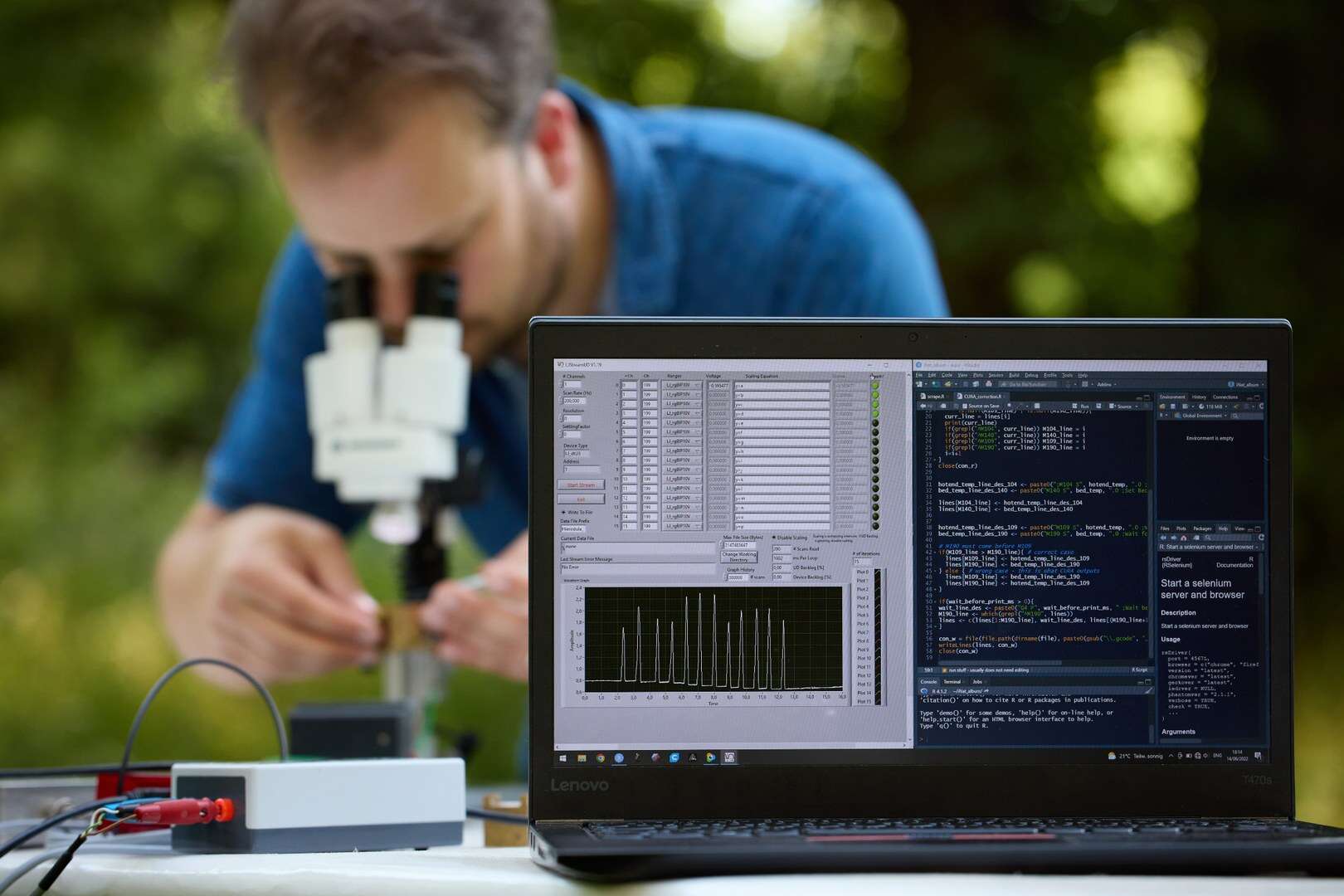
The praying mantis in the scientist’s palm wriggles a bit. The insect protects itself by biting down on the two metal plates that transmit pressure to a piezo crystal as it approaches the sensor. An amplifier transmits the voltage produced by the crystal, which is load-dependent, to a laptop. On the screen, many curves can be seen, some of which jerkily climb abruptly, reach a plateau, and then fall back to zero. Depending on how quickly an insect reaches the maximum power at which it may bite, the rise and fall may sometimes be flatter.
Hardly Any Data on Bite Force
“There is hardly any data available on how hard insects can bite,” says Peter T. Rühr, a doctoral student at the Institute of Evolutionary Biology and Ecology at the University of Bonn. With their sensor system “forceX”, the researchers want to investigate how the mandibles, musculature, and head shape of insects have evolved to meet the challenges of their respective environments. “It may not always be advantageous to be able to bite hard, because maintaining the ability to bite strong demands higher energetic costs,” Rühr says. The bite force may depend, for example, on what food an insect feeds on or whether it needs the mandibles to defend itself.
The team under the direction of Professor Dr. Alexander Blanke, who has been awarded a Starting Grant by the European Research Council (ERC), improved upon the systems already in existence for measuring bite forces.
To determine if the mandibles of the insect being studied are in touch with the metal plates of the sensor at the proper area, the University of Bonn researchers employed a stereo microscope, which is similar to a powerful magnifying glass. The top plate uses a rocker to transmit the force to the sensor while the bottom plate remains stationary.
Flexible Adjustment to Mandible Size Is Possible
“Depending on the size and opening angle of the mandibles, we use differently sized, interchangeable bite plates,” says Rühr, explaining the advancements. “This allows the sensor to be adjusted over a relatively wide range to meet the particular requirements of the animals.” The complete system is battery-powered and can therefore be used for mobile measurements – even in the “wild”.

For stinging insects, the researchers use a holder made of plastic. The animals disappear completely in the vial, with only the head with its mouthparts protrudes from a small hole in the front. Rühr: “This allows us to better position the insects without having to hold them in our hands.” Usually, the animals do not need much persuasion before they bite. They feel uncomfortable in the unfamiliar environment and fight back with defensive bites. If this instinctive behavior fails to materialize, the researchers stroke the insect heads with a delicate brush – at the latest then the insects will close their jaws.
High Accuracy of the Measurement
For publication in Methods in Ecology and Evolution, the researchers determined the accuracy of the system: They did this by attaching different weights, ranging from one gram to almost one kilogram, to the movable metal plate. A total of 1,600 repetitions show that the deviation between measurements is a maximum of 2.2 percent. “That is very accurate,” says Rühr. The system can also be used to measure the force of scorpion or crab claws, for example.

Rühr and Blanke built the system during their time at the University of Cologne, in part with the local precision engineering workshop. At the University of Bonn, they further optimized it and performed the accuracy measurements. The manuscript also describes the new “forceR” software, with which the bite force values and shapes of the bite curves can be evaluated and compared. The researchers do not want to bring the bite force sensor system to market. “Rather, the results presented in ‘Methods in Ecology and Evolution’ provide the basis for replicates,” Rühr says. Essential parts of the sensor can even be reproduced using a 3D printer.
Reference: “forceX and forceR: A mobile setup and r package to measure and analyse a wide range of animal closing forces” by Peter T. Rühr and Alexander Blanke, 29 May 2022, Methods in Ecology and Evolution.
DOI: 10.1111/2041-210X.13909
The study was funded by the European Research Council (ERC) and the German Research Foundation (DFG).
Never miss a breakthrough: Join the SciTechDaily newsletter.
Follow us on Google and Google News.