
It sounds like a “Just So Story” — “How the Insect Got its Wings” — but it’s really a mystery that has puzzled biologists for over a century. Intriguing and competing theories of insect wing evolution have emerged in recent years, but none were entirely satisfactory. Finally, a team from the Marine Biological Laboratory (MBL), Woods Hole, has settled the controversy, using clues from long-ago scientific papers as well as state-of-the-art genomic approaches. The study, conducted by MBL Research Associate Heather Bruce and MBL Director Nipam Patel, is published this week in Nature Ecology & Evolution.
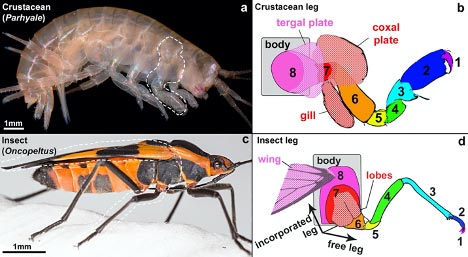
Insect wings, the team confirmed, evolved from an outgrowth or “lobe” on the legs of an ancestral crustacean (yes, crustacean). After this marine animal had transitioned to land-dwelling about 300 million years ago, the leg segments closest to its body became incorporated into the body wall during embryonic development, perhaps to better support its weight on land. “The leg lobes then moved up onto the insect’s back, and those later formed the wings,” says Bruce.
One of the reasons it took a century to figure this out, Bruce says, is that it wasn’t appreciated until about 2010 that insects are most closely related to crustaceans within the arthropod phylum, as revealed by genetic similarities.
“Prior to that, based on morphology, everyone had classified insects in the myriapod group, along with the millipedes and centipedes,” Bruce says. “And if you look in myriapods for where insect wings came from, you won’t find anything,” she says. “So insect wings came to be thought of as ‘novel’ structures that sprang up in insects and had no corresponding structure in the ancestor — because researchers were looking in the wrong place for the insect ancestor.”
“People get very excited by the idea that something like insect wings may have been a novel innovation of evolution,” Patel says. “But one of the stories that is emerging from genomic comparisons is that nothing is brand new; everything came from somewhere. And you can, in fact, figure out from where.”
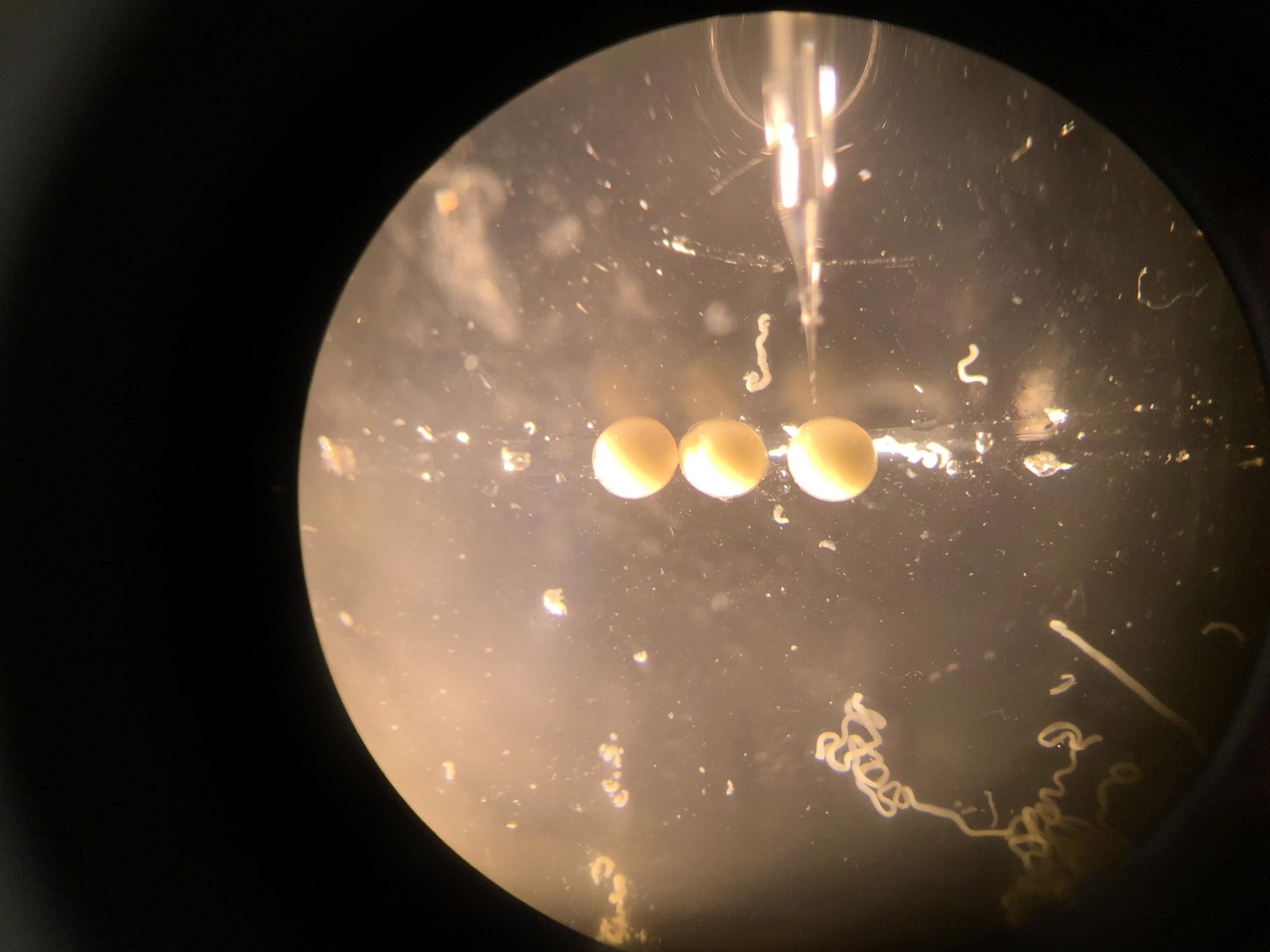
Parhyale hawaiensis, shown here eating, has had its genome sequenced and is the most genetically tractable crustacean for biological research. Credit: Heather Bruce
Bruce picked up the scent of her now-reported discovery while comparing the genetic instructions for the segmented legs of a crustacean, the tiny beach-hopper Parhyale, and the segmented legs of insects, including the fruit fly Drosophila and the beetle Tribolium. Using CRISPR-Cas9 gene editing, she systematically disabled five shared leg-patterning genes in Parhyale and in insects, and found those genes corresponded to the six leg segments that are farthest from the body wall. Parhyale, though, has an additional, seventh leg segment next to its body wall. Where did that segment go, she wondered? “And so I started digging in the literature, and I found this really old idea that had been proposed in 1893, that insects had incorporated their proximal [closest to body] leg region into the body wall,” she says.
“But I still didn’t have the wing part of the story,” she says. “So I kept reading and reading, and I came across this 1980s theory that not only did insects incorporate their proximal leg region into the body wall, but the little lobes on the leg later moved up onto the back and formed the wings. I thought, wow, my genomic and embryonic data supports these old theories.”
It would have been impossible to resolve this longstanding riddle without the tools now available to probe the genomes of a myriad of organisms, including Parhyale, which the Patel lab has developed as the most genetically tractable research organism among the crustaceans.
Reference: “Knockout of crustacean leg patterning genes suggests that insect wings and body walls evolved from ancient leg segments” by Heather S. Bruce and Nipam H. Patel, 1 December 2020, Nature Ecology & Evolution.
DOI: 10.1038/s41559-020-01349-0
Never miss a breakthrough: Join the SciTechDaily newsletter.
Follow us on Google and Google News.
6 Comments
It’s nice to see the mystery of insect wings ‘solved’, but it’s not a very difficult one as organisms grow legs and fins then back again, depending on the environmental pressures .
I would have suggested that a lobe mutation on the back of certain insects gradually grew into some kind of balancing aid, which in turn mutated into a hopping aid, then finally mutated into wings that could give the insect flight.
Indeed! I’m reminded of how the oldest steranes that were associated with animals now have been shown to derive from modified sterols of rotting plants – showing how easy plant evolution (early and 3 times) have been compared to body plan animals (late and 1 time).
I think they were happy to establish the homology (as am I) since it has been outstanding for so long.
THE NATURAL LIMITS TO EVOLUTION
by Babu G. Ranganathan*
(B.A. Bible/Biology)
ONLY LIMITED EVOLUTION (micro-evolution or evolution within biological “kinds”) is genetically possible (such as the varieties of dogs, cats, horses, cows, etc.), but not macro-evolution, or evolution across biological “kinds,” (such as from sea sponge to human). All real evolution in nature is simply the expression, over time, of already existing genes or variations of already existing genes. For example, we have breeds of dogs today that we didn’t have a few hundred years ago. The genes for these breeds had always existed in the dog population but never had opportunity before to be expressed. Only limited evolution, variations of already existing genes and traits, is possible.
The genes (chemical instructions or code) for a trait must first exist or otherwise the trait cannot come into existence. Genes instruct the body to build our tissues and organs. Nature is mindless and has no ability to design and program entirely new genes for entirely new traits.
Evolutionists believe that, if given millions of years, accidents in the genetic code of species caused by the environment will generate entirely new code making evolution possible from one type of life to another. It’s much like believing that by randomly changing the sequence of letters in a romance novel, over millions of years, can turn the novel into a book on astronomy! Not to worry. We’ll address the issue of “Junk DNA” in a moment.
WHAT ABOUT NATURAL SELECTION? Natural selection doesn’t produce biological traits or variations. It can only “select” from biological variations that are possible and which have survival value.
HOW COULD SPECIES HAVE SURVIVED if their vital tissues, organs, reproductive systems, etc. were still evolving? A partially evolved trait or organ that is not complete and fully integrated and functioning from the start would be a liability to a species, not a survival asset. Plants and animals in the process of macro-evolution would be unfit for survival. For example, “if a leg of a reptile were to evolve (over supposedly millions of years) into a wing of a bird, it would become a bad leg long before it became a good wing” (Dr. Walt Brown, scientist and creationist). Survival of the fittest actually would have prevented evolution across biological kinds!
NEW SPECIES BUT NOT NEW DNA: Although it’s been observed that new species have come into existence, they don’t carry any new genes. They’ve become new species only because they can’t be crossed back with the original parent stock for various biological reasons. A biological “kind” allows for new species but not new genes. Nature has no ability to invent new genes for new traits. Only limited variations and adaptations are possible in nature, and all strictly within a biological “kind” (i.e. varieties of dogs, cats, etc.).
Dr. Randy J. Guliuzza’s extensive research points to a better explanation than natural selection for variation and adaptation in nature. Dr. Guliuzza explains that species have pre-engineered mechanisms that enable organisms to continuously track and respond to environmental changes with system elements that correspond to human-designed tracking systems. This model is called CET (continuous environmental tracking). His research strongly indicates that living things have been pre-engineered to produce the right adaptations and changes required to live in changing environments. It’s much like a car that’s been pre-engineered so that the head lights turn on automatically when day changes to night.
What about genetic and biological similarities between species? Genetic information, like other forms of information, cannot happen by chance, so it is more logical to believe that genetic and biological similarities between all forms of life are due to a common Designer who designed similar functions for similar purposes. It doesn’t mean all forms of life are biologically related! Only genetic similarities within a natural species proves relationship because it’s only within a natural species that members can interbreed and reproduce.
Many people have wrong ideas of how evolution is supposed to work. Physical traits and characteristics are determined and passed on by genes – not by what happens to our body parts. For example, if a woman were to lose her finger this wouldn’t affect how many fingers her baby will have. Changing the color and texture of your hair will not affect the color and texture of your children’s hair. So, even if an ape or ape-like creature’s muscles and bones changed so that it could walk upright it still would not be able to pass on this trait to its offspring. Only changes or mutations that occur in the genetic code of reproductive cells (i.e. sperm and egg) can be passed on to offspring.
What about the new science of epigenetics? Epigenetics involves inheritable factors which can turn already-existing genes on, but epigenetics doesn’t create new genes.
Most biological variations are from new combinations of already existing genes, not mutations. Mutations are accidents in the genetic code caused by nature (i.e. environmental radiation), are mostly harmful, and have no capability of producing greater complexity in the code. Even if a good accident occurred, for every good one there would be hundreds of harmful ones with the net result, over time, being harmful, even lethal, to the species. Even if a single mutation is not immediately harmful, the accumulation of mutations over time will be harmful to the species resulting in extinction. At very best, mutations only produce further variations within a natural species.
All species of plants and animals in the fossil record are found complete, fully formed, and fully functional. This is powerful evidence that all species came into existence as complete and fully formed from the beginning. This is only possible by creation.
God began with a perfect and harmonious creation. Even all the animals were vegetarian (Genesis 1:30) in the beginning and did not struggle for survival nor kill and devour each other. Macro-evolutionary theory does not begin with a perfect and harmonious creation as the Bible states. The Bible and macro-evolutionary theory cannot both be true.
All the fossils that have been used to support human evolution have been found to be either hoaxes, non-human, or human, but not non-human and human (i.e. Neanderthal Man was discovered later to be fully human).
There has never been unanimous agreement among evolutionary scientists on ANY fossil evidence that has been used to support human evolution over the many years, Including LUCY.
The actual similarity between ape and human DNA is between 70-87% not 99.8% as commonly believed. The original research stating 99.8% similarity was based on ignoring contradicting evidence. Only a certain segment of DNA between apes and humans was compared, not the entire DNA genome.
Also, so-called “Junk DNA” isn’t junk. Although these “non-coding” segments of DNA don’t code for proteins, they have recently been found to be vital in regulating gene expression (i.e. when, where, and how genes are expressed, so they’re not “junk”). Also, there is evidence that, in certain situations, they can code for protein.
ARE FOSSILS REALLY MILLIONS OF YEARS OLD? (Internet article by author)
Visit my latest Internet site: THE SCIENCE SUPPORTING CREATION (This site answers many arguments, both old and new, that have been used by evolutionists to support their theory)
Author of popular Internet article, TRADITIONAL DOCTRINE OF HELL EVOLVED FROM GREEK ROOTS
*I have given successful lectures (with question and answer period afterwards) defending creation before evolutionist science faculty and students at various colleges and universities. I’ve been privileged to be recognized in the 24th edition of Marquis “Who’s Who in The East” for my writings on religion and science.
Superstition, self promotion and pseudoscience links.
I have already shown how your entire idea of evolution is wrong and the questions have been answered – which you pointedly do not – so I’m not going over that again. Here is a sufficient reference to the science, showing you wrong: “Evolution” @ Wikipedia.
I’ll also add that specifically that kind of superstition has been found to be as much scam as astrology and homeopathy by science, specifically that there are no ‘gods’.
Flat space shows that the universe is entirely natural – we can now test for magic against flat space telling us the sum of energy and the sum of work must both be zero – and it is the result of spontaneous (adiabatic free) expansion.
CRISPR-Cas9 gene editing for the win!
The dominating hypothesis has, I think, been that the leg associated gills that show up in the illustration was that had evolved to become insect wings, perhaps inspired by myriapod anatomy. While gills often have associated musculature – c.f. fish – a leg segment makes so much more sense.
In fact, crustacean legs evolved as doubled and to have all sorts of functions, so while some clades lost the extra leg one can often see various extraneous parts (such as gills actually, I think).