
Close Menu
    Facebook X (Twitter) Instagram
    SciTechDaily
    • Biology
    • Chemistry
    • Earth
    • Health
    • Physics
    • Science
    • Space
    • Technology
    Facebook X (Twitter) Pinterest YouTube RSS
    SciTechDaily
    Home»Science»Primates Change Their “Accent” in Shared Territory to Avoid Conflict
    Science

    Primates Change Their “Accent” in Shared Territory to Avoid Conflict

    By Anglia Ruskin UniversityMay 28, 2021No Comments3 Mins Read
    Facebook Twitter Pinterest Telegram LinkedIn WhatsApp Email Reddit
    Share
    Facebook Twitter LinkedIn Pinterest Telegram Email Reddit
    Pied Tamarin (Saguinus bicolor)
    Pied tamarin (Saguinus bicolor). Credit: Photograph by Tainara Sobroza

    New study finds one species will adopt another species’ calls in shared territory.

    New research has discovered that monkeys will use the “accent” of another species when they enter its territory to help them better understand one another and potentially avoid conflict.

    Published on May 3 in the journal Behavioral Ecology and Sociobiology, the study is the first to show asymmetric call convergence in primates, meaning that one species chooses to adopt another species’ call patterns to communicate.

    The research, co-authored by Dr. Jacob Dunn of Anglia Ruskin University (ARU), investigated the behavior of 15 groups of pied tamarins (Saguinus bicolor) and red-handed tamarins (Saguinus midas) in the Brazilian Amazon.

    Pied tamarins are critically endangered and have one of the smallest ranges of any primate in the world, much of it around the city of Manaus, while red-handed tamarins are found throughout the north-eastern Amazon region.
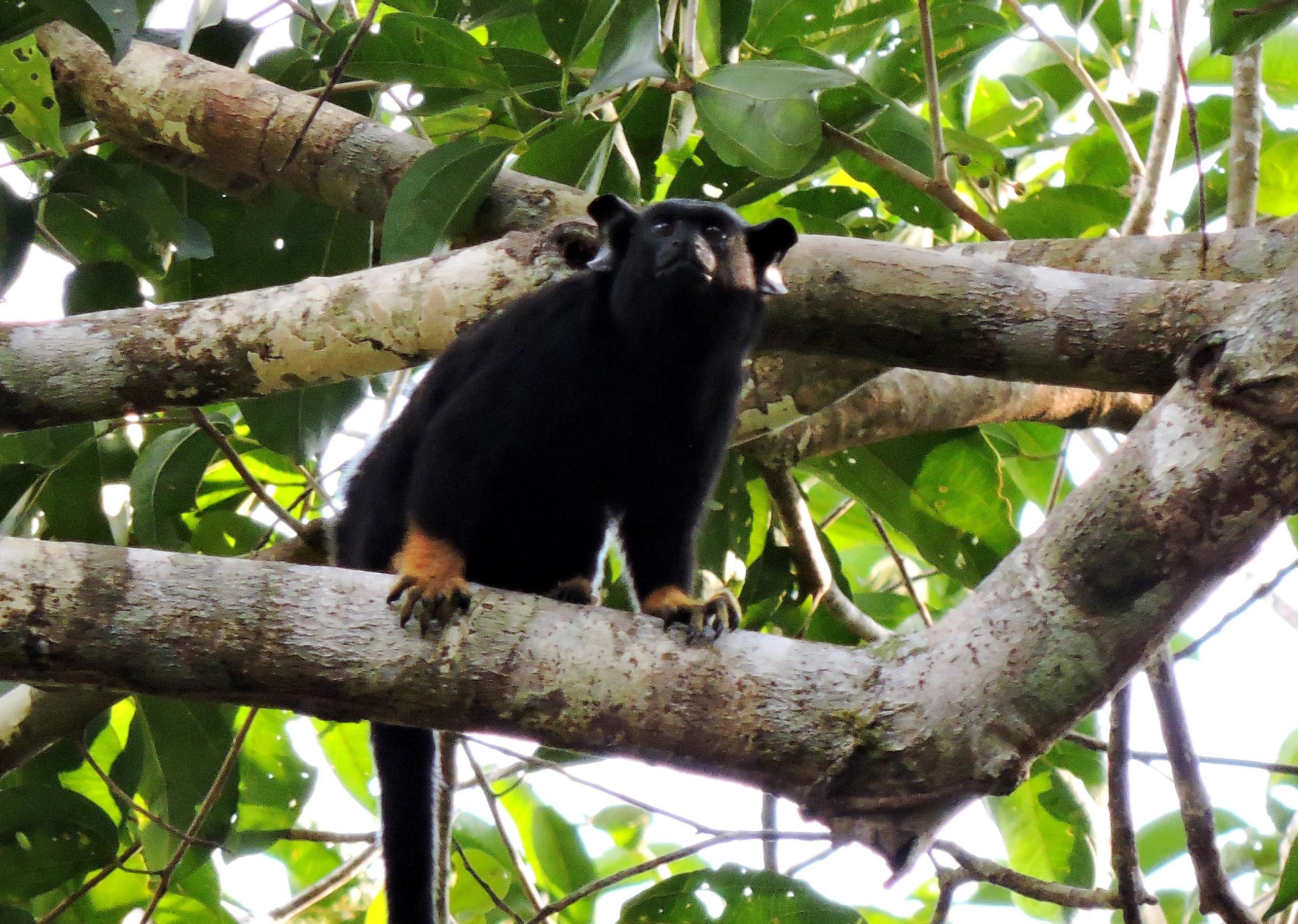
    Red-Handed Tamarin (Saguinus midas)
    Red-handed tamarin (Saguinus midas). Credit: Photograph by Viviane Costa

    The researchers found that when groups of red-handed tamarins entered territory shared with pied tamarins, the red-handed tamarins adopted the long calls used by the pied tamarins.

    Vocal Adaptation to Reduce Territorial Conflict

    Red-handed tamarins have greater vocal flexibility and use calls more often than pied tamarins, and the scientists believe they might alter their calls to avoid territorial disputes over resources.

    Lead author Tainara Sobroza, of the Instituto Nacional de Pesquisas da Amazonia, said: “When groups of tamarins are moving quickly around mature Amazonian forest it can sometimes be difficult to tell the species apart, but during our research we were surprised to discover they also sound the same in the areas of the forest they cohabit.

    “We found that only the red-handed tamarins change their calls to those of the pied tamarins, and this only happens in places where they occur together. Why their calls converge in this way is not certain, but it is possibly to help with identification when defending territory or competing over resources.”
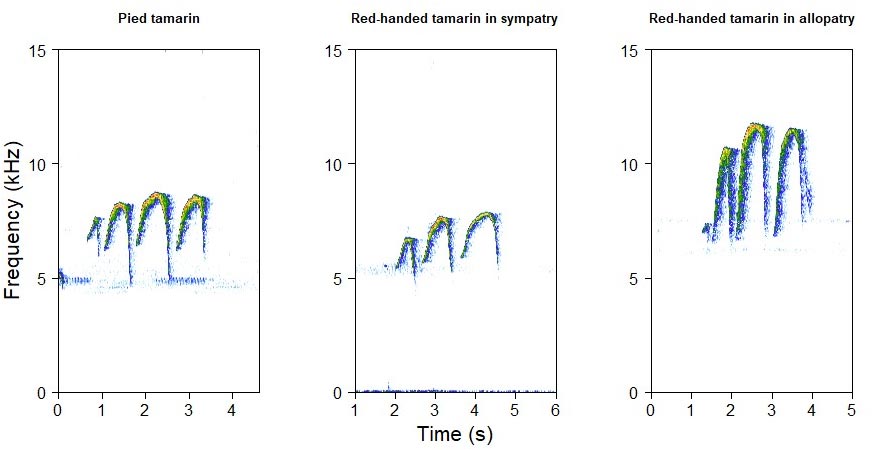
    Spectrograms Showing Red-Handed Tamarin and Pied Tamarin Calls
    Spectrograms showing how the red-handed tamarin calls match the pied tamarin calls in shared territory (in sympatry). Credit: Tainara Sobroza

    Evolutionary Significance of Vocal Convergence

    Co-author Dr. Jacob Dunn, Associate Professor in Evolutionary Biology at Anglia Ruskin University (ARU), said: “We have long known that when closely related species overlap in their geographic ranges, we are likely to see interesting evolutionary patterns. One famous example is the Galapagos finches, studied by Darwin, whose beaks evolved to specialize on different foods on the islands to avoid competition.

    “In some cases, rather than diverging to become more different from one another, some closely related species converge to show similar traits. Our study is the first to show asymmetric call convergence in primates, with one species’ call becoming the ‘lingua franca’ in shared territories.

    “Because these tamarin species rely on similar resources, changing their ‘accents’ in this way is likely to help these tiny primates identify one another more easily in dense forest and potentially avoid conflict.”

    Reference: “Convergent character displacement in sympatric tamarin calls (Saguinus spp.)” by Tainara V. Sobroza, Marcelo Gordo, Pedro A. C. L. Pequeno, Jacob C. Dunn, Wilson R. Spironello, Rafael M. Rabelo and Adrian P. A. Barnett, 3 May 2021, Behavioral Ecology and Sociobiology.
    DOI: 10.1007/s00265-021-03028-x

    Never miss a breakthrough: Join the SciTechDaily newsletter.
    Follow us on Google and Google News.

    Anglia Ruskin University Behavioral Science Evolution Language Primates Zoology
    Share. Facebook Twitter Pinterest LinkedIn Email Reddit

    Related Articles

    Kissing Likely Began 20 Million Years Ago With Ape Ancestors and Neanderthals

    Screams of “Joy” Are Often Mistaken for “Fear” When Heard Out of Context

    New Research Finds Lasting Benefits From Growing Up in a Bilingual Home

    Researchers Use “Artificial Grammars” to Show Building Blocks of Language Evolved 30–40 Million Years Ago

    Distinctive Primal Acoustics of the Human Scream

    Captive Beluga Whale Was Able to Mimic Speech

    Baboons With Stable Relationships Are Nicer and Live Longer

    Hyenas Might Be As Intelligent As Some Primates

    Disease Mapping Methods Indicate That Indo-European Languages Originated From Anatolia

    Leave A Reply Cancel Reply

    • Facebook
    • Twitter
    • Pinterest
    • YouTube

    Don't Miss a Discovery

    Subscribe for the Latest in Science & Tech!

    Trending News

    Scientists Recreate a Nuclear Fireball and Uncover Fallout’s Hidden Chemistry

    These Tiny Gut Particles Could Be Accelerating Aging Throughout the Body

    Doctors Changed One Thing and Weight Gain Stopped

    Magnetic Fields May Solve a Longstanding Binary Star Mystery

    The Probiotic Breakthrough for Natural Anxiety Relief and Better Mental Health

    Animal vs. Plant Protein: Scientists Found a Surprising Nutritional Difference

    According to Scientists, This Simple Dietary Change Is Linked to Lower Depression Scores

    Researchers Discover a Hidden Vitamin D Problem That Persists Year-Round

    Follow SciTechDaily
    • Facebook
    • Twitter
    • YouTube
    • Pinterest
    • Newsletter
    • RSS
    SciTech News
    • Biology News
    • Chemistry News
    • Earth News
    • Health News
    • Physics News
    • Science News
    • Space News
    • Technology News
    Recent Posts
    • Scientists Tracked 4,500 Animals During COVID – What They Discovered Was Surprising
    • Hidden Phase of Matter Finally Captured After Decades of Predictions
    • The Strange “Spacetime Crystal” That Can Suddenly Turn Into a Black Hole
    • A Hidden Gut Signal May Be Driving Sleep Apnea’s Deadly Heart Risks
    • This AI-Designed “Universal Vaccine” Could Stop Future Pandemics Before They Start
    Copyright © 1998 - 2026 SciTechDaily. All Rights Reserved.
    • Science News
    • About
    • Contact
    • Editorial Board
    • Privacy Policy
    • Terms of Use

    Type above and press Enter to search. Press Esc to cancel.