
In a newly published study, astrophysicists detail how they modeled the trajectories of refractory particles in the unstable disk of gas and dust that formed the Solar System, solving two Solar System puzzles.
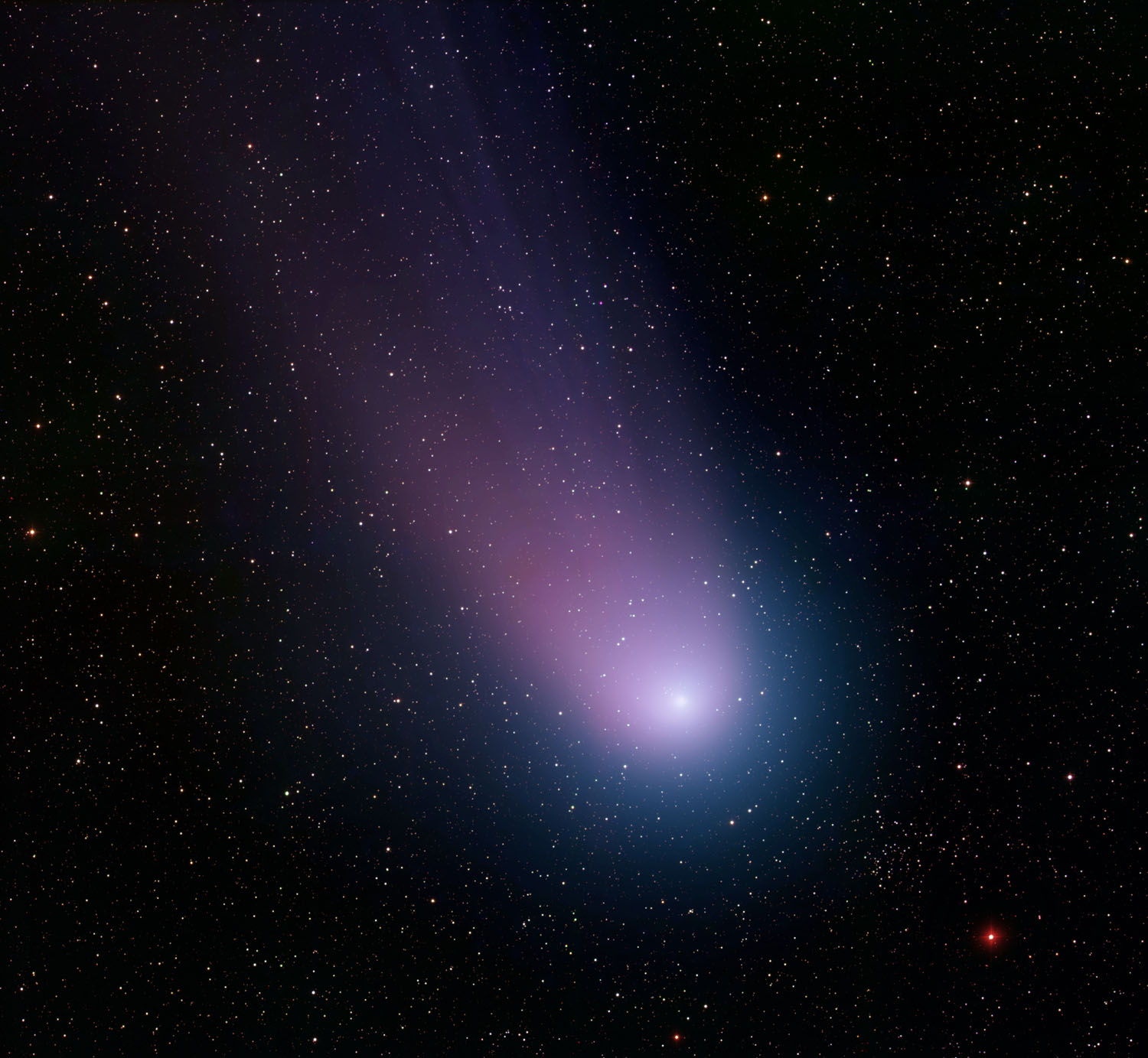
Comets and asteroids preserve the building blocks of our Solar System and should help explain its origin. But there are unsolved puzzles. For example, how did icy comets obtain particles that formed at high temperatures, and how did these refractory particles acquire rims with different compositions?
Carnegie’s theoretical astrophysicist Alan Boss and cosmochemist Conel Alexander* are the first to model the trajectories of such particles in the unstable disk of gas and dust that formed the Solar System. They found that these refractory particles could have been processed in the hot inner disk, and then traveled out to the frigid outer regions to end up in icy comets. Their meandering trips back and forth could help explain the different compositions of their rims. The research is published in Earth and Planetary Science Letters.
The young Sun is thought to have experienced a series of outbursts caused by the rapid infall of disk gas onto the Sun. The leading mechanism for explaining such outbursts is a phase of disk instability. The researchers modeled the trajectories of several hundred centimeter-sized melilite mineral particles during a phase of disk instability. These particles are similar to calcium-aluminum-rich inclusions (or CAIs), the refractory particles often found in well-preserved meteorites, as well as the comet Wild 2.
Their disk model assumed a marginally gravitationally unstable, fully three-dimensional disk, with a mass of about 5 % of today’s Sun and temperatures ranging from a frigid -350 °F (60K) in the outer regions, to a scorching 2240 °F (1500K) near the center. Their calculations allowed the CAIs to orbit in the disk while being subjected to gas drag and the gravity of both the disk and the Sun.
The particles started orbiting in unison, but after about 20 years their trajectories started to diverge significantly. Most struck the inner boundary of the disk at 1 AU (the Earth/Sun distance), while others went to the outer boundary at 10 AU, where they could be swept up by a growing comet. About 10% migrated back and forth in the disk before hitting one or the other boundary.
The researchers then modeled the evaporation and condensation processes that the particles would experience during their migrations and found that such particles were likely to acquire outer rims with varied isotopic compositions recently shown to characterize CAIs.
“CAIs are thought to have formed at the very beginning of the Solar System. Our results show that they must have experienced remarkably complex histories as they were transported chaotically all over the disk,” remarked Alexander.
These migrations could explain the different oxygen isotopes that have been found in particles from meteorites. These are varieties of oxygen atoms with different numbers of neutrons, which point to different processing conditions for the particle rims.
Previous work by Boss had shown that oxygen isotope abundances could vary in an unstable disk by the range found in meteorites. Coupled with the new results, these models show that several puzzles may have been solved—an unstable disk can explain both large-scale outward transport of refractory particles, as well as the peculiar rim compositions acquired during their journeys.
“It’s nice to solve two problems at once,” said Boss. “But there are still many more puzzles about meteorites for us to work on.”
Reference: “Cosmochemical consequences of particle trajectories during FU Orionis outbursts by the early Sun” by Alan P. Boss, Conel M. O’D.Alexander and Morris Podolak, 20 July 2012, Earth and Planetary Science Letters.
DOI: 10.1016/j.epsl.2012.06.046
* The research also included colleague Morris Podolak at Tel Aviv University and was funded in part by NASA Origins of Solar Systems Program. The calculations were performed on the Carnegie Alpha Cluster supported in part by the NSF.
Never miss a breakthrough: Join the SciTechDaily newsletter.
Follow us on Google and Google News.