
Close Menu
    Facebook X (Twitter) Instagram
    SciTechDaily
    • Biology
    • Chemistry
    • Earth
    • Health
    • Physics
    • Science
    • Space
    • Technology
    Facebook X (Twitter) Pinterest YouTube RSS
    SciTechDaily
    Home»Chemistry»Catalytic Hydrogenation of CO2 to Methanol: Low Temperature and High Efficiency
    Chemistry

    Catalytic Hydrogenation of CO2 to Methanol: Low Temperature and High Efficiency

    By Dalian Institute of Chemical PhysicsJune 2, 20211 Comment3 Mins Read
    Facebook Twitter Pinterest Telegram LinkedIn WhatsApp Email Reddit
    Share
    Facebook Twitter LinkedIn Pinterest Telegram Email Reddit
    Catalytic Hydrogenation of CO2 to Methanol
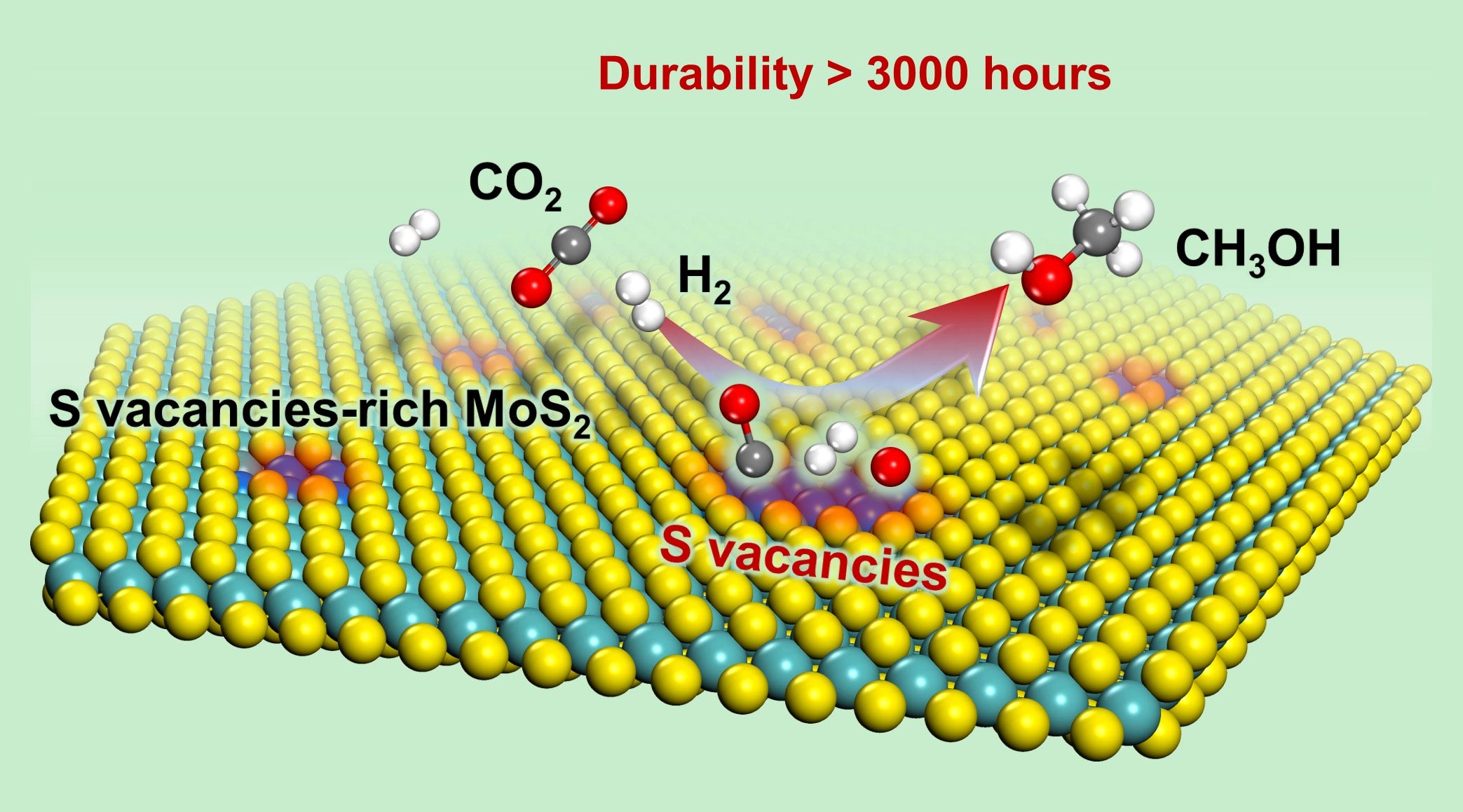
    Researchers achieved for the first time low-temperature high-efficiency hydrogenation of CO2 to methanol, with a long working life over sulfur vacancy-rich few-layered MoS2, as well as remarkably higher activity and selectivity than those of the commercial Cu/ZnO/Al2O3 catalyst. Credit: DICP

    Sulfur-deficient MoS₂ enables efficient CO₂-to-methanol conversion at low temperatures.

    Efficient conversion of CO2 is strategically significant for alleviating the energy crisis and achieving the goal of carbon neutrality. One promising conversion route is the hydrogenation of CO2 to methanol using a renewable energy-based “green hydrogen” source.

    Challenges with Traditional Catalysts

    Traditional metal oxide catalysts for this reaction typically require a high temperature (>300 oC or 570 oF), which tends to promote undesired reverse water-gas shift (RWGS) side reactions, thus producing a large amount of CO as the by-product.

    Introduction of transition metal components onto metal oxides can promote the activation of H2, thereby reducing the reaction temperature, but this also facilitates excessive hydrogenation of CO2 to CH4, leading to lowered methanol selectivity. Further improvement of the performance of conventional metal/metal oxide catalysts for low-temperature CO2 hydrogenation to methanol is severely restricted by the tradeoff between their activity and selectivity.

    Recently, a group led by Prof. DENG Dehui from the Dalian Institute of Chemical Physics (DICP) of the Chinese Academy of Sciences (CAS), in collaboration with Prof. WANG Ye from Xiamen University, achieved for the first time low-temperature high-efficiency hydrogenation of CO2 to methanol, with a long working life over sulfur vacancy-rich few-layered MoS2, as well as remarkably higher activity and selectivity than those of the commercial Cu/ZnO/Al2O3 catalyst.

    Their work which was published in Nature Catalysis, opens up a new way for the conversion of CO2 with low energy consumption and high efficiency.

    Superior Catalytic Performance and Stability

    They found that the sulfur vacancy-rich few-layered MoS2 could simultaneously activate and dissociate CO2 and H2 at low temperatures and even at room temperature, thereby facilitating the low-temperature hydrogenation of CO2 to methanol with high activity and selectivity.

    In addition, they found that the RWGS reaction and excessive hydrogenation of methanol to CH4 were effectively suppressed. At 180 oC (450 oF), 94.3% methanol selectivity for a CO2 conversion of 12.5% was achieved over the catalyst; this result was better than that obtained with the commercial Cu/ZnO/Al2O3 catalyst and previously reported catalysts.

    The activity and selectivity were steadily maintained for over 3000 hours over the MoS2 catalyst, rendering it a promising candidate for industrial applications. In situ characterizations combined with theoretical calculations demonstrated that the in-plane sulfur vacancies on MoS2 were the active centers for catalyzing the highly selective hydrogenation of CO2 to methanol.

    “This work reveals the potential of in-plane vacancies in two-dimensional materials for catalysis and provides a novel strategy for the development of new catalysts to be used in CO2 hydrogenation,” said Prof. DENG.

    Reference: “Sulfur vacancy-rich MoS2 as a catalyst for the hydrogenation of CO2 to methanol” by Jingting Hu, Liang Yu, Jiao Deng, Yong Wang, Kang Cheng, Chao Ma, Qinghong Zhang, Wu Wen, Shengsheng Yu, Yang Pan, Jiuzhong Yang, Hao Ma, Fei Qi, Yongke Wang, Yanping Zheng, Mingshu Chen, Rui Huang, Shuhong Zhang, Zhenchao Zhao, Jun Mao, Xiangyu Meng, Qinqin Ji, Guangjin Hou, Xiuwen Han, Xinhe Bao, Ye Wang & Dehui Deng, 22 March 2021, Nature Catalysis.
    DOI: 10.1038/s41929-021-00584-3

    Never miss a breakthrough: Join the SciTechDaily newsletter.
    Follow us on Google and Google News.

    Catalysts Chinese Academy of Sciences Energy Materials Science Nanotechnology
    Share. Facebook Twitter Pinterest LinkedIn Email Reddit

    Related Articles

    Scientists Discover a Cheaper, More Powerful Catalyst for Clean Hydrogen Energy

    The New King of Propylene? Cobalt Catalyst Outperforms Precious Metals

    Chemical Research Breakthrough Could Transform Clean Energy Technology

    Breakthrough: Catalyzing a Zero-Carbon World by Harvesting Energy From Living Cells

    Ultra-Efficient Catalyst: Making Biodiesel From Dirty Old Cooking Oil Just Got Way Easier

    Metallic Glass: One Step Closer to Solving a Major Problem of Hydrogen Energy

    Aluminum “Octopods” – Shape Matters for Light-Activated Nanocatalysts

    Gasification Goes Green: Low-Temp Photocatalyst Slashes Carbon Footprint for Syngas

    Scientists Examine Platinum-Based Catalyst Design

    1 Comment

    1. xABBAAA on June 2, 2021 8:08 am

      … cool…

      Reply
    Leave A Reply Cancel Reply

    • Facebook
    • Twitter
    • Pinterest
    • YouTube

    Don't Miss a Discovery

    Subscribe for the Latest in Science & Tech!

    Trending News

    First-of-Its-Kind Discovery: Homer’s Iliad Found Embedded in a 1,600-Year-Old Egyptian Mummy

    Beyond Inflammation: Scientists Uncover New Cause of Persistent Rheumatoid Arthritis

    A Simple Molecule Could Unlock Safer, Easier Weight Loss

    Scientists Just Built a Quantum Battery That Charges Almost Instantly

    Researchers Unveil Groundbreaking Sustainable Solution to Vitamin B12 Deficiency

    Millions of People Have Osteopenia Without Realizing It – Here’s What You Need To Know

    Researchers Discover Boosting a Single Protein Helps the Brain Fight Alzheimer’s

    World-First Study Reveals Human Hearts Can Regenerate After a Heart Attack

    Follow SciTechDaily
    • Facebook
    • Twitter
    • YouTube
    • Pinterest
    • Newsletter
    • RSS
    SciTech News
    • Biology News
    • Chemistry News
    • Earth News
    • Health News
    • Physics News
    • Science News
    • Space News
    • Technology News
    Recent Posts
    • Scientists Flip Immune System “Switch,” Uncover Surprising Path To Stop Gut Inflammation
    • Magnesium Magic: New Drug Melts Fat Even on a High-Fat, High-Sugar Diet
    • Weight-Loss Drugs Like Ozempic May Come With an Unexpected Cost
    • After Decades, MIT Researchers Capture the First 3D Atomic View of a Mysterious Material
    • Your Favorite Fishing Spot Is Turning Brown – and the Fish Are Changing
    Copyright © 1998 - 2026 SciTechDaily. All Rights Reserved.
    • Science News
    • About
    • Contact
    • Editorial Board
    • Privacy Policy
    • Terms of Use

    Type above and press Enter to search. Press Esc to cancel.