
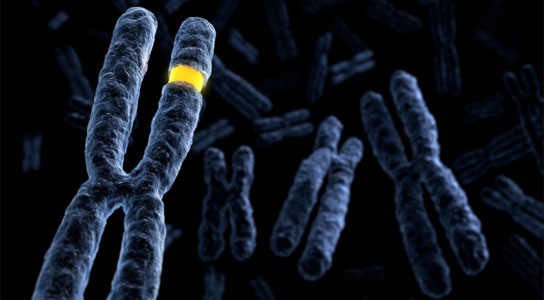
Geneticists at Harvard Medical School have discovered how a deletion in one gene from one parent, called a “hemizygous” deletion, can contribute to cancer, suggesting that cancer cells may grow more easily than researchers had hoped.
Chromosomal deletions in DNA often involve just one of two gene copies inherited from either parent. But scientists haven’t known how a deletion in one gene from one parent, called a “hemizygous” deletion, can contribute to cancer.
A research team led by Stephen Elledge, a professor in the Department of Genetics at Harvard Medical School, and his post-doctoral fellow Nicole Solimini, has now provided an answer. The most common hemizygous deletions in cancer, their research shows, involve a variety of tumor-suppressing genes called STOP genes (suppressors of tumorigenesis and proliferation) that scatter randomly throughout the genome, but sometimes cluster in the same place on a chromosome. And these clusters, said Elledge, who is also a professor of medicine at Brigham and Women’s Hospital, tend to be deleted as a group. “Eliminating the cluster gives a bigger bang for the deletion buck,” he said.
This finding is especially interesting in light of the two-hit model of cancer formation, which holds that both copies of a recessive gene need to be inactivated to trigger a biological effect. Thus the loss of a single tumor suppressor copy should have little or no influence on tumor cell proliferation because the remaining copy located on the other chromosome is there to pick up the slack.
Elledge’s research points to a different hypothesis, namely that STOP genes in a hemizygous deletion aren’t recessive but are instead haploinsufficient, meaning that they depend on two copies to function normally. “If a tumor suppressor is haploinsufficient, then a single gene copy lacks the potency needed to fully restrain tumorigenesis,” Elledge explained, who is also a Howard Hughes Medical Institute Investigator. “So by removing clusters of haploinsufficient genes all at once, the cancer cell immediately propels its growth forward without having to wait for the other copies to also be lost.”
Angelika Amon, a professor of biology at the Massachusetts of Technology, said she’s surprised by the findings. “We’ve known from a lot of human syndromes that haploinsufficiency is widespread in the development of complex multicellular organisms,” she said. “But these data show it’s also critical for individual cells and cell proliferation.”
The results also offer a different take on the two-hit model in carcinogenesis, Amon said. Being remarkably unstable, cancer cells can delete gene copies at every turn of the corner. If the loss of a single tumor suppressor copy provides no survival advantage for the tumor, then the tumor has no incentive to retain the cell with that deletion. But if the loss of that copy boosts proliferation, then the probability of a second hit later is greatly increased. “So haploinsufficiency is a way for the cancer cell to dramatically accelerate the acquisition of growth beneficial mutations,” Amon said.
In other words, all it takes is a 50 percent reduction in gene activity for a cancer cell to grow. “That tells us it’s a lot easier to get cancer than we might have hoped,” Amon said.
According to Elledge, the number of hemizygotic deletions averages roughly six per tumor, with some tumors—breast and pancreatic, for instance—averaging up to ten. Each deletion involves 25 to 40 genes, many of them STOP genes, but also a few GO genes (growth enhancers and oncogenes) that enhance proliferation. That the STOP genes substantially outnumber their GO counterparts is important, Elledge explained, because it means cancer cells can tilt scales toward proliferation without also compromising it at the same time.
“The data reveal a lot of haploinsufficient players that have small effects individually, but large effects in combination,” Elledge said. “Unfortunately, it’s not easy to see how to take advantage of that chemotherapeutically.”
What’s important about the results, he emphasized, is that they open up new views on how tumors evolve. Moreso, they underscore the importance of proliferation as a fundamental feature of tumor growth, he added.
The challenge now, Elledge said, will be to find out which of the genes in a recurring deletion are haploinsufficient. “At the moment, we estimate roughly 25 percent,” he said. “So these findings could also have important ramifications for other human diseases in addition to cancer.”
This work was supported by grants from the NCI/NHGRI funded Cancer Genome Atlas (TCGA) project, from the NIH (U54CA143798) to R.B. and by grants from the NIH, SU2C, and DOD.
Never miss a breakthrough: Join the SciTechDaily newsletter.
Follow us on Google and Google News.