
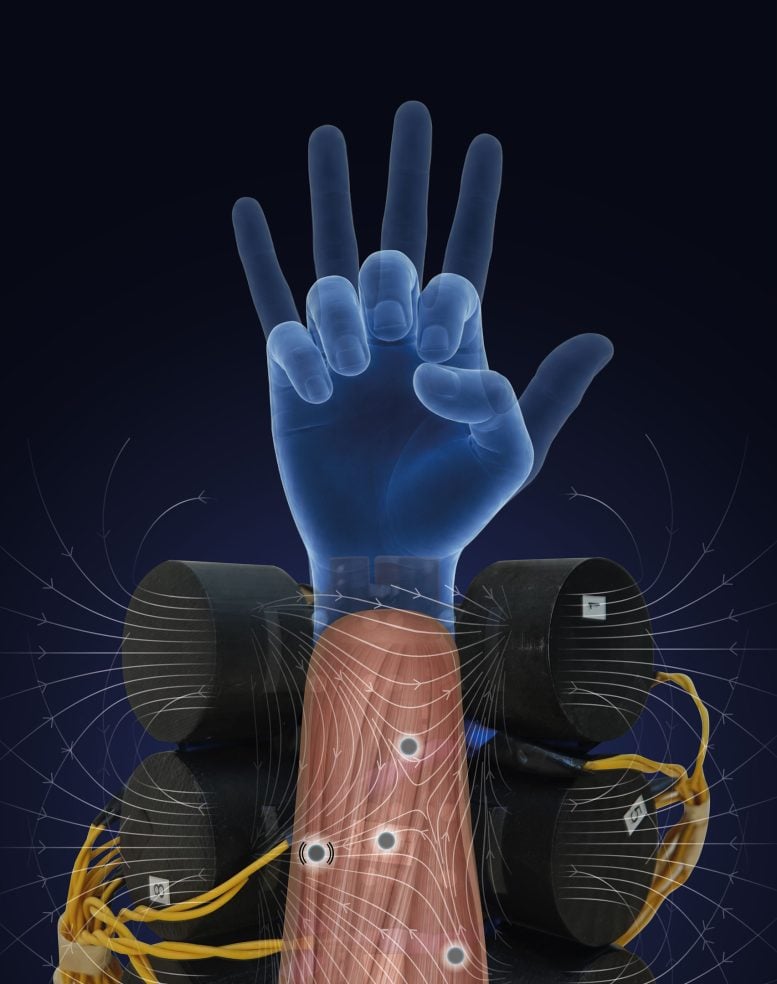
Tiny magnets implanted in muscles are helping a prosthetic hand feel like it is opening and closing naturally.
You can close your eyes, make a fist, or reach for an object without ever needing to look at your hand. That seemingly effortless ability depends on a hidden sense called kinesthesia, which tells the brain how muscles and limbs are moving. After an amputation, this vital stream of sensory information is disrupted, making even simple movements with a prosthetic hand more difficult and less intuitive.
Now, researchers led by the Sant’Anna School of Advanced Studies in Pisa, in collaboration with Cleveland Clinic, have uncovered new clues about how the brain interprets these movement signals. Their findings, published in Science Advances, suggest that the brain perceives finger movements as coordinated patterns rather than isolated actions. The discovery could help scientists develop prosthetic hands that not only move more naturally but also restore the feeling of movement itself.
The team compared data from the world’s only two neural-machine interfaces designed to restore this sense in upper limb prostheses. Despite their different designs, both produced sensations of coordinated finger movements, suggesting that the brain organizes incoming muscle signals into grasp patterns known as “synergies.”
Implanted Magnets Create Movement Sensations
Vibrating a muscle can make someone feel that a limb is moving. But applying vibration from outside the body also stimulates the skin, mixing sensory signals in ways that can complicate feedback from a prosthesis.
Sant’Anna’s myokinetic kinesthetic interface (MKkI) targets the muscles through small magnets implanted in the remaining forearm. The magnets generate vibrations within the muscles without directly stimulating the skin. Researchers connected this bidirectional interface to the Mia Hand, a robotic hand developed by Sant’Anna spin-off company Prensilia.
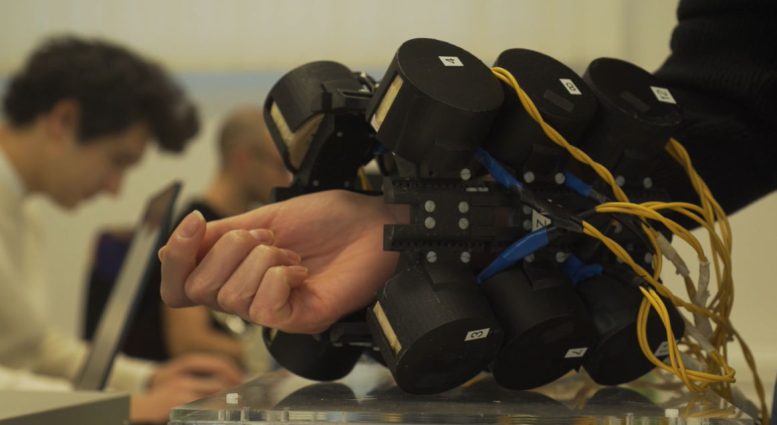
A 34-year-old Italian participant tested the system for six weeks. He experienced sensations of his hand opening and closing, with fingers appearing to move together in patterns closely resembling natural movement.
“The myokinetic kinesthetic interface is unique because it uses a simple, minimally invasive implant to stimulate muscles without touching the skin. This approach may be the key to better understanding how human motor control works but also how to restore movement sensation after amputation,” says Federico Masiero, Ph.D., the study’s first author. A former Ph.D. student at Sant’Anna, Masiero is now a postdoctoral researcher at the Munich Institute of Robotics and Machine Intelligence (MIRMI) of the Technical University of Munich (TUM).
Different Interfaces Reveal A Shared Pattern
The sensations reported in the Italian trial resembled those experienced by participants using a kinesthetic feedback system developed at Cleveland Clinic. That system combines surgical nerve redirection with robotics, whereas Sant’Anna’s approach uses implanted magnets. Both selectively vibrate deep muscles to generate movement sensations.
Across the two systems, users felt coordinated finger actions rather than isolated movements. Both teams also observed that some sensory information was processed without users immediately becoming consciously aware of it. The findings suggest that muscle feedback may be organized into coordinated movement patterns at a more subconscious level than previously understood.
“The ability to compare independently generated data from two very different interfaces makes these findings especially compelling,” says Professor Paul Marasco, Ph.D., who coordinated the study at Cleveland Clinic. “It gives us a stronger foundation for designing therapies and devices that work with the nervous system in a more natural way, with the ultimate goal of improving outcomes for patients.”
Understanding that organization could help researchers deliver feedback that better matches how the brain handles movement. Beyond prosthetics, the findings may eventually inform stroke rehabilitation, epilepsy, and pain treatment, although those applications remain possibilities for future research.
Combining Prosthetic Control With Sensation
The next challenge is to use the implanted magnets for control and sensation at the same time. Building on earlier research, the team plans to track the magnets’ positions to control the prosthesis while simultaneously applying vibrations to the same magnets to provide movement feedback.
The longer-term goal is a permanent implant that can be studied beyond the initial six-week trial. Together with the teams’ previous collaborative studies, this work lays a foundation for combining intuitive control with natural grasp sensations in a new generation of more human-like prosthetic hands.
“Our solution was implemented as a preliminary demonstrator: the implant was designed to last six weeks, a period we considered sufficient for an initial verification of the interface’s usefulness and effectiveness. The results were very promising and prompted us to explore a permanent implantable solution, which will allow us to study the interface over much longer periods and with a larger number of participants,” says Professor Christian Cipriani, who created the interface and coordinated the study.
Reference: “Coordinated hand movement sensation revealed through an implanted magnetic prosthetic kinesthetic interface” by Federico Masiero, Mattia Gentile, Marta Gherardini, Eliana La Frazia, Charles H. Moore, B. Ülgen Kilic, Valerio Ianniciello, Roberta Reho, Tommaso Mori, Flavia Paggetti, Lorenzo Andreani, Simon A. Whitton, Paul D. Marasco and Christian Cipriani, 24 June 2026, Science Advances.
DOI: 10.1126/sciadv.adx5046
The study, coordinated by The BioRobotics Institute of the Sant’Anna School of Advanced Studies in Pisa, in collaboration with the Pisa University Hospital (AOUP) and Cleveland Clinic, was supported by European, Italian, and U.S. funding. These include the ERC projects MYKI and MYTI, the Fit For Medical Robotics and PROPRIOUSS projects funded by the Italian Ministry of University and Research, and US data originally collected under awards from the NIH Office of the Director and DARPA. The first author of the study is a researcher at the Technical University of Munich, funded by a Marie Skłodowska-Curie Action fellowship.
Never miss a breakthrough: Join the SciTechDaily newsletter.
Follow us on Google and Google News.
1 Comment
That’s pretty cool, considering that one of my uncles lost the ability to know what his hand was doing without having lost the hand. He just had to watch his one hand more than the other in order to avoid having his fingers burned by a cigarette in that hand. There is a lot of variability in how nerves regenerate after accidents.