
Close Menu
    Facebook X (Twitter) Instagram
    SciTechDaily
    • Biology
    • Chemistry
    • Earth
    • Health
    • Physics
    • Science
    • Space
    • Technology
    Facebook X (Twitter) Pinterest YouTube RSS
    SciTechDaily
    Home»Technology»Prosthetic Retina Are Experimentally Able to Restore Sight in Mice
    Technology

    Prosthetic Retina Are Experimentally Able to Restore Sight in Mice

    By SciTechDailyAugust 14, 20121 Comment3 Mins Read
    Facebook Twitter Pinterest Telegram LinkedIn WhatsApp Email Reddit
    Share
    Facebook Twitter LinkedIn Pinterest Telegram Email Reddit
    retinal-prosthetic
    Prosthetic Retina

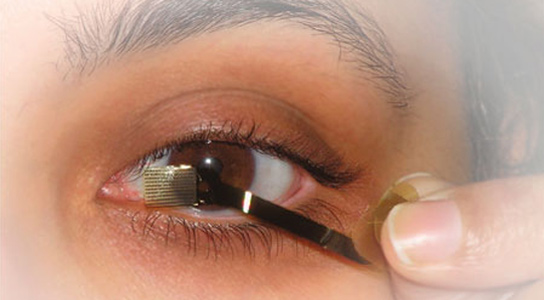
    Neuroscientists have been able to create a prosthetic retina that was able to partially restore sight to blind mice. The device could be eventually adapted to do the same in human patients. Twenty million people worldwide have become blind due to the degeneration of their retinas, which from the back of the eye converts light into a neural signal.

    Currently, there’s only one prosthetic approved for the treatment of this condition consisting of an array of surgically implanted electrodes that directly stimulate the optic nerve and therefore allowing patients to discern edges and letters. These enhanced patients cannot recognize faces or perform everyday tasks.
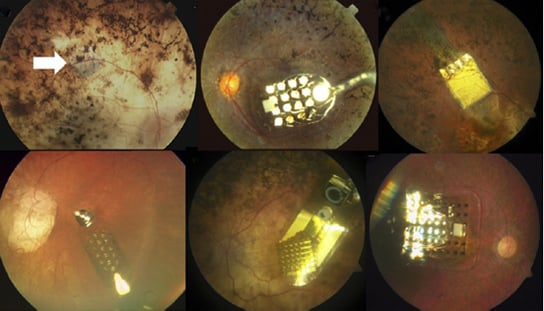
    implanted-retinal-prosthetic

    Sheila Nirenberg, a physiologist at the Weill Medical College at Cornell University in New York, hypothesized that the problem was down to coding. While the retina is as thin as a paper tissue, it contains several layers of nerves that encode light into neural signals. She thinks that once the code has been resolved, visual acuity might be restored.

    Nirenberg and her student, Chethan Pandarinath, have come up with a code and developed a device that was able to restore some sight in blind mice. They published their findings in the journal PNAS. They began the process by injecting nerve cells into the retinas of mice with a genetically engineered virus, which was designed to insert a gene that causes the cells to produce a light-sensitive protein normally found in algae. Once a beam of light was shown to the eye, this protein triggered the nerve cells to send signals to the brain, which is analogous to what a healthy rod and cone cell does.
    retinal-prosthetic-coding

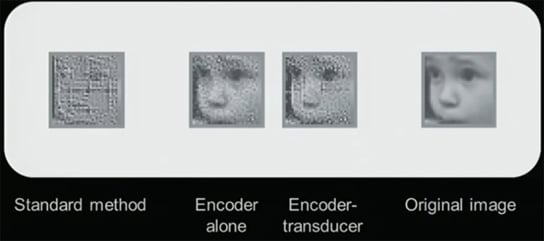
    Rather than feeding visual signals directly into the brain, they processed them using a code that the researchers had developed by watching how a healthy retina responds to stimuli. Once the mice had received the encoded input, the mice were able to track moving stripes, something that they couldn’t do before. Then, an ‘untranslate’ code was used to figure out what the brain was supposed to be seeing. This image was clearer and more recognizable than a previous, non-encoded image.

    This encoding had been debated among scientists working on these kinds of visual prostheses. Some think that the brain could adapt in time to an unprocessed signal. For now, it’s not possible to determine how effective this technique will be in human patients, but this will be revealed when the system is tested in human trials. The encoding is simple enough to be done by one microchip, which would be paired with a small camera mounted on a pair of glasses. The camera would record a signal, which would be then encoded and flashed into genetically treated nerve cells in the eyes.

    Reference: “Retinal prosthetic strategy with the capacity to restore normal vision” by Sheila Nirenberg and Chethan Pandarinath, 13 August 2012, Proceedings of the National Academy of Sciences.
    DOI: 10.1073/pnas.1207035109

    Never miss a breakthrough: Join the SciTechDaily newsletter.
    Follow us on Google and Google News.

    Neuroscience Physiology Popular Prosthetics Retina Sight Vision
    Share. Facebook Twitter Pinterest LinkedIn Email Reddit

    Related Articles

    Stunning Results: Revolutionary Retinal Chip Lets Patients With Severe Vision Loss Read Again

    Solar-Powered Eye Implant Restores Reading Vision

    Vision Scientists Discover New Angle on Path of Light Through Eye’s Photoreceptors

    New Retinal Implant Technology Expected to Help Restore Sight

    Engineers Develop a Telescopic Contact Lens

    DARPA’s CT2WS Program Improves Target Detection

    Scientists Restore Basic Elements of Vision in Live Mice

    Robot Outperforms Humans in Neuroscience Procedure

    PAPupuncture Offers Long-Lasting Pain Relief

    1 Comment

    1. Russell on August 14, 2012 8:49 am

      While a 16 x16 array may be good enough for farmer’s wife recognition , carving knife avoidance will require at least 64×64 photoreceptors.

      Reply
    Leave A Reply Cancel Reply

    • Facebook
    • Twitter
    • Pinterest
    • YouTube

    Don't Miss a Discovery

    Subscribe for the Latest in Science & Tech!

    Trending News

    The Universe Is Expanding Too Fast and Scientists Can’t Explain Why

    “Like Liquid Metal”: Scientists Create Strange Shape-Shifting Material

    Early Warning Signals of Esophageal Cancer May Be Hiding in Plain Sight

    Common Blood Pressure Drug Shows Surprising Power Against Deadly Antibiotic-Resistant Superbug

    Scientists Uncover Dangerous Connection Between Serotonin and Heart Valve Disease

    Scientists Discover a “Protector” Protein That Could Help Reverse Hair Loss

    Bone-Strengthening Discovery Could Reverse Osteoporosis

    Scientists Uncover Hidden Trigger Behind Stem Cell Aging

    Follow SciTechDaily
    • Facebook
    • Twitter
    • YouTube
    • Pinterest
    • Newsletter
    • RSS
    SciTech News
    • Biology News
    • Chemistry News
    • Earth News
    • Health News
    • Physics News
    • Science News
    • Space News
    • Technology News
    Recent Posts
    • Scientists Overcome Major Quantum Bottleneck, Potentially Transforming Teleportation and Computing
    • Quantum Physics’ Strangest Problem May Hold the Key to Time Itself
    • Scientists Create “Liquid Gears” That Spin Without Touching
    • The Simple Habit That Could Help Prevent Cancer
    • Forgotten Medicinal Plant Shows Promise in Fighting Dangerous Superbugs
    Copyright © 1998 - 2026 SciTechDaily. All Rights Reserved.
    • Science News
    • About
    • Contact
    • Editorial Board
    • Privacy Policy
    • Terms of Use

    Type above and press Enter to search. Press Esc to cancel.