
Molecular cages helped chemists remove one electron from terbium, making an unusual form easier to study for possible uses in quantum computing and advanced sensors.
Rare-earth metals are essential to modern technologies, from smartphones and high-performance magnets to advanced medical devices. Yet separating these valuable elements remains a major challenge because many share remarkably similar chemical properties. Terbium is particularly difficult to manipulate, as it strongly favors a stable electronic state that resists change.
Now, researchers led by the University of Iowa have found a way to overcome this barrier, trapping terbium inside specially designed molecular cages and stabilizing an unusual form of the metal under ordinary environmental conditions. The breakthrough could open new possibilities for rare-earth separation and technologies ranging from quantum computing to advanced sensors.
Terbium resists giving up an electron
Terbium usually favors the plus-3 oxidation state, as do the other lanthanides. Oxidation states track how many electrons an atom has formally lost or gained, and moving terbium from plus-3 to plus-4 requires removing one electron. The plus-3 state is terbium’s most stable and has been well documented, while its behavior in other states remains much less explored.
“You can compel it to give away or accept an electron,” explains Korey Carter, an assistant professor in the University of Iowa’s Department of Chemistry, “but it’s generally energetically unfavorable.”
Isolating terbium without an air-free lab
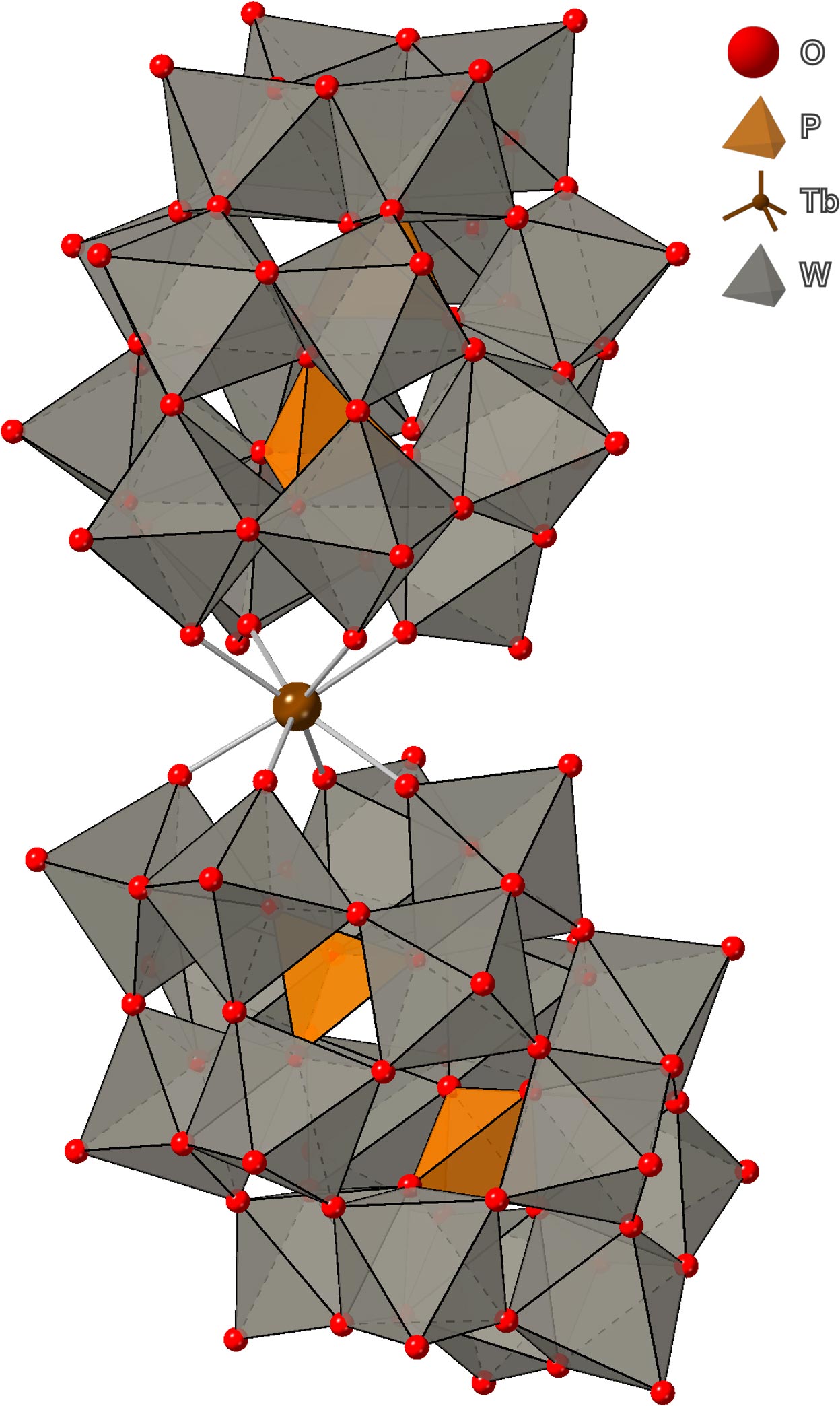
Carter led the study with Pere Miro, an associate professor in the same department. Their team built a molecular assembly of tungsten and oxygen called a polyoxometalate and added binding agents known as ligands. The resulting cage-like structures held terbium in place while the researchers changed its chemistry.
With a terbium atom sandwiched in these cages, the chemists added potassium persulfate, a chemical oxidant. The reaction removed an electron from terbium, changing its charge and shifting it into the plus-4 oxidation state. The team isolated this unusual form and described it in detail.
“One of the challenges with lanthanides is they prefer to be in the same oxidation state, and it’s tricky to change that state and thus separate one from another without it being performed in a tightly controlled environment, such as a lab,” says Carter, the study’s co-corresponding author. “But we devised a method to isolate, or separate terbium, by changing its oxidation state in an environment that doesn’t require specialized lab controls.”
Previous researchers had produced terbium in the plus-4 state in rigorous air-free environments, according to Carter. The Iowa team worked under ambient conditions, without special controls for temperature, humidity, or pressure.
“If you were in your house and you were setting up a chemistry experiment, it would be analogous to what we were doing in the lab,” he says.
From display screens toward quantum sensors
The silvery-gray metal is mined primarily in China, though it is also found in the United States and a few other countries. It already supports a broad range of technologies. Terbium is central to the green phosphors that produce light in televisions, fluorescent lamps, and LED displays, and it plays a key role in solid-state devices and fuel cells. It has also improved the safety of medical X-rays by allowing the same image quality to be achieved with much shorter exposure times.
The new method provides a proof of concept for potentially easier, less expensive separation of terbium, with possible lessons for separating other lanthanides. Making these less familiar chemical states more accessible could also help researchers investigate properties relevant to quantum technologies, which use the unusual behavior of atoms and smaller constituents. Potential applications include computing and advanced sensors for navigation, medical imaging, and other fields.
Carter’s group now wants to apply what it learned from terbium to actinides, a group of highly radioactive elements. Members of this group are used in cancer-fighting treatments, to power cardiac pacemakers implanted in the body, and in smoke detectors.
“Our findings highlight the ability to do transformative research at the University of Iowa, and they provide a platform to extend the chemistry to the actinide series in UI Radiochemistry laboratories,” Carter says.
Reference: “Structural and spectroscopic characterization of a Tb(IV) polyoxometalate” by Primadi J. Subintoro, Brett Lottes, Felipe A. Pereiro, Nolwenn Mahieu, Alexander M. Brown, S. Genevieve Duggan, Monica S. Mullis, Aldo M. Jordan, Cassandra Gates, Samuel M. Greer, Joshua J. Woods, Rebecca J. Abergel, Jenifer C. Shafer, Daniel K. Unruh, Pere Miró, Benjamin W. Stein, Jennifer N. Wacker, Stosh A. Kozimor and Korey P. Carter, 16 July 2026, Nature Communications.
DOI: 10.1038/s41467-026-75657-7
The research was funded by the U.S. Department of Energy.
Never miss a breakthrough: Join the SciTechDaily newsletter.
Follow us on Google and Google News.