
Close Menu
    Facebook X (Twitter) Instagram
    SciTechDaily
    • Biology
    • Chemistry
    • Earth
    • Health
    • Physics
    • Science
    • Space
    • Technology
    Facebook X (Twitter) Pinterest YouTube RSS
    SciTechDaily
    Home»Chemistry»Exotic “Blinking” Crystals May Convert CO2 Into Fuels, Power Quantum Computers
    Chemistry

    Exotic “Blinking” Crystals May Convert CO2 Into Fuels, Power Quantum Computers

    By Rutgers UniversityJuly 22, 2020No Comments3 Mins Read
    Facebook Twitter Pinterest Telegram LinkedIn WhatsApp Email Reddit
    Share
    Facebook Twitter LinkedIn Pinterest Telegram Email Reddit
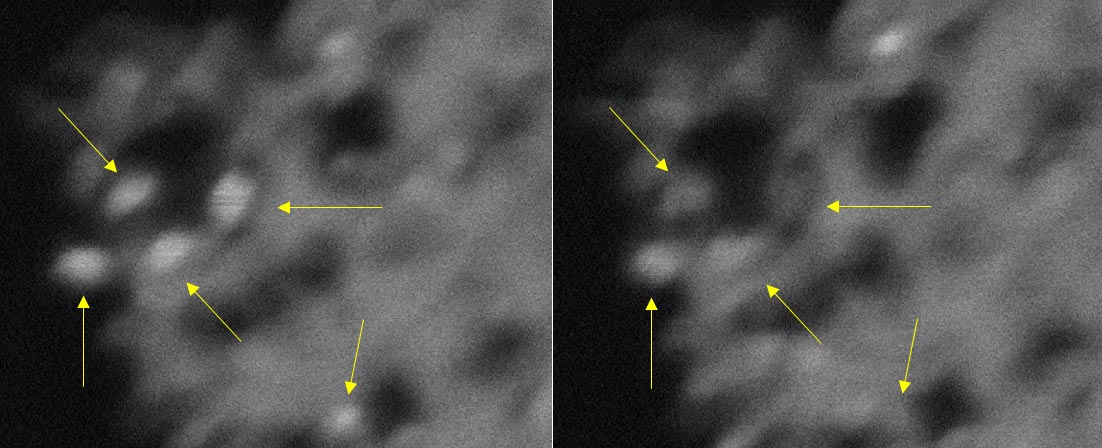
    Titanium Dioxide Nanocrystals Blinking
    The arrows point to titanium dioxide nanocrystals lighting up and blinking (left) and then fading (right). Credit: Tewodros Asefa and Eliska Mikmekova

    Unusual nanoparticles could benefit the quest to build a quantum computer.

    Imagine tiny crystals that “blink” like fireflies and can convert carbon dioxide, a key cause of climate change, into fuels.

    A Rutgers-led team has created ultra-small titanium dioxide crystals that exhibit unusual “blinking” behavior and may help to produce methane and other fuels, according to a study in the journal Angewandte Chemie. The crystals, also known as nanoparticles, stay charged for a long time and could benefit efforts to develop quantum computers.

    “Our findings are quite important and intriguing in a number of ways, and more research is needed to understand how these exotic crystals work and to fulfill their potential,” said senior author Tewodros (Teddy) Asefa, a professor in the Department of Chemistry and Chemical Biology in the School of Arts and Sciences at Rutgers University–New Brunswick. He’s also a professor in the Department of Chemical and Biochemical Engineering in the School of Engineering.

    More than 10 million metric tons of titanium dioxide are produced annually, making it one of the most widely used materials, the study notes. It is used in sunscreens, paints, cosmetics, and varnishes, for example. It’s also used in the paper and pulp, plastic, fiber, rubber, food, glass, and ceramic industries.

    The team of scientists and engineers discovered a new way to make extremely small titanium dioxide crystals. While it’s still unclear why the engineered crystals blink and research is ongoing, the “blinking” is believed to arise from single electrons trapped on titanium dioxide nanoparticles. At room temperature, electrons – surprisingly – stay trapped on nanoparticles for tens of seconds before escaping and then become trapped again and again in a continuous cycle.

    The crystals, which blink when exposed to a beam of electrons, could be useful for environmental cleanups, sensors, electronic devices, and solar cells, and the research team will further explore their capabilities.

    Reference: “A Blinking Mesoporous TiO2−x Composed of Nanosized Anatase with Unusually Long-Lived Trapped Charge Carriers” by Dr. Tao Zhang, Dr. Jingxiang Low, Prof. Jiaguo Yu, Dr. Alexei M. Tyryshkin, Dr. Eliška Mikmeková and Prof. Tewodros Asefa, 22 May 2020, Angewandte Chemie.
    DOI: 10.1002/anie.202005143

    The lead author is Tao Zhang, a Rutgers doctoral student. Co-authors include Alexei M. Tyryshkin, a Rutgers staff scientist, and researchers at Wuhan University of Technology and Czech Academy of Sciences. The research was funded by the U.S. National Science Foundation.

    Never miss a breakthrough: Join the SciTechDaily newsletter.
    Follow us on Google and Google News.

    Materials Science Nanotechnology Popular Quantum Computing Rutgers University
    Share. Facebook Twitter Pinterest LinkedIn Email Reddit

    Related Articles

    Polymer-Eating Enzymes Make “Biodegradable” Plastics Truly Compostable

    Gearing Up Nanoscale Machines: Molecular-Scale Gear Trains for Transmitting Rotational Force

    What Happens Between the Sheets? Extremely-Promising Superconductor Surprises Everyone

    Elusive New Liquid Phase Found by Scientists After a Century of Searching

    Fast, Colorful 3D Printing by Mimicking Chameleons at the Nanoscale

    New Way to Split and Sum Photons With Silicon Is Breakthrough for Quantum Computing, Solar Energy

    New Technology Can Instantly Identify Airborne Chemicals – Down to Parts-Per-Billion

    Unique Particles – With Stickiness of Gecko Feet – Formed by Harnessing Chaos

    Powerful New Electronics Could Be Created at the Edge of Chaos

    Leave A Reply Cancel Reply

    • Facebook
    • Twitter
    • Pinterest
    • YouTube

    Don't Miss a Discovery

    Subscribe for the Latest in Science & Tech!

    Trending News

    Scientists May Have Found the Key to Jupiter and Saturn’s Moon Mystery

    Scientists Uncover Brain Changes That Link Pain to Depression

    Saunas May Do More Than Raise Body Temperature – They Activate Your Immune System

    Exercise in a Pill? Metformin Shows Surprising Effects in Cancer Patients

    Hidden Oceans of Magma Could Be Protecting Alien Life

    New Study Challenges Alzheimer’s Theories: It’s Not Just About Plaques

    Artificial Sweeteners May Harm Future Generations, Study Suggests

    Splashdown! NASA Artemis II Returns From Record-Breaking Moon Mission

    Follow SciTechDaily
    • Facebook
    • Twitter
    • YouTube
    • Pinterest
    • Newsletter
    • RSS
    SciTech News
    • Biology News
    • Chemistry News
    • Earth News
    • Health News
    • Physics News
    • Science News
    • Space News
    • Technology News
    Recent Posts
    • This Small Change to Your Exercise Routine Could Be the Secret to Living Longer
    • Physicists Discover a Strange New Kind of One-Dimensional Particle
    • Scientists Discover Unexpected Climate Benefit Hidden in Forest Soils
    • The Grand Canyon’s “Swiss Cheese” Rocks Hold a Critical Secret
    • Scientists Discover 430,000-Year-Old Wooden Tools, Rewriting Human History
    Copyright © 1998 - 2026 SciTechDaily. All Rights Reserved.
    • Science News
    • About
    • Contact
    • Editorial Board
    • Privacy Policy
    • Terms of Use

    Type above and press Enter to search. Press Esc to cancel.