
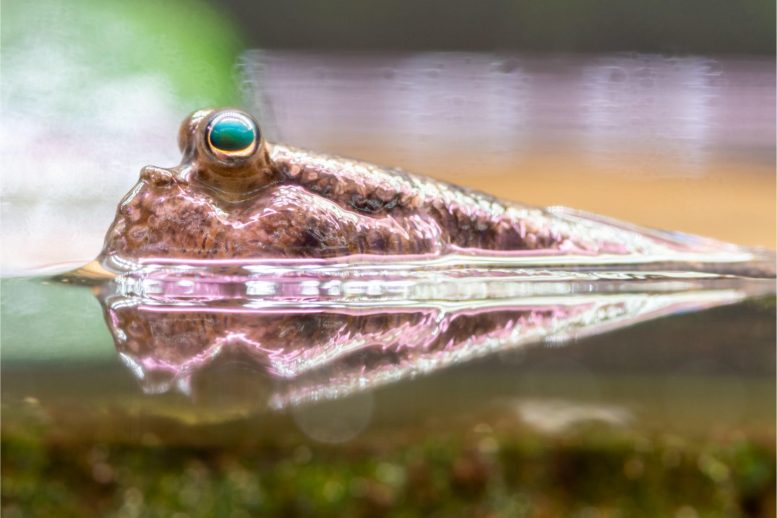
Researchers investigated blinking in mudskippers to uncover how this essential behavior evolved for life on land.
Blinking is vital for the eye’s health and function. It serves multiple purposes such as keeping the eyes clean, safeguarding them, and even conveying nonverbal cues. However, the origin of blinking is still a mystery. To shed light on this subject, a team of researchers from the Georgia Institute of Technology, Seton Hill University, and Pennsylvania State University conducted a study on the mudskipper, a unique amphibious fish that primarily lives on land. The study aimed to understand why blinking is a fundamental behavior for life on land.
Despite being only distantly related to tetrapods, a group that encompasses humans and other four-legged vertebrates, researchers believed studying the fish could unlock how blinking evolved as these animals began to move on land.
The research team, which included several undergraduates, published their findings in the Proceedings of the National Academies of Science.
“By comparing the anatomy and behavior of mudskippers to the fossil record of early tetrapods, we argue that blinking emerged in both groups as an adaptation to life on land,” said Tom Stewart, an assistant professor at Penn State and an author of the paper. “These results help us understand our own biology and raise a whole set of new questions about the variety of blinking behaviors we see in living species.”
Breaking Down Blinking
Mudskippers blink by sucking their eye downward into their eye socket. The evolution of this behavior did not require the evolution of a lot of new parts such as new muscles or special glands, though. Instead, mudskippers use their existing set of eye muscles in a new way.
“This is a very exciting result because it demonstrates that the evolution of a new, complex behavior can be achieved using a relatively rudimentary set of structures,” said Brett Aiello, a former postdoctoral fellow in the Agile Systems Lab and now an assistant professor at Seton Hill.
Next, the research team set out to determine why mudskippers blink. In a series of experiments, they found that mudskippers blink for three main functions: to wet, clean, and protect the eye. These functions are also why humans and other land-dwelling vertebrates blink.
“We find that a single behavior can be deployed to accomplish three complex, distinct functions,” said Aiello. “These results not only help humans understand our own history, but also help us reevaluate the adaptations necessary for major transitions in the evolutionary history of vertebrates, like moving from water to land.”
Blinking isn’t just a unique research question, but also an important mechanism to understand, according to Saad Bhamla, an assistant professor in Georgia Tech’s School of Chemical and Biomolecular Engineering and author on the paper.
“We all blink without thinking, and understanding why we blink is just such a beautiful puzzle right in front of our eyes,” Bhamla said. “Through our research on mudskippers and by conducting biophysical and morphological analyses, we expose how blinking serves a multitude of functions for adapting to life out of water.”
Engaging Undergraduates
To explore such open-ended questions, the researchers engaged the Vertically Integrated Projects (VIP) program, which allows undergraduates to conduct long-term, large-scale research projects as part of their coursework at Georgia Tech.
“The structure of the VIP course empowers students to really lean on their own creativity and drive the project in the directions that are most exciting to them,” said Aiello. “It helps our students gain the ability to solve unknown problems on the ground as they arise — a lot of people become scientists to push research somewhere where nobody else has tried to go before.”
The VIP structure is inherently multidisciplinary. While Aiello is a biologist, most students were engineers and brought their respective expertise. Manognya Sripathi was a biomedical engineering major with a minor in computer science and offered her unique experience to the mudskipper problem.
“I used my computer science skills to gather raw data and analyze and plot them using programs like MATLAB or Python,” Sripathi said. “I also used engineering skills to help build the experimental equipment, allowing us to apply engineering methods to study a biological problem in a unique way.”
Moving Beyond Mudskippers
The research didn’t just expand knowledge of mudskippers — it also contributed to each student’s future aspirations. For example, Kendra Washington’s trajectory was influenced by the two semesters she spent in the lab.
“VIP drew me closer to the programming and device areas of my biomedical engineering major and solidified why I picked up a computer science minor,” she said. “I continued to pursue that fusion through later internships and research, and now work with hemodynamic monitoring. But in a sense, I still help characterize physiology through programming.”
VIP also expanded the students’ knowledge and scientific experience which has propelled them far beyond the lab. Hajime Minoguchi, a biomedical engineering graduate, now works as a systems integration research and development engineer thanks to his experience in the class.
“Working in an interdisciplinary team like this has allowed me to learn how to understand and communicate ideas between disciplines, which allowed me to be a more well-rounded engineer,” Minoguchi said. “My work requires a thorough understanding of biology, electrical circuitry, software, firmware, mechanical interactions, and physics. This VIP experience was instrumental for me in being successful at my current job.”
The research is far greater than the sum of its parts and brings a greater understanding of evolution, noted Simon Sponberg, an associate professor in the School of Physics and the School of Biological Sciences.
“Blinking is a reflection of a bigger question,” Sponberg said. “How did major evolutionary transitions occur that enabled organisms to inhabit basically every environment on this planet? What we learned is you don’t need the evolution of a lot of specialized musculature or glands; evolution can tinker with the structures that are already there, allowing them to be used in a new way and for a new behavior.”
Reference: “The origin of blinking in both mudskippers and tetrapods is linked to life on land” by Brett R. Aiello, M. Saad Bhamla, Jeff Gau, John G. L. Morris, Kenji Bomar, Shashwati da Cunha, Harrison Fu, Julia Laws, Hajime Minoguchi, Manognya Sripathi, Kendra Washington, Gabriella Wong, Neil H. Shubin, Simon Sponberg and Thomas A. Stewart, 24 April 2023, Proceedings of the National Academy of Sciences.
DOI: 10.1073/pnas.2220404120
Never miss a breakthrough: Join the SciTechDaily newsletter.
Follow us on Google and Google News.