
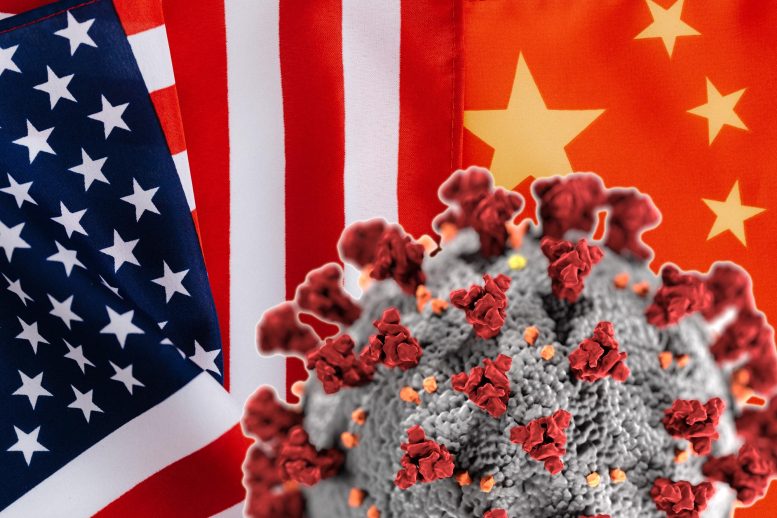
American and Chinese Scientists Leading Efforts on COVID-19
Despite the political tensions between the United States and China, scientists in the two countries are working together more than ever to study the COVID-19 virus, a new study suggests.
Researchers analyzed the scientific papers that researchers around the world produced on coronaviruses before and after the arrival of COVID-19. They found that the United States and China were world leaders in the topic area before COVID-19 and they remain so now.
“The collaborations between U.S. and Chinese scientists have intensified to the exclusion of most other countries, except the U.K.” said Caroline Wagner, co-author of the study and associate professor in the John Glenn College of Public Affairs at The Ohio State University.
“There may be friction between the U.S. and China on the political level, but at the scientific level we see something different — a lot of collaboration.”
The study was published on July 21, 2020, in PLOS ONE.
Wagner and her colleagues analyzed a database of scientific articles on coronavirus-related research between Jan. 1, 2018, and Jan. 1, 2020. They compared that with a similar database of research from January 1 to April 23, 2020.
They examined the country where the authors of each study were based to see if there were differences in the pre- and post-COVID-19 periods.
One key finding was how quickly China ramped up its coronavirus research after COVID-19 was first identified in Wuhan, China, late in 2019, Wagner said.
“Chinese researchers produced more scientific articles on coronavirus in the first four months of 2020 — more than 1,600 articles — than in the previous 24 months combined,” she said.
Chinese papers on coronavirus tended to be published in higher-impact journals after the crisis than before — one indication of better-quality research.
The study also found that China has become the world leader in funding coronavirus research since COVID-19 was discovered. Before COVID-19, the U.S. National Institutes of Health was the leading funder of coronavirus-related research. But since then, Chinese governmental agencies are more likely than the NIH to be acknowledged as the funding source in published studies.
Even before COVID-19, China and the United States were at the center of the global network of coronavirus research, although scientists from many countries also participated, findings showed. But research on coronaviruses today is driven by smaller teams with researchers from fewer countries. Scientists from China, the United States, and the U.K. dominate international teams.
“The network has shifted. With the urgency of the crisis, it makes sense that researchers are looking for smaller teams that can speed up the research process,” Wagner said.
In separate research published in December, Wagner and colleagues found that a growing number of Chinese scientists working in the United States were returning to their homeland. That has probably influenced coronavirus research, according to Wagner.
“Now, many of those Chinese scientists who went back home may be working with their former colleagues in the United States on coronavirus studies, among many other topics,” she said.
While the close connections between U.S. and Chinese scientists may be good for speeding up research, it comes with a cost.
“There is a vulnerability for scientists in other countries who are no longer part of these research networks,” she said. “It is good to have researchers from all over the world working on a crisis like this.”
Reference: “Consolidation in a crisis: Patterns of international collaboration in early COVID-19 research” by Caroline V. Fry, Xiaojing Cai, Yi Zhang and Caroline S. Wagner, 21 July 2020, PLOS ONE.
DOI: 10.1371/journal.pone.0236307
Co-authors on the study were Caroline Fry of the Massachusetts Institute of Technology; Yi Zhang of the University of Technology Sydney in Australia; and Xiaojing Cai, a visiting fellow at Ohio State from Zhejiang University in China.
Never miss a breakthrough: Join the SciTechDaily newsletter.
Follow us on Google and Google News.