
Close Menu
    Facebook X (Twitter) Instagram
    SciTechDaily
    • Biology
    • Chemistry
    • Earth
    • Health
    • Physics
    • Science
    • Space
    • Technology
    Facebook X (Twitter) Pinterest YouTube RSS
    SciTechDaily
    Home»Chemistry»A Game-Changing Discovery: Scientists Invent Unique Method To Create Better Molecule-Based Magnets
    Chemistry

    A Game-Changing Discovery: Scientists Invent Unique Method To Create Better Molecule-Based Magnets

    By University of OttawaSeptember 8, 20231 Comment3 Mins Read
    Facebook Twitter Pinterest Telegram LinkedIn WhatsApp Email Reddit
    Share
    Facebook Twitter LinkedIn Pinterest Telegram Email Reddit
    Magnet With Balls
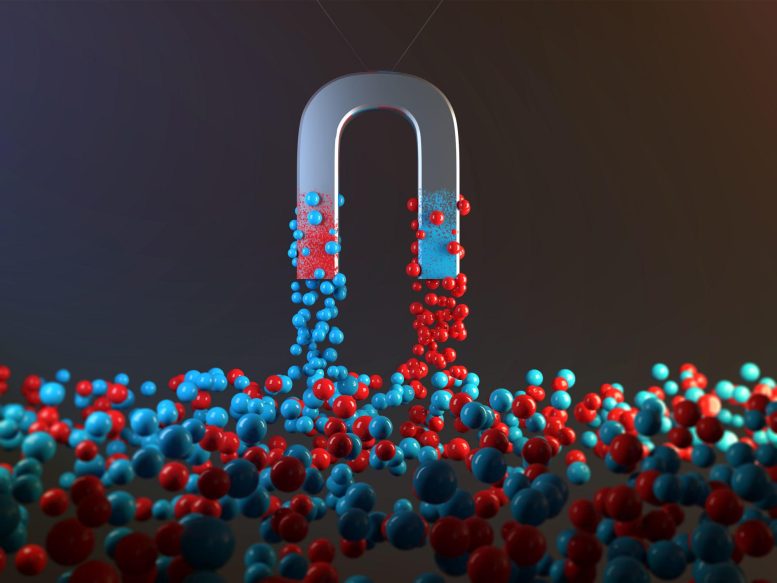
    Scientists have developed a new method for producing improved single-molecule magnets (SMMs) using a two-coordinate lanthanide complex. This advancement holds potential for high-density storage, quantum computing, and miniaturized memory devices.

    Researchers from the University of Ottawa have developed an innovative technique to create better molecule-based magnets, known as single-molecule magnets (SMMs).

    Scientists from the University of Ottawa have invented a unique method to create better molecule-based magnets, known as single-molecule magnets (SMMs). This synthetic tour de force has resulted in a two-coordinate lanthanide complex which has magnet-like properties that are intrinsic to the molecule itself. This advancement paves the way for high-capacity hard drives, potential applications in quantum computing, and the development of faster, more compact memory devices.

    Muralee Murugesu
    “Our discovery is a guide for making new, molecule-based materials for molecular electronics”. Muralee Murugesu — Full professor at uOttawa’s Faculty of Science. Credit: University of Ottawa

    Lanthanide ions like to surround themselves with many organic ligands to stabilize and fill their coordination sphere. But thanks to a novel ligand design and synthetic approach, uOttawa scientists have managed to not only isolate the rare and precious two-coordinate species but also to reveal, for the first time ever, a huge energy level separation, just as theory had predicted. This complex is a synthetic achievement that shows the incredible potential of these molecules.

    The research took place at the Department of Chemistry and Biomolecular Sciences at the University of Ottawa and was led by Muralee Murugesu, a full professor at the Faculty of Science, in collaboration with Professor Akseli Mansikkamäki from the University of Oulu, Finland, and with uOttawa post-doctoral fellows Diogo A. Gálico and Alexandros A. Kitos, as well as doctoral students Dylan Errulat and Katie L. M. Harriman.

    “We have shown very exciting results that confirm for the first time what theory had predicted before and also offer a synthetic way to make better molecular magnets. These magnets are very useful for making smaller and faster memory devices and quantum computers because they have nanoscale sizes and special quantum features, such as quantum tunneling of the magnetization or quantum coherence,” said Professor Murugesu.

    A Game-Changing Discovery

    “We used our CFI-funded equipment to measure the magnetic and luminescent properties of our complexes at very low temperatures, below 10 Kelvin. These measurements showed us the intricate electronic structure of our complexes. We also confirmed our findings with computational studies in collaboration with Professor Mansikkamäki at the University of Oulu, Finland,” adds Professor Murugesu.

    Since 2007, the Murugesu Group at the University of Ottawa has been working on single-molecule magnets (SMMs) that can store and process information at the molecular level. This highly anticipated material promises to save energy and space to make electronics faster and better, which could change the way data is stored and usher in a new era of molecular electronics.

    Reference: “A trivalent 4f complex with two bis-silylamide ligands displaying slow magnetic relaxation” by Dylan Errulat, Katie L. M. Harriman, Diogo A. Gálico, Alexandros A. Kitos, Akseli Mansikkamäki and Muralee Murugesu, 25 May 2023, Nature Chemistry.
    DOI: 10.1038/s41557-023-01208-y

    Never miss a breakthrough: Join the SciTechDaily newsletter.
    Follow us on Google and Google News.

    Materials Science Quantum Computing
    Share. Facebook Twitter Pinterest LinkedIn Email Reddit

    Related Articles

    Exotic “Blinking” Crystals May Convert CO2 Into Fuels, Power Quantum Computers

    New Way to Split and Sum Photons With Silicon Is Breakthrough for Quantum Computing, Solar Energy

    Engineers Show Feasibility of Organic Topological Insulators

    “Molecular Levers” Accelerate Reactions

    Samarium Hexoboride Behaves Like a Topological Insulator

    Forming the Smallest Ice Crystals in the World

    Computer Model Helps Remove Greenhouse Gases From Power Plants

    Scientists Examine Platinum-Based Catalyst Design

    Using X-Ray Imaging to Help Improve Lithium-Sulfur Battery Technology

    1 Comment

    1. Karen Hocking on September 10, 2023 3:53 pm

      That’s so incredible, I can’t even wrap my mind round it! 😅🤣

      Reply
    Leave A Reply Cancel Reply

    • Facebook
    • Twitter
    • Pinterest
    • YouTube

    Don't Miss a Discovery

    Subscribe for the Latest in Science & Tech!

    Trending News

    Largest-Ever Study Finds Medicinal Cannabis Ineffective for Anxiety, Depression, PTSD

    250-Million-Year-Old Egg Solves One of Evolution’s Biggest Mysteries

    Living With Roommates Might Be Changing Your Gut Microbiome Without You Knowing

    Century-Old Cleaning Chemical Linked to 500% Increased Risk of Parkinson’s Disease

    What if Your Memories Never Happened? Physicists Take a New Look at the Boltzmann Brain Paradox

    One of the Universe’s Largest Stars May Be Getting Ready To Explode

    Scientists Discover Enzyme That Could Supercharge Ozempic-Like Weight Loss Drugs

    Popular Sweetener Linked to DNA Damage – “It’s Something You Should Not Be Eating”

    Follow SciTechDaily
    • Facebook
    • Twitter
    • YouTube
    • Pinterest
    • Newsletter
    • RSS
    SciTech News
    • Biology News
    • Chemistry News
    • Earth News
    • Health News
    • Physics News
    • Science News
    • Space News
    • Technology News
    Recent Posts
    • Want Less Stress? Landmark Study Points to a Simple Habit
    • Scientists Reveal Eating Fruits and Vegetables May Increase Your Risk of Lung Cancer
    • AI Reveals Explosive Growth of Floating Algae Across the World’s Oceans
    • 5.5 Million Bees Discovered Living Beneath a New York Cemetery
    • Scientists Reverse Brain Aging With Simple Nasal Spray
    Copyright © 1998 - 2026 SciTechDaily. All Rights Reserved.
    • Science News
    • About
    • Contact
    • Editorial Board
    • Privacy Policy
    • Terms of Use

    Type above and press Enter to search. Press Esc to cancel.