
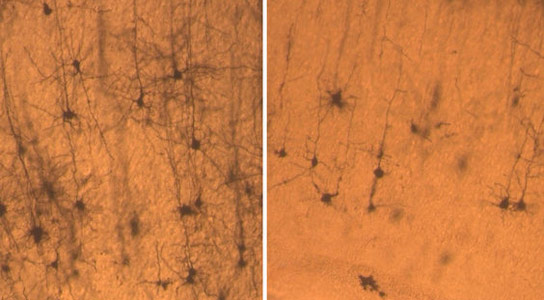
In a newly published study, researchers show how Down syndrome and low SNX27 are connected, discovering that the extra chromosome inherited in Down syndrome impairs learning and memory because it leads to low levels of SNX27 protein in the brain.
What is it about the extra chromosome inherited in Down syndrome—chromosome 21—that alters brain and body development? Researchers have new evidence that points to a protein called sorting nexin 27, or SNX27. SNX27 production is inhibited by a molecule encoded on chromosome 21. The study, published March 24 in Nature Medicine, shows that SNX27 is reduced in human Down syndrome brains. The extra copy of chromosome 21 means a person with Down syndrome produces less SNX27 protein, which in turn disrupts brain function. What’s more, the researchers showed that restoring SNX27 in Down syndrome mice improves cognitive function and behavior.
“In the brain, SNX27 keeps certain receptors on the cell surface—receptors that are necessary for neurons to fire properly,” said Huaxi Xu, Ph.D., Sanford-Burnham professor and senior author of the study. “So, in Down syndrome, we believe lack of SNX27 is at least partly to blame for developmental and cognitive defects.”
SNX27’s role in brain function
Xu and colleagues started out working with mice that lack one copy of the snx27 gene. They noticed that the mice were mostly normal, but showed some significant defects in learning and memory. So the team dug deeper to determine why SNX27 would have that effect. They found that SNX27 helps keep glutamate receptors on the cell surface in neurons. Neurons need glutamate receptors in order to function correctly. With less SNX27, these mice had fewer active glutamate receptors and thus impaired learning and memory.
SNX27 levels are low in Down syndrome
Then the team got thinking about Down syndrome. The SNX27-deficient mice shared some characteristics with Down syndrome, so they took a look at human brains with the condition. This confirmed the clinical significance of their laboratory findings—humans with Down syndrome have significantly lower levels of SNX27.
Next, Xu and colleagues wondered how Down syndrome and low SNX27 are connected—could the extra chromosome 21 encode something that affects SNX27 levels? They suspected microRNAs, small pieces of genetic material that don’t code for protein, but instead influence the production of other genes. It turns out that chromosome 21 encodes one particular microRNA called miR-155. In human Down syndrome brains, the increase in miR-155 levels correlates almost perfectly with the decrease in SNX27.
Xu and his team concluded that, due to the extra chromosome 21 copy, the brains of people with Down syndrome produce extra miR-155, which by indirect means decreases SNX27 levels, in turn decreasing surface glutamate receptors. Through this mechanism, learning, memory, and behavior are impaired.
Restoring SNX27 function rescues Down syndrome mice
If people with Down syndrome simply have too much miR-155 or not enough SNX27, could that be fixed? The team explored this possibility. They used a noninfectious virus as a delivery vehicle to introduce new human SNX27 in the brains of Down syndrome mice.
“Everything goes back to normal after SNX27 treatment. It’s amazing—first we see the glutamate receptors come back, then memory deficit is repaired in our Down syndrome mice,” said Xin Wang, a graduate student in Xu’s lab and first author of the study. “Gene therapy of this sort hasn’t really panned out in humans, however. So we’re now screening small molecules to look for some that might increase SNX27 production or function in the brain.”
Reference: “Loss of sorting nexin 27 contributes to excitatory synaptic dysfunction by modulating glutamate receptor recycling in Down’s syndrome” by Xin Wang, Yingjun Zhao, Xiaofei Zhang, Hedieh Badie, Ying Zhou, Yangling Mu, Li Shen Loo, Lei Cai, Robert C Thompson, Bo Yang, Yaomin Chen, Peter F Johnson, Chengbiao Wu, Guojun Bu, William C Mobley, Dongxian Zhang, Fred H Gage, Barbara Ranscht, Yun-wu Zhang, Stuart A Lipton, Wanjin Hong and Huaxi Xu, 24 March 2013, Nature Medicine.
DOI: 10.1038/nm.3117
Never miss a breakthrough: Join the SciTechDaily newsletter.
Follow us on Google and Google News.