
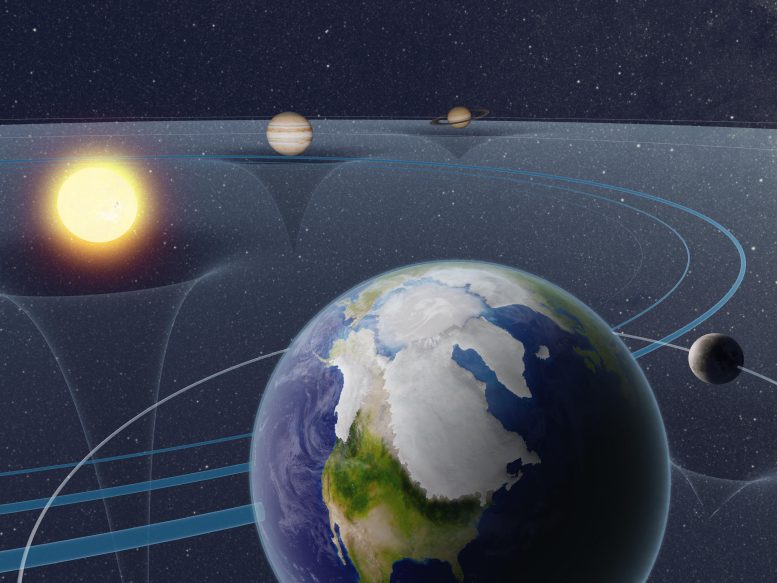
Using advanced climate models, researchers recreated early Pleistocene glacial cycles, uncovering how astronomical forces like spin axis orientation and the position of the summer solstice influenced Earth’s climate.
A team of researchers, including climatologists and an astronomer, has utilized an enhanced computer model to recreate the ice age cycles that occurred between 1.6 and 1.2 million years ago. The findings indicate that the glacial periods were primarily influenced by astronomical forces in quite a different way than it works in the present day. This information will contribute to a more comprehensive understanding of ice sheets and the Earth’s climate throughout the past, present, and future.
The slow, gradual changes in the Earth’s orbit around the Sun and the orientation of its spin axis are influenced by the gravitational forces exerted by the Sun, Moon, and other planets. These astronomical factors impact Earth’s environment by altering the distribution of sunlight and the distinctions between seasons. Ice sheets, in particular, are highly responsive to these external forces, leading to cycles of glacial and interglacial periods.
The present-day glacial-interglacial cycle has a period of about 100,000 years. However, the glacial cycle in the early Pleistocene (about 800,000 years ago) switched more rapidly, with a cycle of about 40,000 years. It has been believed that astronomical external forces are responsible for this change, but the details of the mechanism have not been understood. In recent years, it has become possible to investigate in more detail the role of astronomical forces through the refinement of geological data and the development of theoretical research.
A team led by Yasuto Watanabe at the University of Tokyo focused on the early Pleistocene Epoch from 1.6 to 1.2 million years ago using an improved climate computer model. Astronomical forces based on modern state-of-the-art theory are considered in these simulations. The large numerical simulations in this study reproduce well the glacial cycle of 40,000 years of the early Pleistocene as indicated by the geological record data.
Mechanisms Linking Astronomical Forces to Climate
From the analysis of these simulation results, the team has identified three facts about the mechanisms by which astronomical forces caused changes in climate in those times. (1) The glacial cycle is determined by small differences in the amplitude of variation of the spin axis orientation and the orbit of the Earth. (2) The timing of deglaciation is determined mainly by the position of the summer solstice on its orbit, which is at perihelion, not only by the effect of periodical change of the tilt of the Earth’s axis. (3) The timing of the change in the spin axis orientation and the position of the summer solstice on its orbit determines the duration of the interglacial period.
“As geological evidence from older times comes to light, it is becoming clear that the Earth had a different climatic regime than it does today. We must have a different understanding of the role of astronomical forcing in the distant past,” says Takashi Ito from the National Astronomical Observatory of Japan, a member of this research team who led the discussion on astronomical external forces.
“The numerical simulations performed in this study not only reproduce the Pleistocene glacial-interglacial cycle well but also successfully explain the complex effects of how astronomical forcing drove the cycle at that time. We can regard this work as a starting point for the study of glacial cycles beyond the present-day Earth.”
Reference: “Astronomical forcing shaped the timing of early Pleistocene glacial cycles” by Yasuto Watanabe, Ayako Abe-Ouchi, Fuyuki Saito, Kanon Kino, Ryouta O’ishi, Takashi Ito, Kenji Kawamura and Wing-Le Chan, 15 May 2023, Communications Earth & Environment.
DOI: 10.1038/s43247-023-00765-x
The study was funded by the Japan Society for the Promotion of Science.
Never miss a breakthrough: Join the SciTechDaily newsletter.
Follow us on Google and Google News.
2 Comments
In other words, it is the SUN that truly controls long term climate change. We’ll wish we had more C02 in the atmosphere when the next Ice Age hits.
nope, it’s the axis tilt of our planet caused by earthquakes driven by interstellar factors beyond the sun.
next ice age is coming up soon, 4 axis tilts in less than 30 yrs, never happened in the archaeological past time wise, all known axis tilts in the recorded data shows it only happens once every 10,000-100,000 years.