
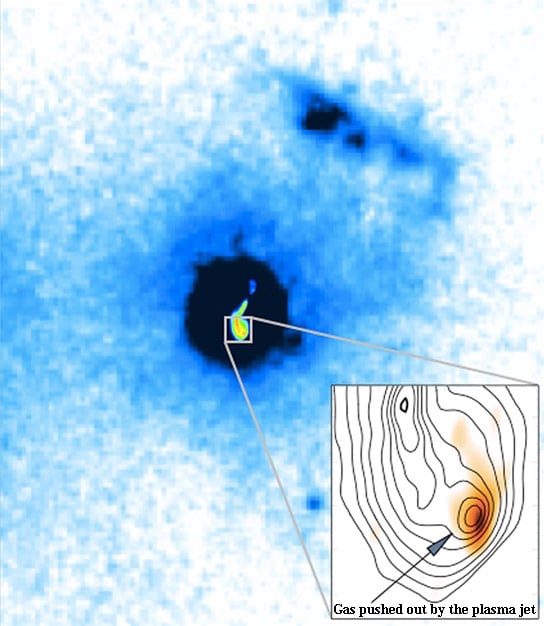
Using data from an intercontinental combination of radio telescopes, astronomers have been able to see massive clumps of cold gas being pushed away from the center of galaxy 4C12.50 by black-hole-powered jets.
Astronomers using a worldwide network of radio telescopes have found strong evidence that a powerful jet of material propelled to nearly light speed by a galaxy’s central black hole is blowing massive amounts of gas out of the galaxy. This process, they said, is limiting the growth of the black hole and the rate of star formation in the galaxy, and thus is a key to understanding how galaxies develop.
Astronomers have theorized that many galaxies should be more massive and have more stars than is actually the case. Scientists proposed two major mechanisms that would slow or halt the process of mass growth and star formation — violent stellar winds from bursts of star formation and pushback from the jets powered by the galaxy’s central, supermassive black hole.
“With the finely-detailed images provided by an intercontinental combination of radio telescopes, we have been able to see massive clumps of cold gas being pushed away from the galaxy’s center by the black-hole-powered jets,” said Raffaella Morganti, of the Netherlands Institute for Radio Astronomy and the University of Groningen.
The scientists studied a galaxy called 4C12.50, nearly 1.5 billion light-years from Earth. They chose this galaxy because it is at a stage where the black-hole “engine” that produces the jets is just turning on. As the black hole, a concentration of mass so dense that not even light can escape, pulls material toward it, the material forms a swirling disk surrounding the black hole. Processes in the disk tap the tremendous gravitational energy of the black hole to propel material outward from the poles of the disk.
At the ends of both jets, the researchers found clumps of hydrogen gas moving outward from the galaxy at 1,000 kilometers per second. One of the clouds has as much as 16,000 times the mass of the Sun, while the other contains 140,000 times the mass of the Sun. The larger cloud, the scientists said, is roughly 160 by 190 light-years in size.
“This is the most definitive evidence yet for an interaction between the swift-moving jet of such a galaxy and a dense interstellar gas cloud,” Morganti said. “We believe we are seeing in action the process by which an active, central engine can remove gas –the raw material for star formation — from a young galaxy,” she added.
The scientists also said their observations indicate that the jets from the galaxy’s core can stretch and deform clouds of interstellar gas to expand their “pushing” effect beyond the narrow width of the jets themselves. In addition, they reported that, at 4C12.50’s stage of development, the jets may turn on and off and so periodically repeat the process of removing gas from the galaxy.
In July, another team of scientists, using the Atacama Large Millimeter/submillimeter Array (ALMA), announced they had found gas being blown from a more-nearby galaxy, called NGC 253, by an intense burst of star formation.
“Both processes are thought to be at work, often simultaneously, in young galaxies to regulate the growth of their central black holes as well as the rate at which they can form new stars,” Morganti said.
Morganti and her team used radio telescopes in Europe and the U.S., combining their signals to make one giant, intercontinental telescope. In the U.S., these included the National Science Foundation’s Very Long Baseline Array (VLBA), a continent-wide system of radio telescopes ranging from Hawaii, across the U.S. mainland, to St. Croix in the Virgin Islands, and one antenna from the Karl G. Jansky Very Large Array (VLA) in New Mexico. The European radio telescopes they used are in Effelsberg, Germany; Westerbork, the Netherlands; and Onsala, Sweden. The extremely high resolving power, or ability to see fine detail, provided by such a far-flung system was essential to pinpointing the location of the gas clouds affected by the galaxy’s jets.
Morganti worked with Judit Fogasy of the Eotvos Lorand University in Budapest, Hungary; Zsolt Paragi of the Joint Institute for Very Long Baseline Interferometry in Europe; Tom Oosterloo of the Netherlands Institute for Radio Astronomy and the University of Groningen; and Monica Orienti of Italy’s National Institute of Astrophysics – Institute of Radioastronomy. The researchers published their findings in the 6 September issue of the journal Science.
The National Radio Astronomy Observatory is a facility of the National Science Foundation, operated under cooperative agreement by Associated Universities, Inc.
Reference: “Radio Jets Clearing the Way Through a Galaxy: Watching Feedback in Action” by Raffaella Morganti, Judit Fogasy, Zsolt Paragi, Tom Oosterloo and Monica Orienti, 6 September 2013, Science.
DOI: 10.1126/science.1240436
arXiv:1309.1240
Never miss a breakthrough: Join the SciTechDaily newsletter.
Follow us on Google and Google News.
2 Comments
Science has previously discovered evidence that the ‘jets’ are actually formed hundreds of ly away from the bh on the accretion disc itself.
Perhaps there is another reason than the one commonly used, the gravity of the bh. Perhaps the metalized gas, dirty gas, that is rejected by the bh, is actually the cause.
Perhaps the process of star making itself is the cause of the ending star making. The pure gas is the desired medium for stars and the rejection of metalized gas may be the cause of the envelope of hot gas we see around all galaxies including ours.
I imagine a blackholes meh Id rather call them darkStars as a super-dense star with a crystalline lattice structure, so compact that electrons can not fall into their orbitals, being expelled to its surface yet remain trapped by gravity. Photons are also in this electron gas. If it was a hydrogen heavy area of space there could be electron gas buildup. spilling out leaving the wispy tendrils.