
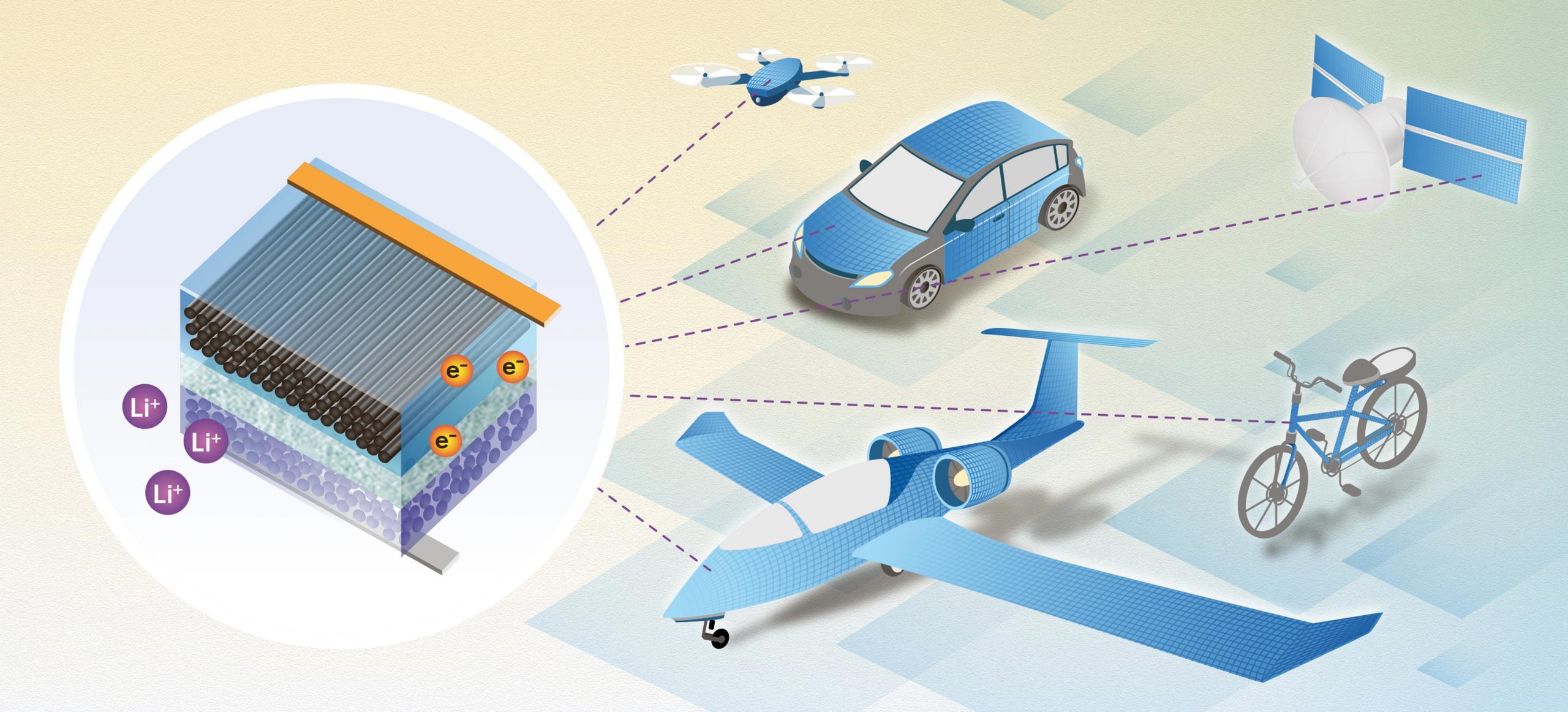
Researchers from Chalmers University of Technology have produced a structural battery that performs ten times better than all previous versions. It contains carbon fiber that serves simultaneously as an electrode, conductor, and load-bearing material. Their latest research breakthrough paves the way for essentially ’massless’ energy storage in vehicles and other technology.
The batteries in today’s electric cars constitute a large part of the vehicles’ weight, without fulfilling any load-bearing function. A structural battery, on the other hand, is one that works as both a power source and as part of the structure – for example, in a car body. This is termed ‘massless’ energy storage, because in essence the battery’s weight vanishes when it becomes part of the load-bearing structure. Calculations show that this type of multifunctional battery could greatly reduce the weight of an electric vehicle.
The development of structural batteries at Chalmers University of Technology has proceeded through many years of research, including previous discoveries involving certain types of carbon fiber. In addition to being stiff and strong, they also have a good ability to store electrical energy chemically. This work was named by Physics World as one of 2018’s ten biggest scientific breakthroughs.
The first attempt to make a structural battery was made as early as 2007, but it has so far proven difficult to manufacture batteries with both good electrical and mechanical properties.
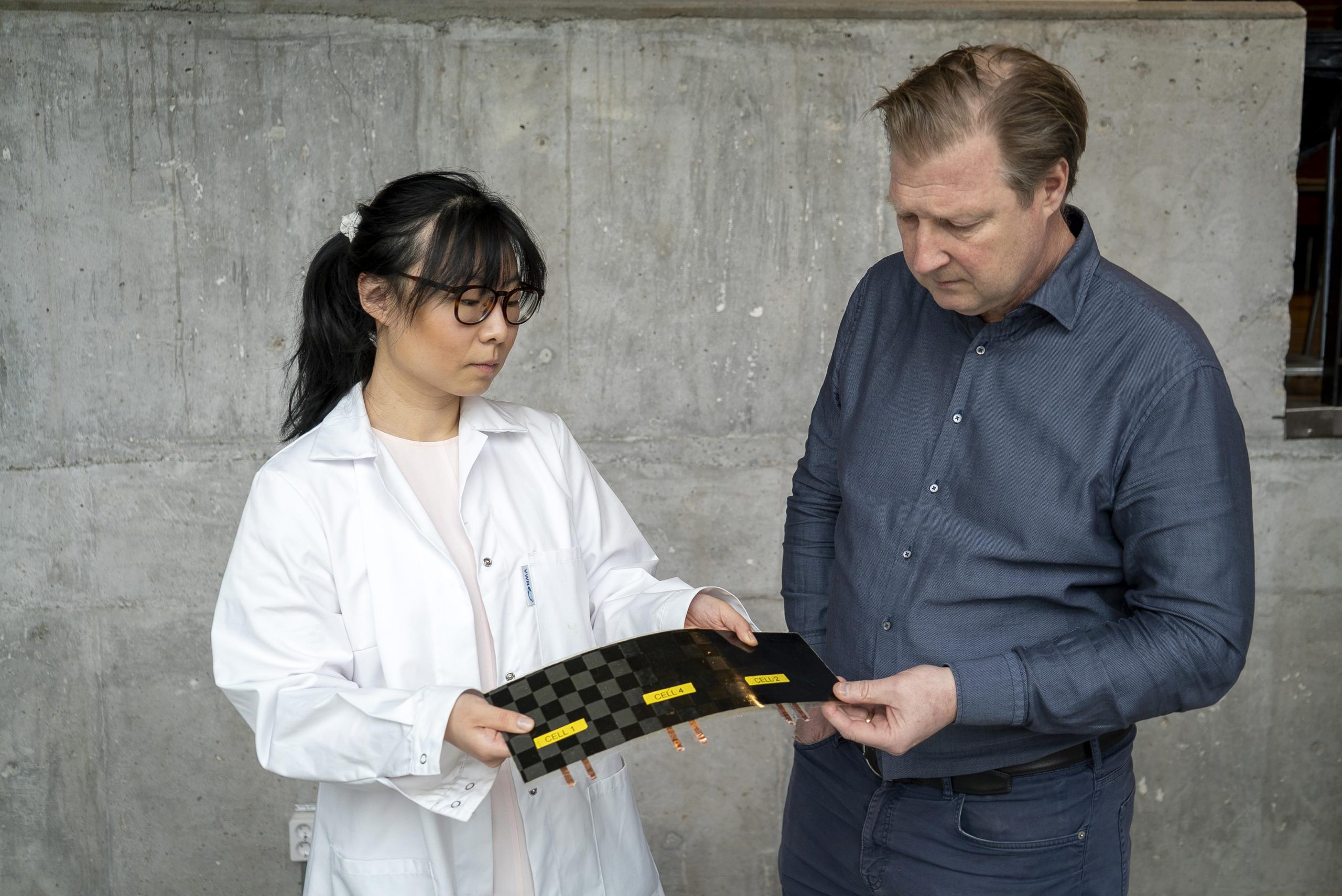
But now the development has taken a real step forward, with researchers from Chalmers, in collaboration with KTH Royal Institute of Technology in Stockholm, presenting a structural battery with properties that far exceed anything yet seen, in terms of electrical energy storage, stiffness and strength. Its multifunctional performance is ten times higher than previous structural battery prototypes.
The battery has an energy density of 24 Wh/kg, meaning approximately 20 percent capacity compared to comparable lithium-ion batteries currently available. But since the weight of the vehicles can be greatly reduced, less energy will be required to drive an electric car, for example, and lower energy density also results in increased safety. And with a stiffness of 25 GPa, the structural battery can really compete with many other commonly used construction materials.
“Previous attempts to make structural batteries have resulted in cells with either good mechanical properties, or good electrical properties. But here, using carbon fiber, we have succeeded in designing a structural battery with both competitive energy storage capacity and rigidity,” explains Leif Asp, Professor at Chalmers and leader of the project.
Super Light Electric Bikes and Consumer Electronics Could Soon Be a Reality
The new battery has a negative electrode made of carbon fiber, and a positive electrode made of a lithium iron phosphate-coated aluminum foil. They are separated by a fiberglass fabric, in an electrolyte matrix. Despite their success in creating a structural battery ten times better than all previous ones, the researchers did not choose the materials to try and break records – rather, they wanted to investigate and understand the effects of material architecture and separator thickness.
Now, a new project, financed by the Swedish National Space Agency, is underway, where the performance of the structural battery will be increased yet further. The aluminum foil will be replaced with carbon fiber as a load-bearing material in the positive electrode, providing both increased stiffness and energy density. The fiberglass separator will be replaced with an ultra-thin variant, which will give a much greater effect – as well as faster charging cycles. The new project is expected to be completed within two years.
Leif Asp, who is leading this project too, estimates that such a battery could reach an energy density of 75 Wh/kg and a stiffness of 75 GPa. This would make the battery about as strong as aluminum, but with a comparatively much lower weight.

“The next generation structural battery has fantastic potential. If you look at consumer technology, it could be quite possible within a few years to manufacture smartphones, laptops or electric bicycles that weigh half as much as today and are much more compact,” says Leif Asp.
And in the longer term, it is absolutely conceivable that electric cars, electric planes and satellites will be designed with and powered by structural batteries.
“We are really only limited by our imaginations here. We have received a lot of attention from many different types of companies in connection with the publication of our scientific articles in the field. There is understandably a great amount of interest in these lightweight, multifunctional materials,” says Leif Asp.
Reference: “A Structural Battery and its Multifunctional Performance” by Leif E. Asp, Karl Bouton, David Carlstedt, Shanghong Duan, Ross Harnden, Wilhelm Johannisson, Marcus Johansen, Mats K. G. Johansson, Göran Lindbergh, Fang Liu, Kevin Peuvot, Lynn M. Schneider, Johanna Xu and Dan Zenkert, 27 January 2021, Advanced Energy & Sustainability Research.
DOI: 10.1002/aesr.202000093
More about: The Research on Structural Batteries
The structural battery uses carbon fiber as a negative electrode, and a lithium iron phosphate-coated aluminum foil as the positive electrode. The carbon fiber acts as a host for the lithium and thus stores the energy. Since the carbon fiber also conducts electrons, the need for copper and silver conductors is also avoided – reducing the weight even further. Both the carbon fiber and the aluminum foil contribute to the mechanical properties of the structural battery. The two electrode materials are kept separated by a fiberglass fabric in a structural electrolyte matrix. The task of the electrolyte is to transport the lithium ions between the two electrodes of the battery, but also to transfer mechanical loads between carbon fibers and other parts.
The project is run in collaboration between Chalmers University of Technology and KTH Royal Institute of Technology, Sweden’s two largest technical universities. The battery electrolyte has been developed at KTH. The project involves researchers from five different disciplines: material mechanics, materials engineering, lightweight structures, applied electrochemistry and fiber and polymer technology. Funding has come from the European Commission’s research program Clean Sky II, as well as the US Airforce.
Never miss a breakthrough: Join the SciTechDaily newsletter.
Follow us on Google and Google News.
28 Comments
Takes off pc case side panels for testing with such batteries soon before making laptops, smartphones, smart tvs and pc cases like all electronics like this for true wireless abilities to get rid of the power cord and just use solar artifical or real soon.
Great development. The structural battery ratings should be improved. Such an approach can apply in many applications such as trucks, aeroplanes etc.
Cell phone batteries currently supply much of the stiffness strength required to protect the OLED screen and PCB. Structured stiffness component from the battery is why they are no longer consumer replaced and are glued in a phone. The energy density of the massless battery is far too low for a cell phone, and most handheld consumer applications where energy density is more critical than strength. “Massless” batteries only adds value when it can replace a structural only component as in vehicle applications. Releasable glues also aid the thermal management of cell phones where the heat spreading ability the battery is an asset.
hydrogen is the next beautiful thing!
accesible for everyone!
quit polluting our planet and bring war to other countries for rare metals…! quit killing people!
Enough with the exaggeration of the impacts of renewables. They are light years ahead of fossil fuels in terms of environmental impacts. Michael Moore did us all a disservice with his tragically and deeply flawed movie, which has been widely debunked
Don’t bother making vehicles out of this yet, instead make solar panels and exterior siding or roofing material out of it so it won’t be subject to failure by a crash as easily.
Environmental disaster. Vehicle will become disposable instead of battery replacement.
Awesome, so when the battery is dead or damaged you simply throw away the entire vehicle now. Brilliant! What a worthwhile investment!
Your heart’s in the right place but I can’t believe you would be actually that naive to think that wars are caused by lust for metals and other assets wars are basically caused by human greed and basic avarice when you get people who accumulate wealth so far beyond their needs for the sheer reason of having power over others you’re always going to have trouble there is no just way to stop this you could have Injustice by taking away the wealth of others that’s called communism and socialism which essentially feed the evil. So people will stop killing people when greed and lust in envy and the other basic deadly sins are removed from the human heart I only know one way to do that ….
At least in part ask Jesus about it
Has anybody researched how long these batteries will operate before either burning out or become inefficient and useless because the whole idea of batteries is that they are replaceable?
This check has applications for space travel however satellites probes where efficiency is absolutely a necessity
How can a simple article on scientific advances spark so much right wing and religious diatribe. Is this the new reality? Science equals socialism, communism and Satan
If the battery is a major structural component of a vehicle how do you repair or replace the battery after an accident or the battery wears out over time?
Interesting concept however you go ahead and build a car’s body out of what is essentially it’s battery and in 7 to 10 years when the battery no longer holds the charge your choices are trash the entire car or replace the entire body.it might make it environmentally friendly but it certainly not friendly on the pocketbook. Electric vehicles will never be ready for prime time until they can compete with the performance of today’s internal combustion vehicles. Namely, be able to travel at least 300 miles on one full charge and second and more importantly be able to charge the battery in the same amount of time it takes to fill your gas tank. Until those two thresholds are crossed no electric vehicle will be ready for prime time
Well done to these researchers. And well done to the author of the article: great example of science communication.
Can you recycle these materials? What would need to change to do this?
Could they be used to build boats, buildings, or even bridges? No rust, but what is the affect of salt on these surfaces. Any?
The carbon and glass fiber foundations nicely reinforce rebuild capabilities and that the shape is set at formup rather than later (unless you like Tesla truck low-poly aesthetic.) Get your nicer connectors prepped…
I can see some obvious problems. The first is that, with current technology batteries, an accident which causes structural deflection could be disastrous. If you’ve ever seen a laptop battery or one from an RC car burn you will know what I mean.
Next there is the fact that the batteries in EVs at some time need replacement, not so easy if the battery is structural.
New technologies tend to cost more initially. How much extra will this cost over the life of the vehicle considering replacement?
This is an interesting idea but not a panacea. Unsubsidized EVs are not attractive to buyers with current technology so having something that costs even more will be a hard sell.
Another so called breakthrough that will disappear later. These miracle inventions have been on the news for 100 years but nothing happens for real. Even Tesla cars another scam..still you have to pay for charging..you own charger costs thousands, and car cannot be fixed except at Tesla factory at rip off bill..
Put solar panels along our hwys and storage facilities. Then install magnetic paint strip in the center of road coast to coast.then allow your electric car charge while you drive.then add 5g and you can sleep and not worry about a wreck. If a car stops your car will know it.
remember the hot wheels race track same idea would cost us nothing in free sunlight but wait noone makes money ,thats right not about saving planet just like teslas free energy .folks rich people doesnt care about this planet .you really think they do???. Look around at what they have done until now.NOW THEY WANT TO FIX IT hahahah
battery has an energy density of 24 Wh/kg, meaning approximately 20 percent capacity compared to comparable lithium-ion batteries currently available. So to sum it up, very, very, X5 inefficient and built in a high cost mold for 1 use only both of body (if cracked by anything would render useless) and also theenergy source (internal short or break down). I say everybody should have a carbon fiber car (speed bumps n pot holes). yummy, yummy high mining of carbon fiber materials including epoxys. Truck in another roof honey a baseball hit our roof and now we have a fire hazard…
So, dive in & buy stocks while you can 🙂
So many of these negative comments boil down to “Old man yells at cloud.”
The technology itself is a great addition and advance to our knowledge base.
It’s application towards vehicles leaves a number of questions.
– viable life of use. Tesla battery packs half life is a fraction of that of the vehicle and the pack can be relegated to secondary applications before recycling.
– recycling how
– servicing how
– collisions and passenger extraction safety, would the jaws of life put rescue crews at extreame risk?
– fires, burning carbon fibre composites is already an issue with releasing microfibers into the atmosphere
Some of these points would apply in any application but the automotive questions need to be addressed before ever considering that application.
24wh/kg is 10% of current batteries, not 20%. If an electric vehicle today is more than 10% by mass batteries, then it means you literally cannot achieve the same performance with this tech even if the vehicle was 100% batteries. This is dumb and the author of this article should learn some highschool math and stop hyping unworkable tech.
Yes, you save weight, but batteries can only be recharged so many times before they have to be replaced, or if they are damaged. This means pieces of the structure must be replaced? And they are not even as efficient as LiPo batteries? I’m not sure this is an advance.
10x… Really… Im not sure i believe that. Double would be impressive. But 10x nah…
Tesla is doing a structural battery pack in their vehicles
So the technology is already out there
I hope you can improve upon it in the future
So, when the battery is consumed and it’s the frame of your unibody car you just dispose of the whole vehicle and buy a new one or what?
thanks for informative blog.
visit our website: http://www.vitaranexpress.in