
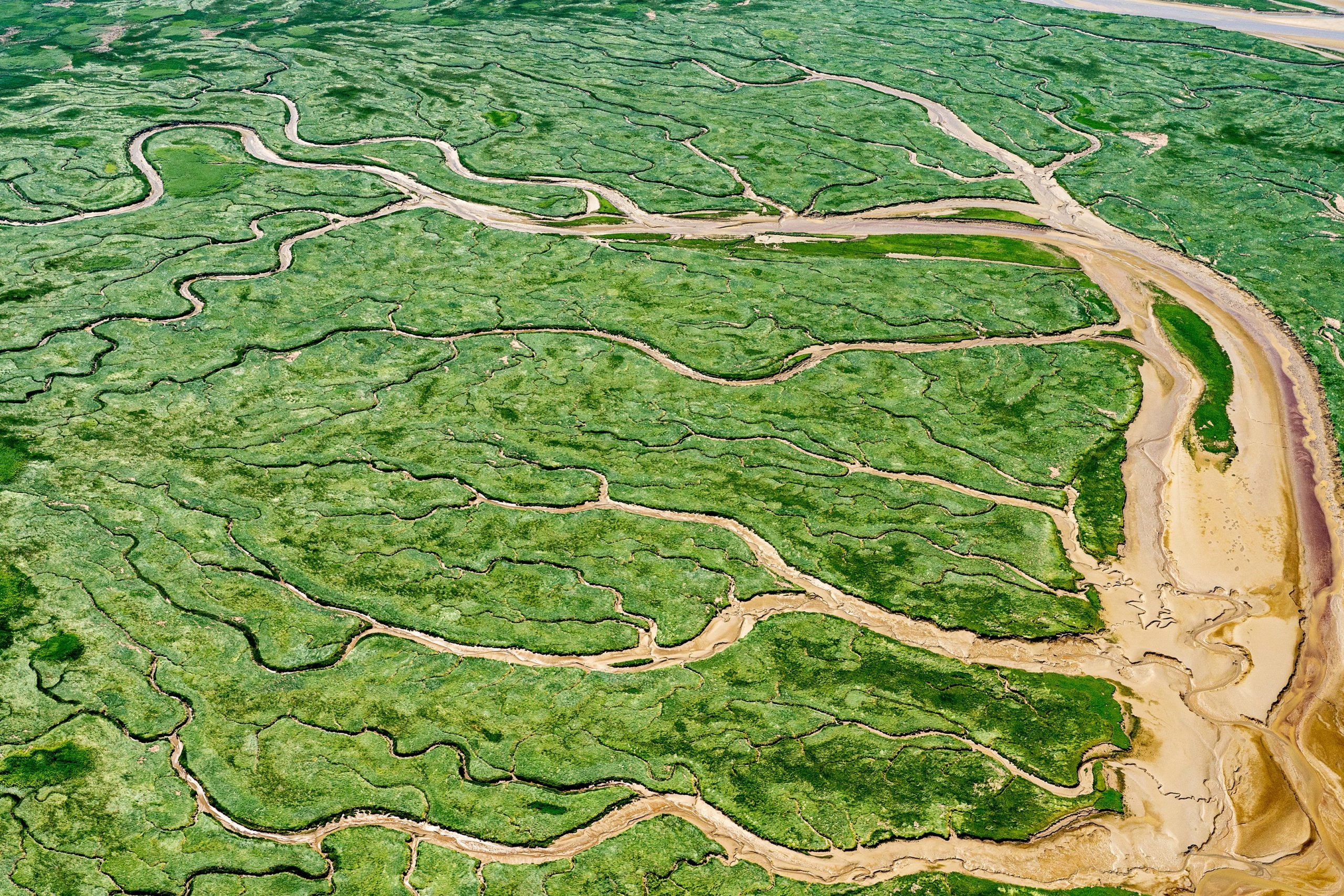
Wetlands are Earth’s most efficient natural storage system for climate-warming carbon dioxide.
Human activities such as marsh draining for agriculture and logging are increasingly eating away at saltwater and freshwater wetlands. These vital areas cover only 1% of Earth’s surface but store more than 20% of all the climate-warming carbon dioxide absorbed by ecosystems worldwide.
A new study published on May 6, 2022, in the journal Science by a team of Dutch, American, and German scientists shows that it’s not too late to reverse the losses.
The key to success, according to the paper’s authors, is using innovative restoration practices — identified in the new research paper — that replicate natural landscape-building processes and enhance the restored wetlands’ carbon-storing potential.
And doing it on a huge scale.
“About 1 percent of the world’s wetlands are being lost each year to pollution or marsh draining for agriculture, development, and other human activities,” said Brian R. Silliman, Rachel Carson Distinguished Professor of Marine Conservation Biology at Duke University, who co-authored the study.
“Once disturbed, these wetlands release enormous amounts of CO2 from their soils, accounting for about 5 percent of global CO2 emissions annually,” Silliman said. “Hundreds, even thousands of years of stored carbon are exposed to air and start to rapidly decompose and release greenhouse gases. The result is an invisible reverse waterfall of CO2 draining into the atmosphere. The wetlands switch from being carbon sinks to sources.”
“The good news is, we now know how to restore these wetlands at a scale that was never before possible and in a way that both stops this release of carbon and re-establishes the wetland’s carbon-storing capacity,” he said.
How Wetlands Store Carbon
What makes most wetlands so effective at carbon storage is that they are formed and held together by plants that grow close to each other, Silliman explained. Their dense above- and below-ground mats of stems and roots trap nutrient-rich debris and defend the soil against erosion or drying out — all of which helps the plants to grow better and the soil layer to build up, locking in a lot more CO2 in the process.
In the case of raised peat bogs, the process works a little differently, Silliman noted. Layers of living peat moss on the surface act as sponges, holding enormous amounts of rainwater that sustain its own growth and keeps a much thicker layer of dead peat moss below it permanently under water. This prevents the lower layer of peat, which can measure up to 10 meters thick, from drying out, decomposing, and releasing its stored carbon back into the atmosphere. As the living mosses gradually build up, the amount of carbon stored belowground continually grows.
Successful restorations must replicate these processes, he said.
Innovative Restoration Techniques
“More than half of all wetland restorations fail because the landscape-forming properties of the plants are insufficiently taken into account,” said study coauthor Tjisse van der Heide of the Royal Institute for Sea Research and the University of Groningen in the Netherlands. Planting seedlings and plugs in orderly rows equidistant from each other may seem logical, but it’s counter-productive, he said.
“Restoration is much more successful when the plants are placed in large dense clumps, when their landscape-forming properties are mimicked, or simply when very large areas are restored in one go,” van der Heide said.
“Following this guidance will allow us to restore lost wetlands at a much larger scale and increase the odds that they will thrive and continue to store carbon and perform other vital ecosystem services for years to come,” Silliman said. “The plants win, the planet wins, we all win.”
Silliman and van der Heide conducted the new study with scientists from the Netherlands’ Royal Institute for Sea Research, Utrecht University, Radboud University, the University of Groningen, the University of Florida, Duke University, and Greifswald University.
The Global Carbon Storage Potential of Wetlands
By synthesizing data on carbon capture from recent scientific studies, they found that oceans and forests hold the most CO2 globally, followed by wetlands.
“But when we looked at the amount of CO2 stored per square meter, it turned out that wetlands store about five times more CO2 than forests and as much as 500 times more than oceans,” says Ralph Temmink, a researcher at Utrecht University, who was first author on the study.
Reference: “Recovering wetland biogeomorphic feedbacks to restore the world’s biotic carbon hotspots” by Ralph J. M. Temmink, Leon P. M. Lamers, Christine Angelini, Tjeerd J. Bouma, Christian Fritz, Johan van de Koppel, Robin Lexmond, Max Rietkerk, Brian R. Silliman, Hans Joosten and Tjisse van der Heide, 6 May 2022, Science.
DOI: 10.1126/science.abn1479
Funding for the new study came from the Dutch Research Council, the Oak Foundation, Duke RESTORE, the Lenfest Ocean Program, the National Science Foundation, and Natuurmonumenten.
In addition to his faculty appointment at Duke’s Nicholas School, Silliman is director of Duke RESTORE.
Never miss a breakthrough: Join the SciTechDaily newsletter.
Follow us on Google and Google News.
2 Comments
People need to grow a lot more marsh plants more than enough to really restore the earth and take away so much of the carbon dioxide worldwide and create more oxygen in the atmosphere. It’s all a matter of time until eventually it will be too late to recover the planet people need to start working on changes. Not until 2050 for oil companies to start carbon neutral that might be too late by 2050 the time is now 2022 to make a change to recover the planet. Already a warning sign the fires burning in new mexico and the west coast in california and Australia is burning up on fire. The longer people don’t do enough to make the planet better than the worse the fires are going to get as the years go by. The world is burning this is an emergency if humanity doesn’t act on it than humanity might fail in this world.
The global populaon grows by over 70 million people a year the same me are natural resources are
dwindling coal oil gas water. The development of a third world were just creang a cking me bomb.
Even though we know that forests are essenal to reducing carbon emissions but we connue to cut
them down for housing farming alternave energy or just useless furniture. Instead geng truly
together and fighng for something fighng against global warming against polical social unrest are
policians are using the same band aid tech niches for reelecon over and over again what we need is
change we can’t stand for this anymore. Why do we accept it because were a society built on wants not
needs we talk wants from childhood big bank accounts fast cars plasma screen TVs its useless does this
help anyone no. What is it it’s ego this doesn’t help the world we need to bind together we don’t need
to be individuals we need to become whole as a country as a world we need someone who stands for
something we need someone who believes in what they say and believes in acon in the way that we
view our world. We can’t survive with our policians focusing there me fighng over religious wars
fighng over control of natural resources can anyone do this well I don’t know do you have any thoughts
humanity can’t survive the next 100 years the facts don’t lie. We need someone who stands for
something we need someone who believes in what they say and believes in acon believes in posive
acon. The global populaon grows by over 70 million people a year then why do we accept this
because were a society built on wants not needs we talk wants from childhood big bank accounts fast
cars plasma screen TVs liposucon it’s useless does this help anyone no what is this it’s ego. We need
someone who will stand for something we need someone who believes in what they say and believes in
acon believes in posive acon. Changing the way that we view our world.
All biomass is temporary. Unless it is buried away from the oxygen it helped create it will be recycled back to CO2 and water. That’s nature’s carbon cycle. Attempting any man-made restorations or plantings will require transportation. Until a complete transition to a renewable all-electric world is done the vehicles will be using fossil fuels to do it. There is no alternative. Expect to read about a new atmospheric record from Mauna Loa every year for the foreseeable future. There is no action that can be taken without fossil fuels for transportation.