
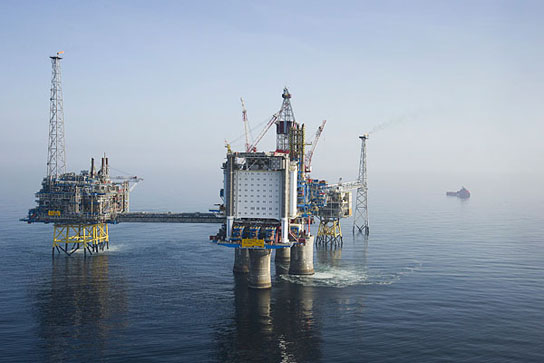
A recently published paper from Stanford scientists suggests that carbon sequestration is likely to create pressure build-up large enough cause intraplate earthquakes, breaking the reservoirs’ seals and releasing the stored CO2.
Carbon capture and storage, or CCS, is a major component of the world’s greenhouse gas reduction strategy. Involving injecting and storing carbon dioxide in underground geologic reservoirs, the method is used at several oil and gas exploration sites worldwide to prevent the gases from entering the atmosphere.
But to significantly reduce emissions, CCS would need to operate on a massive scale, potentially sequestering upwards of 3.5 billion metric tons of CO2 each year. A new technical hurdle may mean CCS won’t be able to get anywhere near that volume.
In a paper appearing in the journal Proceedings of the National Academy of Sciences, Stanford geophysics Professor Mark Zoback and environmental Earth science Professor Steven Gorelick argue that, in many areas, carbon sequestration is likely to create pressure build-up large enough to break the reservoirs’ seals, releasing the stored CO2.
“Almost all of our current climate mitigation models assume CCS is going to be one of the primary tools we use,” said Zoback. “What we’re saying is, not so fast.”
Induced seismicity
Intraplate earthquakes – earthquakes that occur far from the boundaries between tectonic plates – can occur nearly anywhere in continental interiors, due to what the researchers describe as “the critically stressed nature of the Earth’s crust.” Small pressure build-ups near potential faults reduce friction, increasing the likelihood of a fault slip.
It’s been known for a half-century that human activities can increase pressure to the point of inducing small temblors. In the 1960s, the injection of wastewater into a well near Denver triggered a series of small earthquakes. Last year, similar quakes were induced in Arkansas, Ohio, and on the border of Colorado and New Mexico.
Reviewing field stress measurements and laboratory studies of shear displacements, Zoback and Gorelick say the injection of massive quantities of CO2 would be likely to produce the same result.
Zoback has previously described wastewater-induced quakes as manageable, low-risk events. Carbon injection is unlikely to trigger large, destructive earthquakes, the professors argue, but “the implications are different if you’re trying to store carbon for thousands of years.” Zoback said.
Zoback and Gorelick state that even a fault slip of a few centimeters could allow stored CO2 to reach the surface – a serious concern, since the researchers argue that carbon repositories need a leak rate of less than 1 percent every thousand years to be effective.
“The bar is much higher in this case,” Zoback said.
Where to put it
The areas where CCS is already practiced successfully follow a very specific geologic profile. Ideally, the reservoirs themselves are formed from porous, weakly cemented materials that slow pressure build-up, but are isolated from the surface by an impermeable rock layer.
The North Sea’s Sleipner gas field, for example, makes use of the Utsira formation – a porous sandstone structure under impermeable shale.
It’s an open question as to whether there are enough low-risk geologic formations to engage in CCS at the necessary level.
The authors say that approximately 3,500 Utsiras would be necessary to contribute significantly to reductions. But some scientists say fewer would suffice.
“Of course, you need to pick sites carefully,” said Sally Benson, Stanford professor of energy resources engineering and director of Stanford’s Global Climate and Energy Project. “But finding these kinds of locations does not seem infeasible.”
She argues that only 600 such sites would be necessary and that existing formations in Texas and the Gulf Coast, the Middle East, the North Sea, and Western Australia provide promising sequestration reservoirs. Pressure build-up in other areas can also be managed, she says, by controlling injection rates and well design.
Zoback says there will continue to be a use for CCS at a small scale, in regions that are near both CO2-producing plants and ideal geologic formations.
“But for the U.S. and the world to be considering CCS one of the potential solutions to the greenhouse gas problem – it’s a very high-risk endeavor,” he said. “We need options that are practical, don’t cost literally trillions of dollars, and aren’t vulnerable to moderate size earthquakes.”
The issue of triggered earthquakes is also the subject of a new report from the National Research Council, which concludes that “continued research will be needed to examine the potential for induced seismicity in large-scale carbon capture and storage projects.”
Reference: “Earthquake triggering and large-scale geologic storage of carbon dioxide” by Mark D. Zoback and Steven M. Gorelick, 18 June 2012, Proceedings of the National Academy of Sciences.
DOI: 10.1073/pnas.1202473109
Zoback speaks to the Senate Committee on Energy and Natural Resources on Tuesday.
Never miss a breakthrough: Join the SciTechDaily newsletter.
Follow us on Google and Google News.