
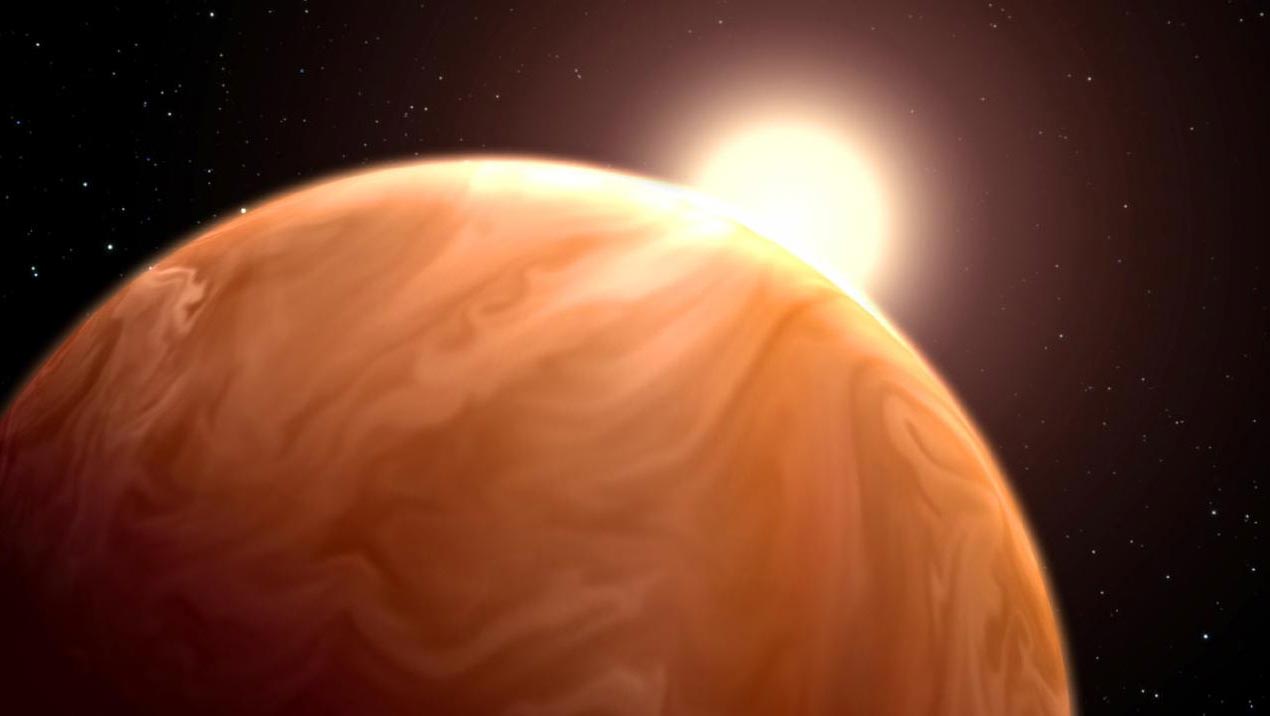
Oceans of magma may limit the amount of Neptune-sized exoplanets, study finds.
For many years, for all we knew, our solar system was alone in the universe. Then better telescopes began to reveal a treasure trove of planets circling distant stars.
In 2014, NASA’s Kepler Space Telescope handed scientists a smorgasbord of more than 700 brand-new distant planets to study—many of them unlike what we had previously seen. Instead of gas giants like Jupiter, which earlier surveys had picked up first because they are easier to see, these planets were smaller and mostly rock by mass.
Scientists noticed that there were lots of these planets about the size of or just larger than Earth, but there was a steep cutoff before planets reached the size of Neptune. “This is a cliff edge in the data, and it’s quite dramatic,” said University of Chicago planetary scientist Edwin Kite. “What we have been puzzling over is why planets would tend to stop growing beyond about three times Earth’s size.”
The question Kite and his colleagues considered was whether, as the planets acquired more hydrogen, the ocean might begin to “eat” the sky.
In a paper published on December 17, 2019, in Astrophysical Journal Letters, Kite and colleagues at Washington University, Stanford University, and Penn State University offer an innovative explanation for this drop-off: The oceans of magma on the surface of these planets readily absorb their atmospheres once planets reach about three times the size of Earth.
Kite, who studies the history of Mars and the climates of other worlds, was well-positioned to study the question. He thought the answer might hinge on a little-studied aspect of such exoplanets. Most of the planets slightly smaller than the drop-off size are thought to have oceans of magma on their surfaces—great seas of molten rock like the ones that once covered Earth. But instead of solidifying as ours did, these are kept hot by a thick blanket of hydrogen-rich atmosphere.
“So far, almost all models we have ignore this magma, treating it as chemically inert, but liquid rock is almost as runny as water and very reactive,” said Kite, an assistant professor in the Department of Geophysical Sciences.
The question Kite and his colleagues considered was whether, as the planets acquired more hydrogen, the ocean might begin to “eat” the sky. In this scenario, as the planet acquires more gas, it piles up in the atmosphere, and the pressure at the bottom where the atmosphere meets the magma starts to build. At first, the magma takes up the added gas at a steady rate, but as the pressure rises, the hydrogen starts to dissolve much more readily into the magma.
“Not only that, but the little bit of the added gas that stays in the atmosphere raises the atmospheric pressure, and thus an even greater fraction of later-arriving gas will dissolve into the magma,” Kite said.
Thus the planet’s growth stalls out before it reaches the size of Neptune. (Because the majority of the volume of these planets is in the atmosphere, shrinking the atmosphere shrinks the planets.)
The authors call this the “fugacity crisis,” after the term that measures how much more readily a gas dissolves into a mixture than what would be expected based on pressure.
The theory fits well with existing observations, Kite said. There are also several markers that astronomers could look for in the future. For example, if the theory is correct, planets with magma oceans that are cold enough to have crystallized on the surface should display different profiles, since this would prevent the ocean from absorbing so much hydrogen. Ongoing and future surveys from TESS and other telescopes should give astronomers more data with which to work.
“Nothing like these worlds exists in our solar system,” said Kite. “Although our work suggests a solution to one of the puzzles posed by sub-Neptune exoplanets, they still have a lot to teach us!”
Reference: “Superabundance of Exoplanet Sub-Neptunes Explained by Fugacity Crisis” by Edwin S. Kite, Bruce Fegley Jr., Laura Schaefer and Eric B. Ford, 17 December 2019, Astrophysical Journal Letters.
DOI: 10.3847/2041-8213/ab59d9
Funding: NASA, NSF, Pennsylvania State University, Eberly College of Science, Pennsylvania Space Grant Consortium.
Never miss a breakthrough: Join the SciTechDaily newsletter.
Follow us on Google and Google News.