
Close Menu
    Facebook X (Twitter) Instagram
    SciTechDaily
    • Biology
    • Chemistry
    • Earth
    • Health
    • Physics
    • Science
    • Space
    • Technology
    Facebook X (Twitter) Pinterest YouTube RSS
    SciTechDaily
    Home»Space»Fine Tuning the James Webb Space Telescope, a Different View of Venus [Video]
    Space

    Fine Tuning the James Webb Space Telescope, a Different View of Venus [Video]

    By NASAFebruary 13, 20221 Comment4 Mins Read
    Facebook Twitter Pinterest Telegram LinkedIn WhatsApp Email Reddit
    Share
    Facebook Twitter LinkedIn Pinterest Telegram Email Reddit
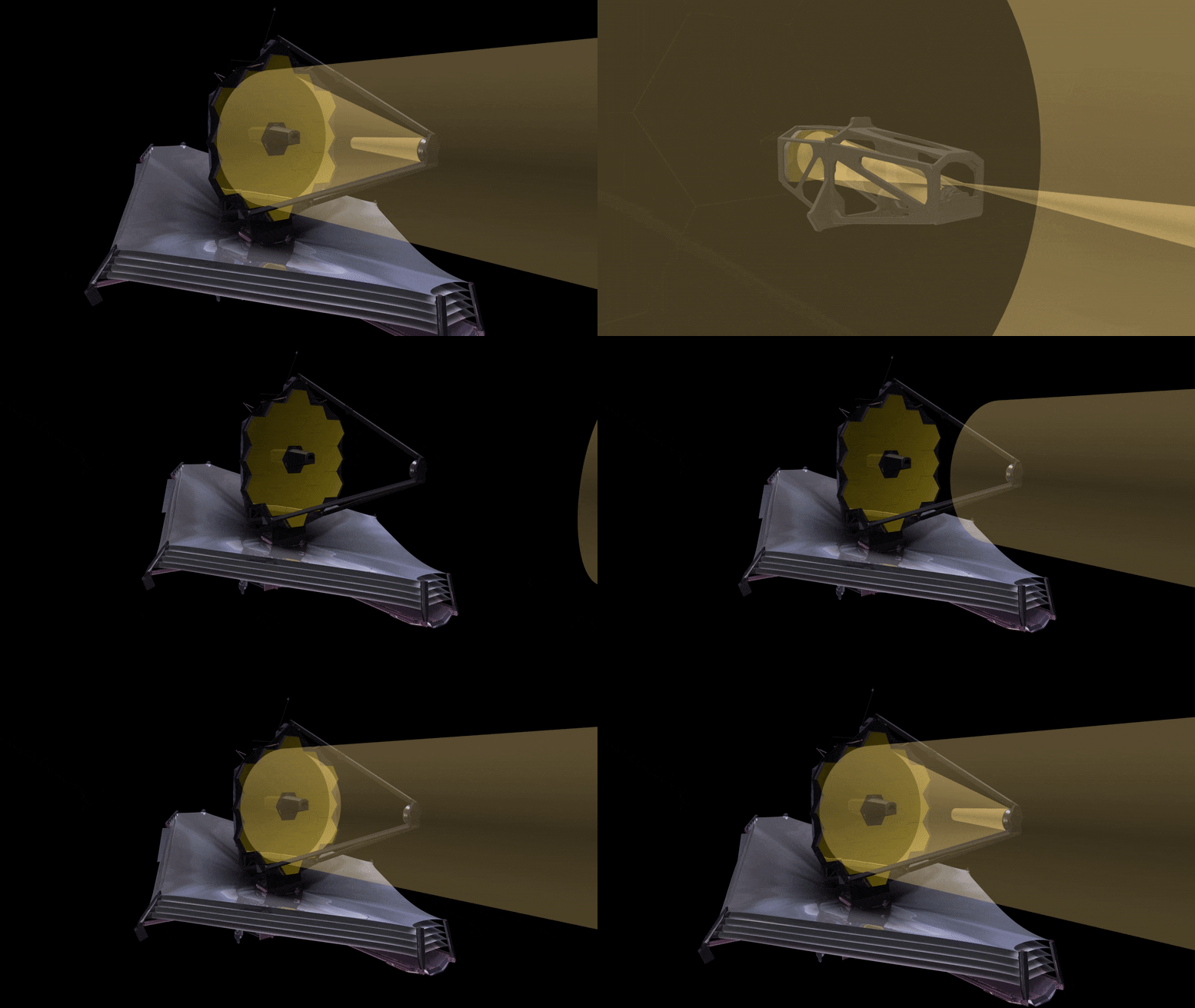
    James Webb Space Telescope Light Path
    This animation shows the path light will follow as it hits the primary James Webb Space Telescope (JWST) mirror, and is reflected to the secondary, and then in through the aft optics assembly where the tertiary and fine steering mirrors are. The light is then reflected and split and directed to the science instruments by pick-off mirrors. JWST is a three-mirror anastigmat telescope. Credit: NASA, ESA, and G. Bacon (STScI)

    Fine-tuning the James Webb Space Telescope, a different view of Venus, and the science on an upcoming space station resupply mission … a few of the stories to tell you about – This Week at NASA!

    Video Transcript:

    Fine-tuning the James Webb Space Telescope…

    A different view of Venus …

    And the science on an upcoming space station resupply mission

    … a few of the stories to tell you about – This Week at NASA!

    The James Webb Space Telescope team is nearing completion of the first phase of the months-long process of aligning the observatory’s primary mirror using the Near Infrared Camera or NIRCam instrument.

    As planned, NIRCam has detected the first photons of starlight that traveled through the observatory and has identified starlight from the same star in each of Webb’s 18 primary mirror segments.

    The result is this mosaic image release on February 11, that appears to be random dots of starlight – but is actually light from the same star reflected by Webb’s unaligned mirror segments.

    This simple image of blurry starlight now becomes the foundation to align and focus the telescope so that it can deliver unprecedented views of the universe this summer.

    During recent flybys of Venus, our Parker Solar Probe captured its first visible light images of the Venusian surface taken from space.

    Some of the images, captured in wavelengths of the visible spectrum that human eyes can see, were used to create a video of the planet’s entire night side.

    In the video, light and dark surface features can be seen, as well as glowing features in the planet’s atmosphere.

    These images can help us learn more about the evolution of Venus, which has been referred to as Earth’s twin.

    Our commercial partner Northrop Grumman is targeting February 19 for the launch of its next resupply mission to the International Space Station from our Wallops Flight Facility in Virginia.

    More than 8,200 pounds of cargo will launch aboard the company’s Cygnus cargo spacecraft.

    The science being delivered on the mission includes a study to evaluate the effects of a drug on breast and prostate cancer cells, an investigation that could potentially lead to products to protect aging skin, and a system to test techniques for hydroponic and aeroponic plant growth.

    This is the company’s 17th resupply mission to the station for NASA.

    NASA’s Investigation of Microphysics and Precipitation for Atlantic Coast-Threatening Storms or IMPACTS mission is a multi-year airborne science campaign tracking snowstorms across the Midwest and Eastern U.S.

    Data collected by a suite of instruments on a pair of NASA aircraft helps researchers determine how snowstorms develop, how much snow a storm will bring, and where the bulk of it will fall.

    The current campaign is the second deployment of IMPACTS and is scheduled to wrap up at the end of the month.

    Engineers at our Stennis Space Center conducted the second RS-25 engine hot fire test of 2022 on February 8.

    Four RS-25s will help power our Space Launch System rocket on future Artemis deep-space missions, including this year’s uncrewed Artemis I mission around the Moon.

    This was the third overall test in the current test series which began in mid-December. Each test provides valuable data that can be used to help develop the engines.

    That’s what’s up this week @NASA

    Never miss a breakthrough: Join the SciTechDaily newsletter.
    Follow us on Google and Google News.

    Astronomy International Space Station James Webb Space Telescope NASA Popular Venus
    Share. Facebook Twitter Pinterest LinkedIn Email Reddit

    Related Articles

    Webb Space Telescope Cracks Case of Puffy “Microwaved Marshmallow” Exoplanet

    Super-Earth Surprise: Webb Finds Atmosphere on Rocky Exoplanet For the First Time

    Webb Space Telescope Reveals Extreme Starburst Galaxy’s Hidden Secrets

    Webb’s Ethanol Discovery Fuels Search for Alien Life

    Webb’s Historic Discovery: The Farthest Active Supermassive Black Hole Ever Found

    Webb Space Telescope Reveals “Mind-Blowing” Structure in 19 Nearby Spiral Galaxies

    Webb Telescope’s Startling Reveal: Many Early Galaxies Looked Like Pool Noodles and Surfboards

    Webb’s Infrared Eye Uncovers Bizarre “Cat’s Tail” Dust Structure in Beta Pictoris

    From IRAS to Webb: The Incredible Evolution of NASA’s Infrared Telescopes

    1 Comment

    1. Desalegn Workalemahu Woldemariam on February 14, 2022 4:08 am

      I am a material engineer and am interested to see building materials on Mars to see besides evidences of large scale nuclear activity on Mars comes from a variety of sources. It has been a long standing paradox that uranium,thorium and potassium, appear hyper-abundent on Mars surface when compared to Mars meteorites, which are believed to sample subsurface rocks.

      Reply
    Leave A Reply Cancel Reply

    • Facebook
    • Twitter
    • Pinterest
    • YouTube

    Don't Miss a Discovery

    Subscribe for the Latest in Science & Tech!

    Trending News

    Largest-Ever Study Finds Medicinal Cannabis Ineffective for Anxiety, Depression, PTSD

    250-Million-Year-Old Egg Solves One of Evolution’s Biggest Mysteries

    Living With Roommates Might Be Changing Your Gut Microbiome Without You Knowing

    Century-Old Cleaning Chemical Linked to 500% Increased Risk of Parkinson’s Disease

    What if Your Memories Never Happened? Physicists Take a New Look at the Boltzmann Brain Paradox

    One of the Universe’s Largest Stars May Be Getting Ready To Explode

    Scientists Discover Enzyme That Could Supercharge Ozempic-Like Weight Loss Drugs

    Popular Sweetener Linked to DNA Damage – “It’s Something You Should Not Be Eating”

    Follow SciTechDaily
    • Facebook
    • Twitter
    • YouTube
    • Pinterest
    • Newsletter
    • RSS
    SciTech News
    • Biology News
    • Chemistry News
    • Earth News
    • Health News
    • Physics News
    • Science News
    • Space News
    • Technology News
    Recent Posts
    • AI Reveals Explosive Growth of Floating Algae Across the World’s Oceans
    • 5.5 Million Bees Discovered Living Beneath a New York Cemetery
    • Scientists Reverse Brain Aging With Simple Nasal Spray
    • The Surprising Diet Rule That Makes “Good” Parasites Work
    • This Simple Blood Test Could Outperform “Bad Cholesterol” in Preventing Heart Disease
    Copyright © 1998 - 2026 SciTechDaily. All Rights Reserved.
    • Science News
    • About
    • Contact
    • Editorial Board
    • Privacy Policy
    • Terms of Use

    Type above and press Enter to search. Press Esc to cancel.