
Experts say the ocean could help remove vast amounts of carbon dioxide, but the technologies are still shaky and hard to verify.
With warming accelerating, residual emissions from aviation, shipping, and industry mean carbon removal will be essential. Yet marine approaches—from seaweed to plankton fertilization—carry scientific and environmental uncertainties.
Oceans as a Climate Tool: Promise and Uncertainty
The world’s oceans are expected to play a crucial part in removing carbon dioxide from the atmosphere to help limit dangerous climate warming. The big question is whether current technologies are ready to be expanded to the scale needed.
According to an expert panel advising the European Union, the answer is no.
At least, not yet – not until strong systems are in place to confirm that these marine carbon dioxide removal technologies work as intended and do not create new environmental problems.
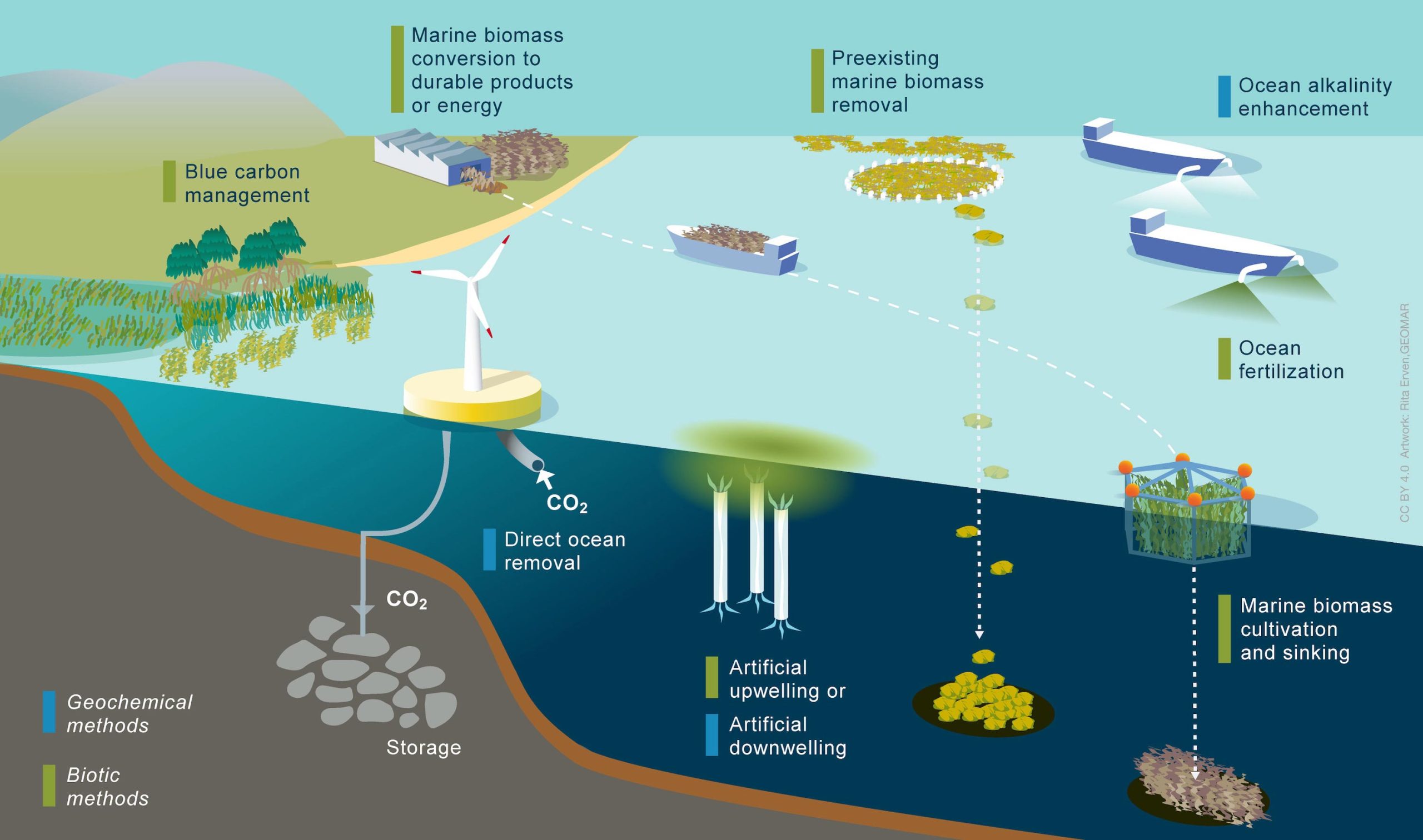
These approaches take advantage of the ocean’s natural ability to absorb carbon. Some methods rely on living organisms, such as boosting plankton or seaweed growth, so they can draw carbon dioxide from the water as they develop. Others use chemical or physical processes, including techniques designed to directly extract carbon dioxide from seawater.
Once carbon is removed from the upper layers of the ocean, it can be stored in deep-sea sediments, the ocean floor, the deep ocean itself, geological formations, or long-lasting products.
Safeguarding the Seas Before Scaling Up
“This is about safeguarding the oceans for a common good. The oceans can be part of the climate solution, but we need to strengthen the way we safeguard them before we scale things up,” said Helene Muri, a senior researcher at NILU, the Norwegian Institute for Air Research and the Norwegian University of Science and Technology (NTNU).
Muri served as chair of an expert group organized by the European Marine Board to examine the issue.
The group’s findings are presented in the report “Monitoring, Reporting and Verification for Marine Carbon Dioxide Removal,” released alongside COP30, the UN climate conference currently taking place in Brazil.
Escalating Warming and the 1.5°C Red Line
Global temperatures continue to climb, and much more quickly than world leaders anticipated when they pledged in Paris to limit warming to 1.5°C above “pre-industrial levels.”
During his opening remarks at the COP30 Leaders’ Summit on November 6, UN General Secretary António Guterres emphasized the seriousness of the moment.
“Science now tells us that a temporary overshoot beyond the 1.5°C limit – starting at the latest in the early 2030s – is inevitable,” he said. “Let us be clear: the 1.5°C limit is a red line for humanity. It must be kept within reach. And scientists also tell us that this is still possible.”
The European Marine Board report highlights that immediate action must focus on strategies already proven to reduce emissions. “We know how to cut emissions, and we have lots of methods that work,” Muri said. “That has to take top priority.”
Why Carbon Removal Is Still Needed
So why talk about removing carbon dioxide from the ocean at all, if the goal is to cut carbon dioxide emissions to zero?
Here’s where reality comes in. Cutting emissions from burning fossil fuels for energy, while difficult, is doable because we have alternative energy sources, such as solar and wind energy, that can do the job.
However, some products and technologies we rely on are difficult to make carbon free. There’s plenty of research being done to reduce carbon emissions from air travel, for example, but carbon-free flight has proved elusive. And even as people are encouraged to fly less, there are still times when air travel is the only option.
Societies across the globe need to achieve something called net zero by 2050. That’s when all the CO2 emissions are zeroed out by removing the exact same amount of emissions.
Reaching the 1.5°C level requires reaching net negative emissions. That’s where societies cut all emissions that are possible to cut but then find ways to compensate for “residual” emissions, those that simply can’t be eliminated.
Reaching Net Negative: The Gigaton Challenge
“We must have a net removal of carbon dioxide from the atmosphere to get to 1.5°C and that means that you will likely have some residual emissions from some sectors, such as shipping and aviation, and some industries,” Muri said. “And then you will have relatively large scale removal of carbon dioxide from the atmosphere as well, so that the net is at about between 5 to 10 gigatons of CO2 removed per year towards the end of the century, according to scenarios by the IPCC.”
To put those numbers into context: Total global CO2 emissions were 42.4 gigatons of CO2 in 2024, according to CICERO, the Oslo-based Center for International Climate Research.
Land-based technologies to remove this “residual” carbon are already underway – the main method is through afforestation. Another example are the Climeworks direct air capture plants in Iceland, where giant fans suck air through a filter that removes the CO2, which is then mixed with water and injected into bedrock, where it turns to stone.
There have been quite a few field tests of different kinds of marine carbon dioxide removal, but many of the technologies remain in their infancy. Others are gaining more traction. Here is why setting standards now, for monitoring, reporting and verifying what is being done, is important.
The Challenge: Measuring and Governing the Ocean
Some marine based approaches to removing carbon dioxide from the ocean are similar to land-based mitigation options. Planting lots of trees or protecting rainforests because they soak up carbon are two examples of land-based mitigation. In the same way, some marine carbon dioxide removal technologies involve protecting and enhancing coastal areas, such as mangrove swamps.
Other approaches are more interventionist, such as fertilizing the ocean with iron or other nutrients to fuel plankton growth. These huge plankton blooms absorb carbon dioxide. When they die, they carry the carbon into the deep ocean, far from the atmosphere. That’s the theory, at least.
The problem, Muri says, is knowing how well these different technologies actually work.
Verification, Governance, and the Ocean’s Complexity
For example, how does a company actually prove how much excess carbon dioxide is being removed by the technology in question?
If we send carbon to the deep ocean, do we know how long it will stay there?
And while there are a number of different government and international agencies, along with international treaties and protocols, which ones should take the lead role? And how do they verify what is actually being done?
Ideally, “you monitor what is the background state of carbon (in the ocean) and then you implement your project and make sure that you have removed carbon from the atmosphere. And you try to monitor how much carbon that you have removed and how long it is staying away from the atmosphere. And then you report that to some independent party and then it verifies that what you’re saying is correct,” Muri said.
The twist?
“If you’re storing it in the ocean, in some form or another, not in a geological reservoir, it’s a lot harder to to govern it and also monitor it. The ocean doesn’t stay put,” she said.
Carbon Credits and Responsibility in Marine CDR
Addressing these issues will be critical as technologies mature to the point where they are used by governments or companies to claim credit for removing carbon dioxide.
Some companies have already begun to do so, Muri says.
“None of these methods are mature to use if you cannot verify impacts or where the carbon goes, or how long it stays away from the atmosphere,” Muri said.
“If we want to be serious about figuring out if you can do marine carbon dioxide removal in responsible ways that can make meaningful contributions, then we have to get serious about the monitoring, reporting and verification aspects,” she added.
“The credit part of it also has to work right. You have to have reliable and transparent and scientifically defensible crediting systems.”
Reporting will also have to include any environmental impacts, Muri said.
The Way Forward: Necessary but Not a Miracle Fix
In spite of the many uncertainties surrounding marine carbon dioxide removal, “all future scenarios are showing us that we will need carbon dioxide removal in order to reach our most ambitious temperature goal,” Muri said.That’s the conclusion of the IPCC from any number of the organization’s reports, but particularly in a special report from 2018 on Global Warming of 1.5°C.
“We don’t know all the threats of these immature methods yet, but it’s a bit hard to just take them off the table because they’re uncomfortable to think about,” she said.
Nevertheless, marine carbon dioxide removal will not be a “miracle ocean fix to climate change,” she said. “Some people are really hoping to find an answer in the ocean, but in our opinion, we’re not there yet.”
“And there’s a question of whether it can be a scientifically governed climate solution, and we don’t have the answer to that yet. But if we want to go in that direction, then we need to clear up all of these standards and establish these properly before we can scale things up,” she said.
Reference: “Monitoring, Reporting and Verification for Marine Carbon Dioxide Removal” by Muri, H., Sulpis, O., Argüello, G., Baker, C. A., Böettcher, M., García-Ibáñez, M. I., Kuliński, K., Landolfi, A., Landschützer, P., McGovern, E., Ninčević Gladan, Ž., Oschlies, A., Yfantis, E. A., Future Science Brief N°. 13 of the European Marine Board, Ostend, Belgium.
DOI: 10.5281/zenodo.17435116
Never miss a breakthrough: Join the SciTechDaily newsletter.
Follow us on Google and Google News.
9 Comments
“With warming ACCELERATING, …”
Where is the evidence to support the above assertion? Back in 2018, no less than Dr. James Hansen’s personal data showed a rate of warming of 1.8 deg C. [See second graph in the body of the text here: https://wattsupwiththat.com/2018/06/30/analysis-of-james-hansens-1988-prediction-of-global-temperatures-for-the-last-30-years/ ] That 2018 graph has recently been updated (2025/11/15) showing the same linear trend for the 1880-1920 Base Period here: https://www.columbia.edu/~mhs119/Temperature/ . Changes in the base period can shift the anomaly graph up and down, but shouldn’t impact the shape or slope of the lines.
Formally, if a time series is accelerating, then a second-order fit should provide a higher Coefficient of Determination (r^2) than a linear fit and is typically noticeable as a curved line. There is a hint of a potential upturn resulting from the 2020 super-El Nino coincident with the Hunga-Tonga eruption in January 2022, the largest volcanic eruption in the 21st Century. However, the temperature anomaly has been decreasing (slowly) since the eruption. I think that it is premature to conclude that Earth has entered a new warming regime.
Here you go…..evidence https://www.columbia.edu/~jeh1/mailings/2024/Hopium.MarchEmail.2024.03.29.pdf
“all future scenarios are showing us that we will need carbon dioxide removal in order to reach our most ambitious temperature goal,”
Just what is the “temperature goal?” If we are going to start trying to manipulate the global temperature on an industrial scale we should be able state what the optimal temperature is and why. So far, all I have heard are arguments to preserve the status quo, namely what global temperatures are thought to have been between about the end of the Little Ice Age and the end of World War Two. On the face of it, that doesn’t seem unreasonable. However, currently, more people die from cold weather than from hot weather. Should that be considered? Biologists are of the opinion that the tropics have greater species diversity than any other biomes. In comparison, the polar regions have very low diversity, with some being seasonal tourists. Historically, evolution seems to be accelerated by warmth, with the hot Eocene literally being a hot bed of speciation, having given birth to primates. While current warming is reducing ice around the world, NASA has documented increasing vegetation, which it has labeled as ‘greening.’ Which is more desirable — trees or ice?
Anyone here who doesn’t own beach front property care to take a crack at rationalizing the push to maintain the status quo, or alternatively, look at the bigger picture and suggest some other goal?
I’m surprised no one has risen to the challenge of proposing and defending the optimum temperature for Earth. Are none of the placard-carrying acolytes capable of thinking independently? Perhaps those who so ardently defend the paradigm of Catastrophic Anthropogenic Global Warming should adopt the motto of “What he said!”
It’s the CO2 fast (century level) rising levels causing warming. Slow (multi millenial) increase or decrease is not a concern.
Hence “optimum” temperature of the earth is irrelevant, as long as the rise or fall is slow enough to prevent mass extinction.
“…, then we have to get serious about the monitoring, reporting and verification aspects,”
This sounds like an argument for increased government oversight and control. And the government she is alluding to isn’t even elected to their positions, but rather, appointed. Brave New World, I await thee.
So far, it’s been corporations that are paying for captured carbon, and necessarily focused on accounting for carbon durably sequestered. Academics were not participants in MRV because their studies were in contrained situations (labs). Field trials are currently research scale when ut comes to marine CDR.
Governments will need to get involved when scale of removal is detectable in the atmospheric CO2 levels. Not yet.
Essentially, the lower humans make atmospheric carbon, the closer we come to a real catastrophe: we have the lowest C02 level in the history of the earth @ 0.04% – where 0.02%, all plant life dies away –
We need to replant forests and manage forestry – we have the computers for that now. And by all means save the flora by ADDING atmospheric carbon. We should be propounding the support of atmospheric carbon enriching activities.
You don’t want to be cut off from Oxygen, the forests that give you that don’t want to be starved of carbon.
You appear to be advocating an increase in CO2. What should the target level be for an optimum level? Why? Without answering those questions, your remarks are simply of the “Ready, Fire, Aim” variety but from the other side of the political spectrum. Is thinking a lost art?