
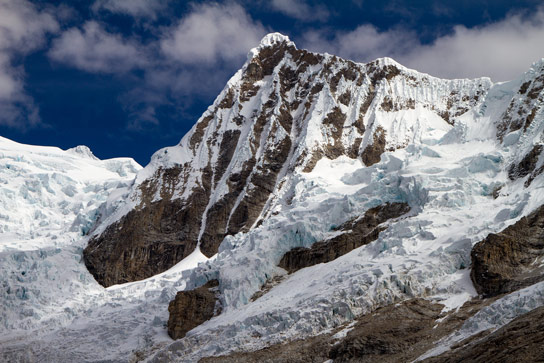
By using computer simulations of the climate, researchers have found evidence for anthropogenic glacier mass loss in recent decades. In a paper published in the journal Science, the team reports that about one-quarter of the global glacier mass loss during the period of 1851 to 2010 is attributable to anthropogenic causes and that the fraction of human contribution has increased steadily and accelerated to almost two-thirds between 1991 and 2010.
The ongoing global glacier retreat causes rising sea levels, changing seasonal water availability, and increasing geo-hazards. While melting glaciers have become emblematic of anthropogenic climate change, glacier extent responds very slowly to climate changes. “Typically, it takes glaciers decades or centuries to adjust to climate changes,” says climate researcher Ben Marzeion from the Institute of Meteorology and Geophysics of the University of Innsbruck. The global retreat of glaciers observed today started around the middle of the 19th century at the end of the Little Ice Age. Glaciers respond both to naturally caused climate change of past centuries, for example solar variability, and to anthropogenic changes. The real extent of human contribution to glacier mass loss has been unclear until now.
Anthropogenic causes
By using computer simulations of the climate, Ben Marzeion’s team of researchers simulated glacier changes during the period between 1851 and 2010 in a model of glacier evolution. “The results of our models are consistent with observed glacier mass balances,” says Marzeion. All glaciers in the world outside Antarctica were included in the study. The recently established Randolph Glacier Inventory (RGI), a complete inventory of all glaciers worldwide, enabled the scientists to run their model. “The RGI provides data of nearly all glaciers on the Earth in a machine-readable format,” explains Graham Cogley from Trent University in Canada, one of the coordinators of the RGI and co-author of the current study.
Since the climate researchers are able to include different factors contributing to climate change in their model, they can differentiate between natural and anthropogenic influences on glacier mass loss. “While we keep factors such as solar variability and volcanic eruptions unchanged, we are able to modify land use changes and greenhouse gas emissions in our models,” says Ben Marzeion, who sums up the study: “In our data, we find unambiguous evidence of anthropogenic contribution to glacier mass loss.”
Significant increase in recent decades
The scientists show that only about one quarter (25 +/-35 %) of the global glacier mass loss during the period of 1851 to 2010 is attributable to anthropogenic causes. However, during the last two decades between 1991 and 2010 the fraction increased to about two-thirds (69+/-24%). “In the 19th and first half of 20th century we observed that glacier mass loss attributable to human activity is hardly noticeable but since then has steadily increased,” says Ben Marzeion. The authors of the study also looked at model results on regional scales. However, the current observation data is insufficient in general to derive any clear results for specific regions, even though anthropogenic influence is detectable in a few regions such as North America and the Alps. In these regions, glacier changes are particularly well documented.
The study is supported, among others, by the Austrian Science Fund (FWF) and the research area Scientific Computing at the University of Innsbruck.
Reference: “Attribution of global glacier mass loss to anthropogenic and natural causes” by Ben Marzeion, J. Graham Cogley, Kristin Richter and David Parkes, 22 August 2014, Science.
DOI: 10.1126/science.1254702
Never miss a breakthrough: Join the SciTechDaily newsletter.
Follow us on Google and Google News.