
Close Menu
    Facebook X (Twitter) Instagram
    SciTechDaily
    • Biology
    • Chemistry
    • Earth
    • Health
    • Physics
    • Science
    • Space
    • Technology
    Facebook X (Twitter) Pinterest YouTube RSS
    SciTechDaily
    Home»Space»New Rosetta Image of 67P/Churyumov-Gerasimenko
    Space

    New Rosetta Image of 67P/Churyumov-Gerasimenko

    By DC Agle, Jet Propulsion LaboratoryAugust 18, 2014No Comments3 Mins Read
    Facebook Twitter Pinterest Telegram LinkedIn WhatsApp Email Reddit
    Share
    Facebook Twitter LinkedIn Pinterest Telegram Email Reddit
    New Rosetta Image of 67P Churyumov Gerasimenko
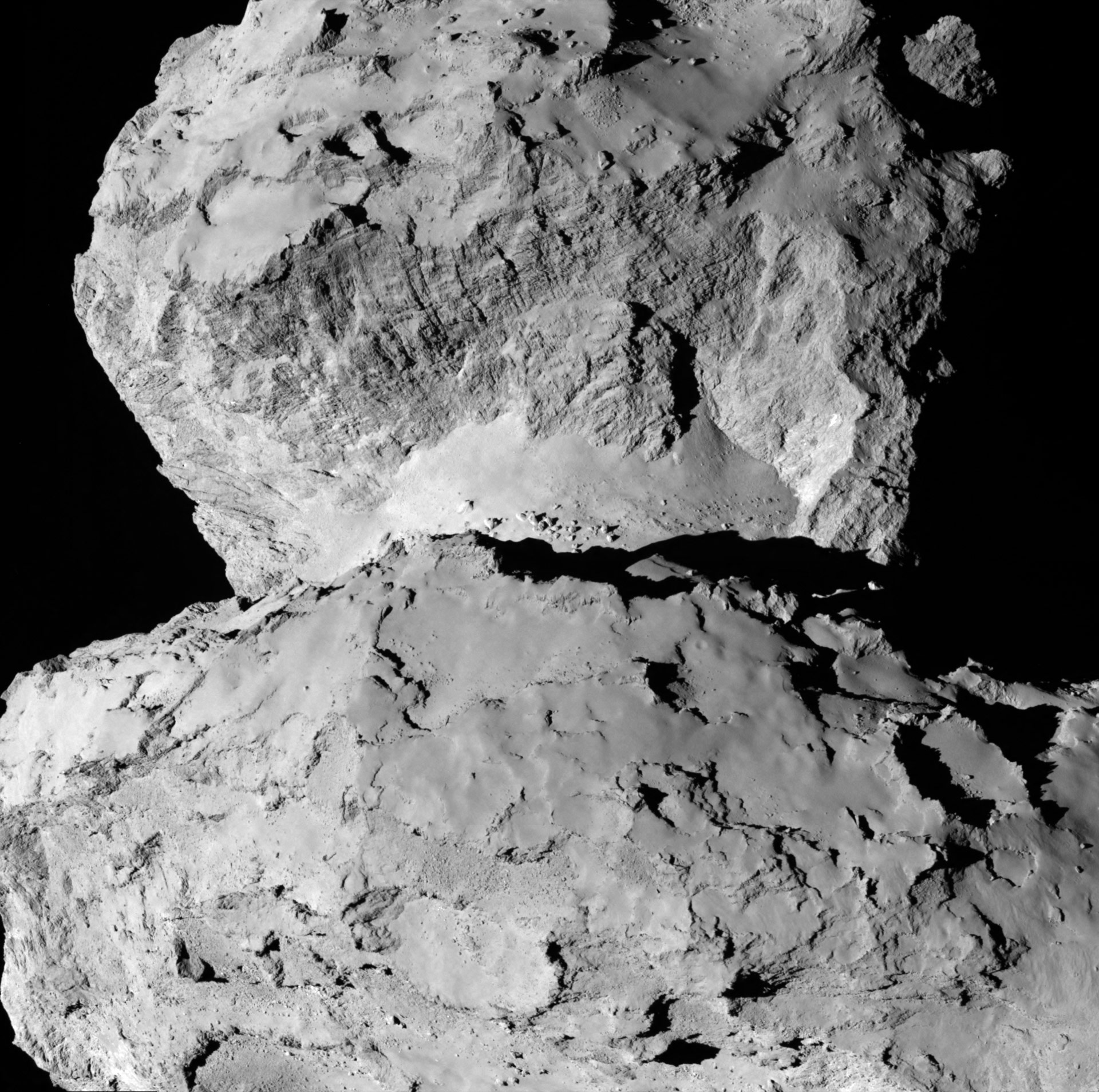
    Image of 67P/Churyumov-Gerasimenko shows the diversity of surface structures on the comet’s nucleus. Credit: ESA/Rosetta/NAVCAM

    Taken by ESA’s Rosetta Spacecraft, this new image of comet 67P/Churyumov-Gerasimenko shows the diversity of surface structures on the comet’s nucleus.

    The image was taken by the Rosetta spacecraft’s OSIRIS narrow-angle camera on August 7, 2014. At the time, the spacecraft was 65 miles (104 kilometers) away from the 2.5-mile-wide (4-kilometer) nucleus.

    In the image, the comet’s head (in the top half of the image) exhibits parallel linear features that resemble cliffs, and its neck displays scattered boulders on a relatively smooth, slumping surface. In comparison, the comet’s body (lower half of the image) seems to exhibit a multi-variable terrain with peaks and valleys, and both smooth and rough topographic features.

    Launched in March 2004, Rosetta was reactivated in January 2014 after a record 957 days in hibernation. Composed of an orbiter and lander, Rosetta’s objectives are to study comet 67P/Churyumov-Gerasimenko up close in unprecedented detail, prepare for landing a probe on the comet’s nucleus in November, and track its changes as it sweeps past the sun.

    Comets are time capsules containing primitive material left over from the epoch when the sun and its planets formed. Rosetta’s lander will obtain the first images taken from a comet’s surface and will provide the first analysis of a comet’s composition by drilling into the surface. Rosetta also will be the first spacecraft to witness at close proximity how a comet changes as it is subjected to the increasing intensity of the sun’s radiation. Observations will help scientists learn more about the origin and evolution of our solar system, and the role comets may have played in seeding Earth with water.

    The scientific imaging system, OSIRIS, was built by a consortium led by the Max Planck Institute for Solar System Research (Germany) in collaboration with Center of Studies and Activities for Space, University of Padua (Italy), the Astrophysical Laboratory of Marseille (France), the Institute of Astrophysics of Andalusia, CSIC (Spain), the Scientific Support Office of the European Space Agency (Netherlands), the National Institute for Aerospace Technology (Spain), the Technical University of Madrid (Spain), the Department of Physics and Astronomy of Uppsala University (Sweden) and the Institute of Computer and Network Engineering of the TU Braunschweig (Germany). OSIRIS was financially supported by the national funding agencies of Germany (DLR), France (CNES), Italy (ASI), Spain, and Sweden and the ESA Technical Directorate.

    Rosetta is an ESA mission with contributions from its member states and NASA. Rosetta’s Philae lander is provided by a consortium led by the German Aerospace Center, Cologne; Max Planck Institute for Solar System Research, Gottingen; French National Space Agency, Paris; and the Italian Space Agency, Rome. JPL, a division of the California Institute of Technology, Pasadena, manages the U.S. participation in the Rosetta mission for NASA’s Science Mission Directorate in Washington.

    Never miss a breakthrough: Join the SciTechDaily newsletter.
    Follow us on Google and Google News.

    Astronomy Comet JPL Rosetta Spacecraft
    Share. Facebook Twitter Pinterest LinkedIn Email Reddit

    Related Articles

    Astronomers Discover “One of a Kind” Glow Surrounding Comet – Ultraviolet Atomic Emissions

    A Close Up View of the Primary Landing Site on Comet 67P

    Rosetta “Selfie” with Comet 67P/Churyumov–Gerasimenko in the Background

    Astronomers Choose Primary Landing Site for Rosetta’s Lander

    Rosetta Orbiter Delivers First Batch of Science Data

    ESA Identifies Five Candidate Landing Sites on Comet 67P

    NASA’s NEOWISE Spacecraft Views Its First Comet

    NASA’s Near-Earth Object Observations Program Discovers Ten Thousandth NEO

    Comet 2013 A1 to Make a Very Close Flyby of Mars

    Leave A Reply Cancel Reply

    • Facebook
    • Twitter
    • Pinterest
    • YouTube

    Don't Miss a Discovery

    Subscribe for the Latest in Science & Tech!

    Trending News

    Scientists May Have Found the Key to Jupiter and Saturn’s Moon Mystery

    Scientists Uncover Brain Changes That Link Pain to Depression

    Saunas May Do More Than Raise Body Temperature – They Activate Your Immune System

    Exercise in a Pill? Metformin Shows Surprising Effects in Cancer Patients

    Hidden Oceans of Magma Could Be Protecting Alien Life

    New Study Challenges Alzheimer’s Theories: It’s Not Just About Plaques

    Artificial Sweeteners May Harm Future Generations, Study Suggests

    Splashdown! NASA Artemis II Returns From Record-Breaking Moon Mission

    Follow SciTechDaily
    • Facebook
    • Twitter
    • YouTube
    • Pinterest
    • Newsletter
    • RSS
    SciTech News
    • Biology News
    • Chemistry News
    • Earth News
    • Health News
    • Physics News
    • Science News
    • Space News
    • Technology News
    Recent Posts
    • Breakthrough Drug Delays Rheumatoid Arthritis for Years After Treatment Ends
    • This Small Change to Your Exercise Routine Could Be the Secret to Living Longer
    • Physicists Discover a Strange New Kind of One-Dimensional Particle
    • Scientists Discover Unexpected Climate Benefit Hidden in Forest Soils
    • The Grand Canyon’s “Swiss Cheese” Rocks Hold a Critical Secret
    Copyright © 1998 - 2026 SciTechDaily. All Rights Reserved.
    • Science News
    • About
    • Contact
    • Editorial Board
    • Privacy Policy
    • Terms of Use

    Type above and press Enter to search. Press Esc to cancel.