
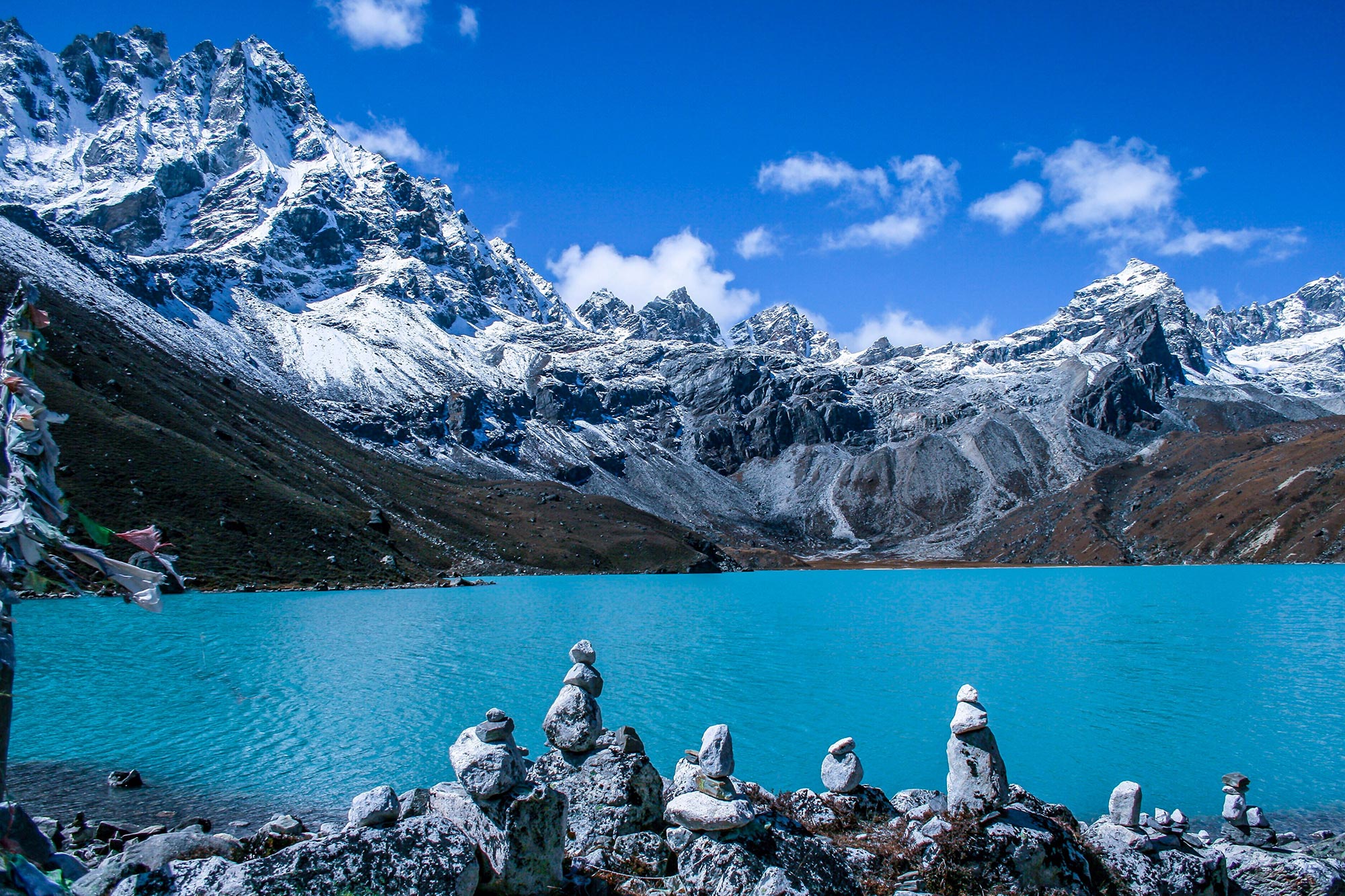
The mass loss of lake-terminating glaciers in the greater Himalayas has been significantly underestimated due to satellite limitations, with major implications for projections of glacier disappearance and water resources. Researchers call for incorporating subaqueous mass loss in future mass-change estimates and glacier evolution models.
A new study reveals that the mass loss of lake-terminating glaciers in the greater Himalayas has been significantly underestimated, due to the inability of satellites to see glacier changes occurring underwater, with critical implications for the region’s future projections of glacier disappearance and water resources.
Published in the journal Nature Geoscience on April 3, the study was conducted by an international team including researchers from the Chinese Academy of Sciences (CAS), Graz University of Technology (Austria), the University of St. Andrews (UK), and Carnegie Mellon University (USA).

The researchers found that a previous assessment underestimated the total mass loss of lake-terminating glaciers in the greater Himalayas by 6.5%. The most significant underestimation of 10% occurred in the central Himalayas, where glacial lake growth was the most rapid. A particularly interesting case is Galong Co in this region, with a high underestimation of 65%.
This oversight was largely due to the limitations of satellite imaging in detecting underwater changes, which has led to a knowledge gap in our understanding of the full extent of glacier loss. From 2000 to 2020, proglacial lakes in the region increased by 47% in number, 33% in area, and 42% in volume. This expansion resulted in an estimated glacier mass loss of around 2.7 Gt, equivalent to 570 million elephants, or over 1,000 times the total number of elephants in the world. This loss was not considered by previous studies since the utilized satellite data can only measure the lake water surface but not underwater ice that is replaced by water.
“These findings have important implications for understanding the impact of regional water resources and glacial lake outburst floods,” said lead author ZHANG Guoqing from the Institute of Tibetan Plateau Research, CAS.
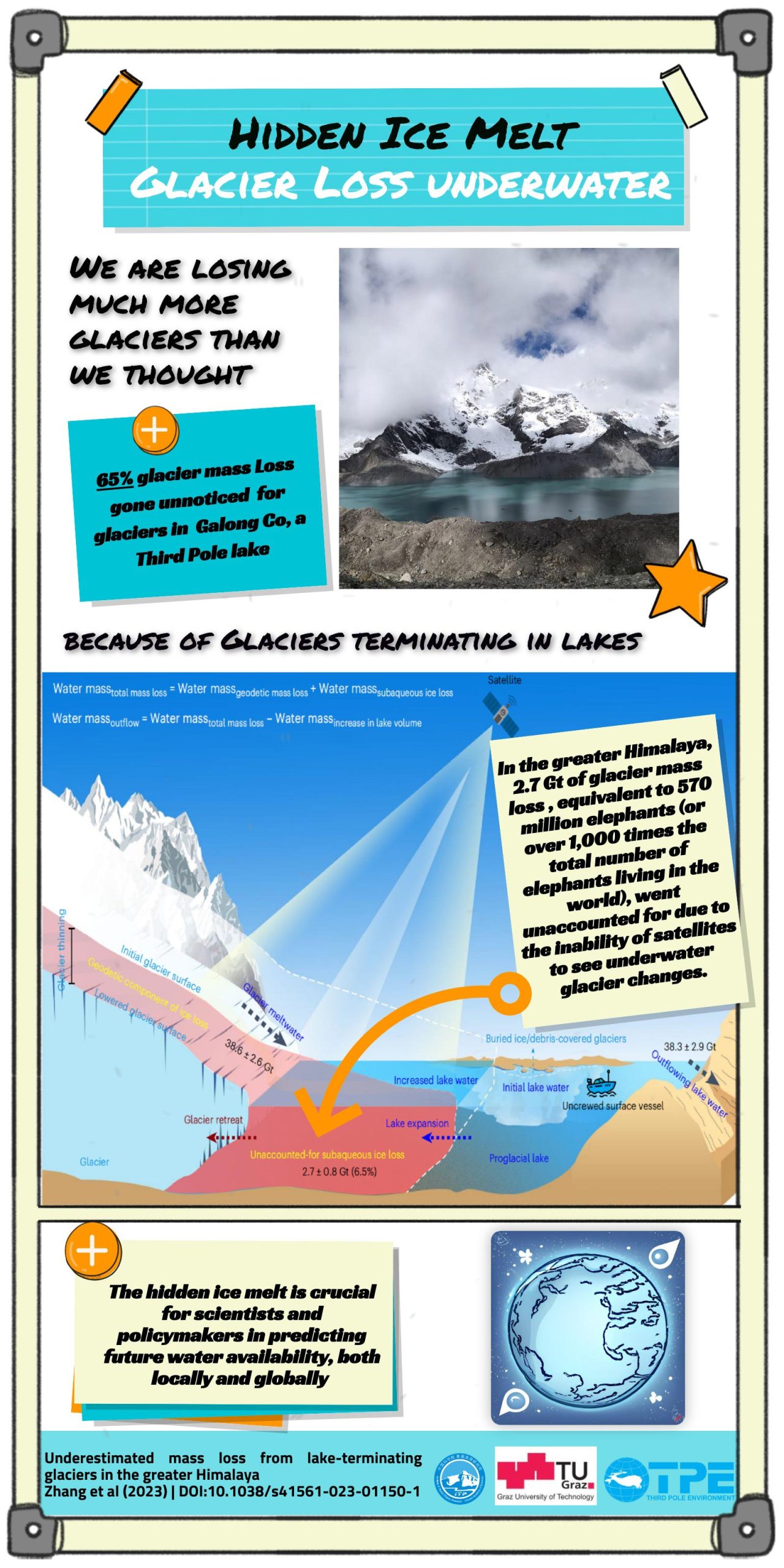
By accounting for the mass loss from lake-terminating glaciers, the researchers can more accurately assess the annual mass balance of these glaciers compared to land-terminating ones, thus further highlighting the accelerated glacier mass loss across the greater Himalayas.
The study also highlights the need to understand the mechanisms driving glacier mass loss and the underestimated mass loss of lake-terminating glaciers globally, which is estimated to be around 211.5 Gt, or roughly 12%, between 2000 and 2020.
“This emphasizes the importance of incorporating subaqueous mass loss from lake-terminating glaciers in future mass-change estimates and glacier evolution models, regardless of the study region,” said co-corresponding author Tobias Bolch from Graz University of Technology.
David Rounce, a co-author from Carnegie Mellon University, noted that in the long run, the mass loss from lake-terminating glaciers may continue to be a major contributor to total mass loss throughout the 21st century as glaciers with significant mass loss may disappear more rapidly compared to existing projections.
“By more accurately accounting for glacier mass loss, researchers can better predict future water resource availability in the sensitive mountain region,” said co-author YAO Tandong, who also co-chairs Third Pole Environment (TPE), an international science program for interdisciplinary study of the relationships among water, ice, climate, and humankind in the region and beyond.
Reference: “Underestimated mass loss from lake-terminating glaciers in the greater Himalaya” by Guoqing Zhang, Tobias Bolch, Tandong Yao, David R. Rounce, Wenfeng Chen, Georg Veh, Owen King, Simon K. Allen, Mengmeng Wang and Weicai Wang, 3 April 2023, Nature Geoscience.
DOI: 10.1038/s41561-023-01150-1
Never miss a breakthrough: Join the SciTechDaily newsletter.
Follow us on Google and Google News.
2 Comments
“… equivalent to 570 million elephants, …”
Asiatic or African elephants? If intended to be all elephants of all species, both genders, and all ages (including pregnant females?) how was that average arrived at?
I don’t understand the fascination with converting perfectly good units of measurement into ‘equivalents,’ such as elephants or Olympic swimming pools, which people have even less familiarity with. If one is irrationally tempted to offer such an equivalence, why not pick something that people actually have familiarity with, such as a car, excluding MINI Coopers? Therein lies the problem with the false equivalences. A “ton” has a precise definition, while elephants and cars have a range of weights and therefore any average also has a standard deviation associated with the average.
I laughed equivelently to 5 Volkswagon Beetles in 2 Libraries of Congress. Are these unlaiden elephants?
The question of the study is if glaciers are melting faster when they end in a lake. The original estimates didn’t account for how ice underwater might melt, I guess. The study says “Here we use multi-temporal satellite data and an empirical area–volume relationship to estimate the volume change of glacial lakes”, so they’re still only using satellites with “the inability of satellites to see glacier changes occurring underwater”, but now guessing at the status of the underwater ice they still can’t detect by using lake size changes? That’s exactly what previous estimates were based on.