
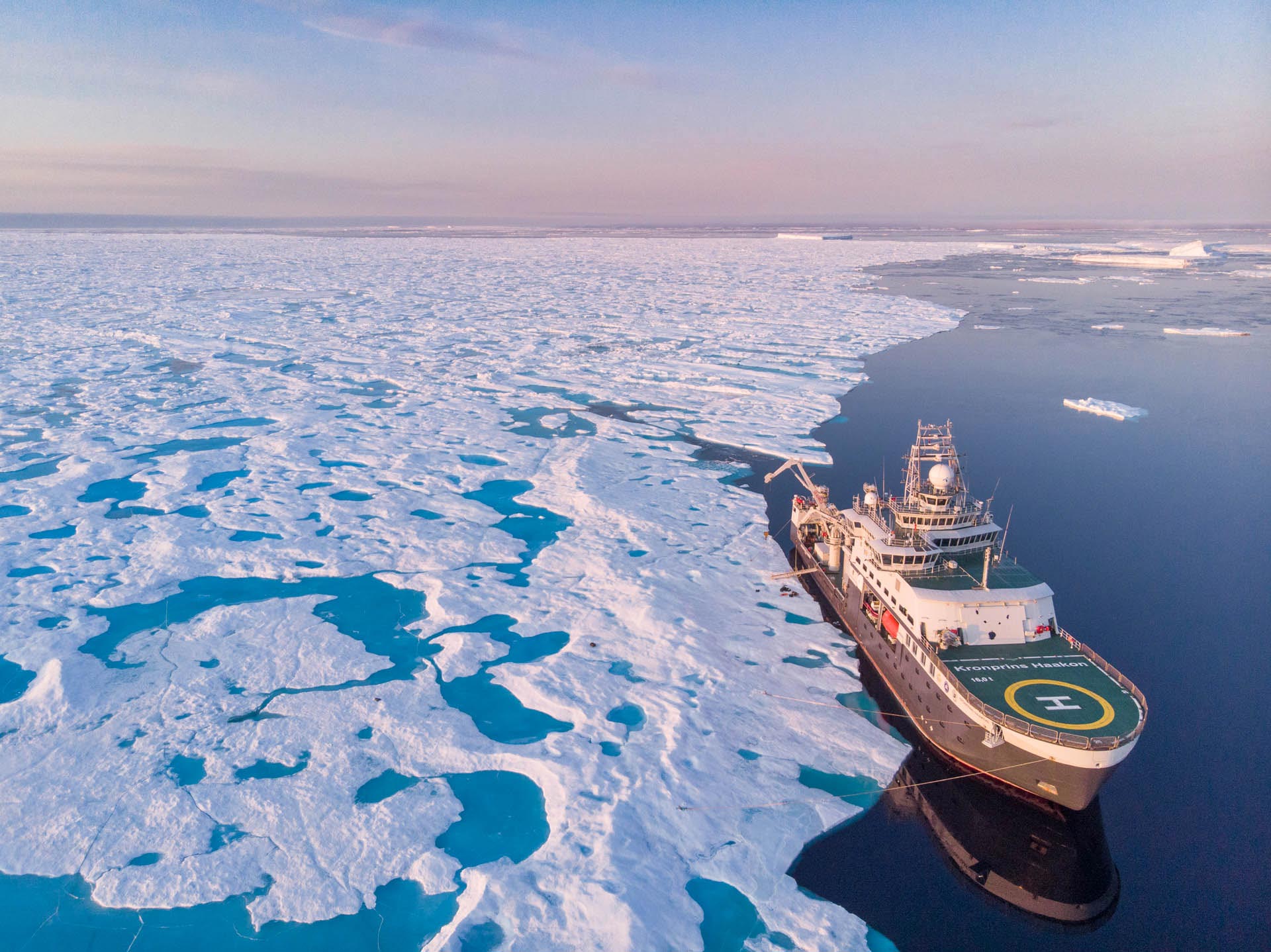
Scientists say melting sea ice may have pushed the Arctic Ocean past a tipping point, triggering changes that could reshape marine life for decades.
Scientists have identified what appears to be a major and potentially irreversible change in the Arctic Ocean. According to a new study, climate-driven sea ice loss has altered the region’s chemistry in a way that is disrupting the marine food web and could have long-lasting consequences for ecosystems across the North Atlantic.
Researchers found that levels of nitrate, a nutrient essential for the growth of microscopic plankton, have been steadily declining in Arctic waters. Because plankton form the foundation of the Arctic food chain, the loss of this key nutrient could affect everything from fish and seabirds to marine mammals.
The study also suggests the changes may reduce the Arctic Ocean’s ability to absorb carbon from the atmosphere. Plankton play an important role in removing carbon dioxide through photosynthesis, meaning lower plankton productivity could weaken this natural carbon storage system.
Two Decades of Arctic Ocean Data Reveal a Shift
While scientists have observed changes in Arctic wildlife populations in recent years, the underlying causes have remained difficult to pinpoint due to limited long-term data on ocean chemistry.
To investigate, researchers from the University of Edinburgh analyzed more than 20 years of measurements collected from the Fram Strait, the primary passage where Arctic waters flow into the Atlantic Ocean.
Their findings showed a clear turning point beginning around 2009. From that period onward, nitrate concentrations in water leaving the Arctic declined consistently. The timing closely matched a dramatic reduction in Arctic sea ice that also accelerated around the same time.
How Melting Sea Ice Is Removing Nitrate
The team concluded that widespread sea ice loss exposed vast shallow regions of the Arctic Ocean to sunlight. This increased a natural process known as benthic denitrification, which converts nitrate into nitrogen gas and removes it from seawater.
These shallow continental shelf areas cover nearly half of the Arctic Ocean. As more sunlight reaches these regions, nitrate removal accelerates, leaving less of the nutrient available to support plankton growth.
For many years, scientists expected shrinking sea ice to boost plankton production because greater sunlight exposure would encourage photosynthesis. However, the new findings indicate that nutrient availability is now becoming the limiting factor.
Impacts on the Arctic Food Chain
According to the researchers, the Arctic Ocean appears to be shifting toward conditions that favor smaller plankton species. Because these organisms provide less food for larger animals, the change could reduce the amount of energy moving through the food web.
The result could affect a wide range of Arctic species, with consequences extending beyond the polar region. Scientists say further study is needed to determine how changes in Arctic waters may influence marine ecosystems elsewhere, including the North Atlantic and commercially important fisheries.
Because the nutrient decline is linked to ongoing sea ice loss, researchers believe the Arctic Ocean is unlikely to return to its previous state.
Marta Santos-García, a PhD student in the University of Edinburgh’s School of GeoSciences, who co-led the study, said: “For years, sea-ice loss in the Arctic Ocean was expected to increase phytoplankton growth because more sunlight could reach surface waters. Our findings suggest that this relationship has changed: the Arctic Ocean appears to have shifted from a system mainly limited by light to one increasingly limited by nitrate availability, with far-reaching consequences for marine ecosystems, food chains and the role of the Arctic in the Earth’s climate.”
Professor Raja Ganeshram, of the University of Edinburgh’s School of GeoSciences, who has led the study over the last two decades, said: “The changes we report suggest that the Arctic Ocean ecosystem passed a tipping point around 2009. How this change cascades through the food chain needs to closely monitored as this has profound implications for us, including on commercial fishing in the North Atlantic Ocean.”
Reference: “Sea ice loss drives a regime shift in Arctic Ocean nitrogen biogeochemistry” by Marta Santos-García, Raja S. Ganeshram, Laurent Oziel, Paul A. Dodd, Laura de Steur, Robyn E. Tuerena and Colin A. Stedmon, 28 May 2026, Communications Earth & Environment.
DOI: 10.1038/s43247-026-03569-x
The study was published in the journal Communications Earth & Environment and was supported by the Natural Environment Research Council (NERC)’s Changing Arctic Ocean project.
The research also included scientists from the Norwegian Polar Institute, Scottish Association for Marine Science, Technical University of Denmark, and Alfred-Wegener-Institut in Germany.
Never miss a breakthrough: Join the SciTechDaily newsletter.
Follow us on Google and Google News.
8 Comments
Out of 790 words, I found 10 instances of using the word “could”, 4 instances of “may”, and 3 instances of “appears”. However, there is not a single instance of a numeric probability. This ‘research’ seems heavy on speculation.
Use of these words is common in legitimate scientific literature; knowledge is tentative in science, not absolute.
Yes, they are common, which is why I make a point of mentioning their use here, and the absence of numeric probabilities. However, just because something is common does not mean it is appropriate.
It is also common to claim that mathematics is the language of science. Mathematics requires measurements. To be of value, those measurements should be used in calculations. If nothing else, measurements can be summarized numerically in descriptive statistics. To take full advantage of mathematics the measurements should be used to make predictions. When research only uses ambiguous or poorly defined generalizations, it is virtual hand waving or conjecture, lacking the numerical precision of measurements, statistical summarization, and prediction of how variations in the independent variable(s) control the dependent variable. It is the difference between E = mC^2 and “big badda boom.”
If all this ice has melted, where has it gone. Sea levels haven’t moved in a hundred years.
Melting SEA ice does not affect sea level. At all.
The melting of ice which is ON Greenland and Antarctica, plus the flow of ice off of those into the ocean, DO cause sea level rise. As does thermal expansion.
As a result, the sea level is going up, though complex shifts in both wind and currents affect where this happens.
The difference between high tide and low tide has always varied enormously from place to place–in Oregon it’s 5 feet, eastern Mexico less than one foot.
The planet ain’t simple.
And the tides reach 52 feet in the Bay of Fundy!
Wenn man keinen Demut Respekt vor der göttlichen Schöpfung hatt wird man ihn bekommen zum Schluss werden sie auf die Knie gehen und um Verzeihung beden weil ihre Lebensgrundlage weg ist jetzt und hier alle weltweit aufwachen miteinander füreinander zueinander mit helfen alles geben was sie geben können weil sie sonst alles was sie haben verlieren und das mit ihrem Leben bezahlen müssen das darf nicht passieren um Gottes Willen bitte aufwachen jetzt und hier sofort mithelfen Danke
“…, climate-driven sea ice loss has altered the region’s chemistry in a way that is disrupting the marine food web and could have long-lasting consequences for ecosystems across the North Atlantic.”
Other than the initial cooling down of the primordial Earth, and the later Great Oxygen Event, I’m unaware of anything that truly fits the definition of a “Tipping Point.” Yes, things change, like the scenery and the players, but the processes controlled by the laws of physics haven’t.
The authors change from describing a tipping point as an event from which there is no recovery, to one which “COULD have long-lasting consequences.” Which is it? They have not established that this decline is unprecedented. Nor have they ruled out the possibility that what they have recorded is a natural cycle of boom and bust when an organism reproduces beyond the supply of a limiting resource. Nitrate limitations are well known in agriculture, which is why farmers add bio-available nitrogen, such as ammonia, to their fields. This article is unwarranted extrapolation of sampling of one point in time to an unquantified speculation about something which is not impossible, but they have no idea about the probability.