
World-renowned climate scientist J. Shukla calls the new paper by University of Maryland scientists ‘a very important paper in the history of predictability research.’
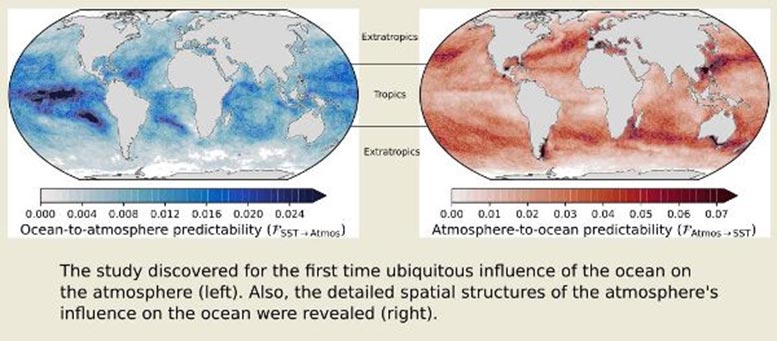
University of Maryland (UMD) scientists have carried out a novel statistical analysis to determine for the first time a global picture of how the ocean helps predict the low-level atmosphere and vice versa. They observed ubiquitous influence of the ocean on the atmosphere in the extratropics, which has been difficult to demonstrate with dynamic models of atmospheric and oceanic circulation. The results are published in the Journal of Climate, “Local atmosphere–ocean predictability: dynamical origins, lead times, and seasonality.”
The research draws on a classic statement often heard in introductory statistics classes that “correlation is not causation.” Clive Granger was a Nobel-laureate mathematician who came up with a novel method to address this issue by distinguishing correlation from causation.
“The Granger method relies upon a simple but important notion that a cause precedes its effect, and should improve the prediction of effect in the future. We realized that this could be a powerful method to study the interactions between atmosphere and ocean, and to provide a global picture of how well they predict each other,” said applied mathematician Safa Motesharrei, an Environmental Systems Scientist at UMD. “This method sheds light on both the potential to better predict regional climate as well as the nature of the interactions.”
“There are many physical processes that govern the interaction between the atmosphere and ocean,” said lead author Eviatar Bach, a Ph.D. student in the Department of Atmospheric and Oceanic Science (AOSC) at UMD. “For example, wind blowing on the ocean surface creates currents, and the sea surface heats up the lower atmosphere. These interactions between the atmosphere and ocean play a major role in climate and our ability to predict it, so understanding their geographical structure is important.”
“It has been known that in the tropical oceans, the ocean is predominantly driving the atmospheric changes, while in the extratropics the atmosphere generally drives the ocean,” said co-author Eugenia Kalnay, Distinguished University Professor of AOSC at UMD. “I developed a dynamical rule to determine the direction of the forcing in 1986, and others have addressed this question using climate models. This study provides a definitive answer.”
The basic Granger method was introduced in 1969, but the authors “cleverly applied it for the first time to atmosphere and ocean data,” said Juergen Kurths, Head of Complexity Science Department at Potsdam Institute for Climate Impact Research in Germany, who was not a co-author. Kurths is a prominent physicist who has developed many novel mathematical methods for studying climate and other nonlinear systems.
“The most novel finding of this research is that the method of Granger causality found the ocean to influence the atmosphere almost everywhere in the extratropics,” said Samantha Wills, a postdoctoral researcher at NOAA’s Pacific Marine Environmental Laboratory, who was not a co-author. “This can be a challenging task given that the atmosphere dominates air–sea interaction in the extratropics, and the influence of the ocean on the atmosphere is not much larger than internal variability.”
“This had not been demonstrated by previous General Circulation Model experiments. Although there have been a few special cases where it has been shown that mid-latitude sea-surface temperatures have a significant impact on the atmosphere, this relationship was not known to be as ubiquitous as this paper has shown,” said J. Shukla, University Professor at George Mason University, who was not a co-author. Shukla is a world-renowned climate scientist who pioneered studies of predictability.
Moreover, the study’s estimates of the spatial structure of predictability could help to further advance the science of coupled data assimilation, the nascent field that attempts to leverage the interactions between atmosphere and ocean to improve climate prediction.
“The ability to anticipate changes to the ocean or atmosphere based on information from the other system provides society with the opportunity to prepare for future impacts, such as to agriculture and fisheries,” said Wills.
“This is a very important paper in the history of predictability research,” said Shukla, “It will surely inspire further research by the predictability research community. In particular, this paper identifies geographical regions on the globe over which there exists potential predictability which can be harvested for improving operational predictions.”
Reference: “Local Atmosphere–Ocean Predictability: Dynamical Origins, Lead Times, and Seasonality ” by Eviatar Bach, Safa Motesharrei, Eugenia Kalnay, and Alfredo Ruiz-Barradas, 7 October 2019, Journal of Climate.
DOI: 10.1175/JCLI-D-18-0817.1
Never miss a breakthrough: Join the SciTechDaily newsletter.
Follow us on Google and Google News.
1 Comment
“Shukla is a world renowned climate scientist who pioneered studies of predictability”
That would be this Jagdish Shukla I believe: https://www.wsj.com/articles/the-climate-change-1-1456886481
“According to [House Science Committee Chairman Lamar Smith]’s letter, the audit “appears to reveal that Dr. Shukla engaged in what is referred to as ‘double dipping.’ In other words, he received his full salary at GMU, while working full time at IGES and receiving a full salary there.”
Mr. Smith cites a memo from the school’s internal auditor in claiming that Mr. Shukla appeared to violate the university’s policy on outside employment and paid consulting. The professor received $511,410 in combined compensation from the school and IGES in 2014, according to Mr. Smith, “without ever receiving the appropriate permission from GMU officials.”