
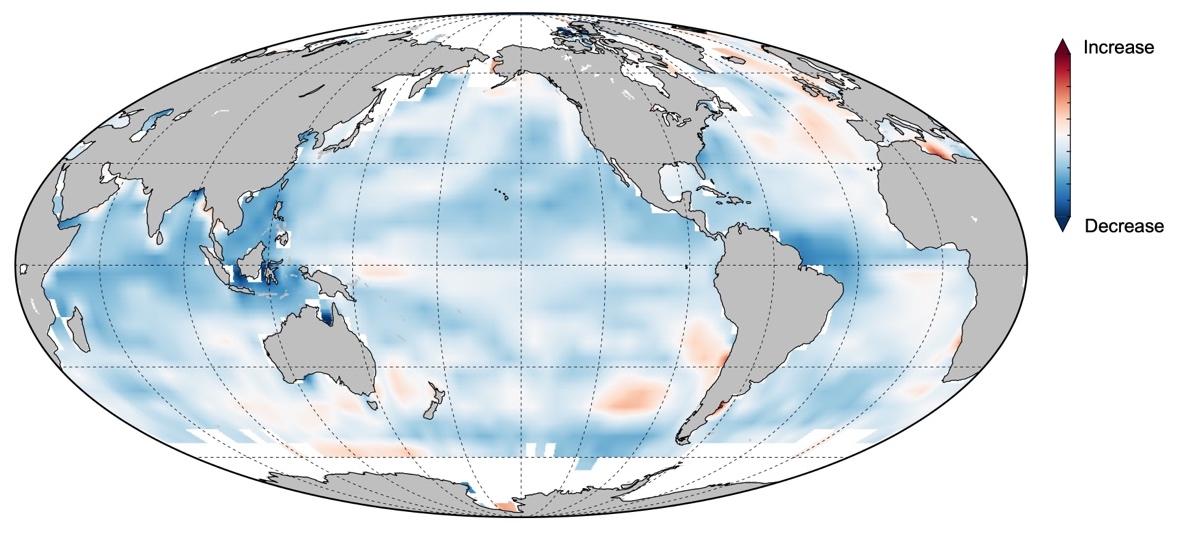
Using future projections from the latest generation of Earth System Models, a recent study published in Science Advances found that most of the world’s ocean is steadily losing its year-to-year memory under global warming.
In contrast to the rapid weather changes in the atmosphere, the slowly fluctuating ocean exhibits high persistence or “memory,” meaning the ocean temperature tomorrow is likely to appear quite similar to today’s, with only small variations. As a result, ocean memory is often used to predict ocean conditions.
Ocean memory loss was found to be a common reaction to human-induced warming in climate models. As the amount of greenhouse gases in the atmosphere continues to expand, this kind of memory decline will become more apparent.
“We discovered this phenomenon by examining the similarity in ocean surface temperature from one year to the next as a simple metric for ocean memory,” said Hui Shi, lead author, and researcher at the Farallon Institute in Petaluma, California. “It’s almost as if the ocean is developing amnesia.”
Ocean memory is found to be related to the thickness of the uppermost layer of the ocean, known as the mixed layer. Deeper mixed layers have greater heat content, which confers more thermal inertia that translates into memory. However, the mixed layer over most oceans will become shallower in response to continued anthropogenic warming, resulting in a decline in ocean memory.
“Other processes, such as changes in ocean currents and changes in the energy exchange between the atmosphere and ocean, also contribute to changes in ocean memory, but the shoaling of the mixed layer depth and resulting memory decline happens in all regions of the globe, and this makes it an important factor to consider for future climate predictions,” said Robert Jnglin Wills, a research scientist at the University of Washington in Seattle, Washington, and co-author of the research.
New Challenges for Ocean Predictions
Along with ocean memory decline, the thinning mixed layer is also found to increase the random fluctuations of the sea surface temperature. As a result, although the ocean will not become much more variable from one year to the next in the future, the fraction of helpful signals for prediction largely reduces.
“Reduced ocean memory together with increased random fluctuations suggest intrinsic changes in the system and new challenges in prediction under warming,” said Fei-Fei Jin, an atmospheric sciences professor at the University of Hawai‘i Manoa School of Ocean and Earth Science and Technology, and co-author of the research.
Impacts on Ocean Management and More
Ocean memory loss does not just impact the prediction of physical variables, but could also influence the way we manage sensitive marine ecosystems.
“Reduced memory means less time in advance for a forecast to be made. This could hinder our ability to predict and prepare for ocean change including marine heatwaves, which are known to have caused sudden and pronounced changes in ocean ecosystems around the world,” said Michael Jacox, a research scientist at NOAA Fisheries’ Southwest Fisheries Science Center in Monterey, California, and co-author of the research.
The biological parameters used for stock estimation in fisheries management are estimated assuming a stable environment represented by the recent past. Reduced ocean memory may make such estimations unreliable, necessitating new techniques in ecosystem-based fisheries management, such as real-time ocean monitoring and other measures. The loss of ocean memory is also expected to have an impact on biological resource populations. Future population fluctuations may be better anticipated and forecasted by taking ocean memory loss into account, depending on whether the species is adapted to constant or more variable environmental conditions.
Besides ocean prediction, forecasting land-based impacts on temperature, precipitation as well as extreme events might also be affected by ocean memory decline due to their dependence on the persistence of sea surface temperature as a predictability source. As ocean memory continues to decline, researchers will likely be challenged to search for alternative predictors for skillful predictions.
The research is a collaboration among scientists at Farallon Institute, University of Hawaii at Manoa, University of Washington, NOAA Southwest Fisheries Science Center, NOAA Physical Sciences Laboratory, University of Arizona and NOAA Pacific Islands Fisheries Science Center.
Reference: “Global decline in ocean memory over the 21st century” by Hui Shi, Fei-Fei Jin, Robert C. J. Wills, Michael G. Jacox, Dillon J. Amaya, Bryan A. Black, Ryan R. Rykaczewski, Steven J. Bograd, Marisol García-Reyes and William J. Sydeman, 6 May 2022, Science Advances.
DOI: 10.1126/sciadv.abm3468
Never miss a breakthrough: Join the SciTechDaily newsletter.
Follow us on Google and Google News.
1 Comment
“… the slowly fluctuating ocean exhibits high persistence or “memory,” meaning the ocean temperature tomorrow is likely to appear quite similar to today’s, with only small variations.”
This is a science website, not “The Price is Right.” Why not call “memory” what real scientists do — auto-correlation. The lay readers might learn something. Besides, “memory” is a poor choice of words. It implies the ability of a sentient creature to recall some fact or event. Instead, what is being discussed is the predictive utility of past measured temperatures. Loss of “memory” might stir up some latent existential fears of senility in readers. However, it is a poor choice for a description. It is almost as bad as “ocean acidification.”
Like so many dire predictions, this appears to be the result of blindly running models of questionable skill. Another possible interpretation might be that the claimed reduction in auto-correlation might be a result of the model(s) being wrong. There is no indication that possibility was investigated and rejected.
This prediction contradicts other model predictions. That is, one frequently hears such things as increased frequency and intensity of heat waves, stronger and more frequent hurricanes, and increased rainfall. All these things should stir up the “mixed layer,” strengthening the auto-correlation. It seems that we are now paying technicians, who call themselves scientists, to dump data into questionable models and report the outcome, instead of asking basic questions such as “Why?” or “Is that a reasonable outcome?”