
Close Menu
    Facebook X (Twitter) Instagram
    SciTechDaily
    • Biology
    • Chemistry
    • Earth
    • Health
    • Physics
    • Science
    • Space
    • Technology
    Facebook X (Twitter) Pinterest YouTube RSS
    SciTechDaily
    Home»Earth»Last Ice-Covered Parts of Summertime Arctic Ocean – a Refuge for Polar Bears, Seals, Walruses – Vulnerable to Climate Change
    Earth

    Last Ice-Covered Parts of Summertime Arctic Ocean – a Refuge for Polar Bears, Seals, Walruses – Vulnerable to Climate Change

    By University of WashingtonJuly 11, 2021No Comments5 Mins Read
    Facebook Twitter Pinterest Telegram LinkedIn WhatsApp Email Reddit
    Share
    Facebook Twitter LinkedIn Pinterest Telegram Email Reddit
    Polarstern Icebreaker in Wandel Sea
    This photo of sea ice on the Wandel Sea north of Greenland was taken August 16, 2020, from the German icebreaker Polarstern, which passed through the area as part of the year-long MOSAiC Expedition. This area used to remain fully covered in ice throughout the year. Satellite images show that August 14, 2020, was a record low sea ice concentration for this region, at 50%. Credit: Felix Linhardt/Kiel University

    The Arctic’s Last Ice Area is melting faster than expected, endangering habitats for polar bears and other species.

     
    In a rapidly changing Arctic, one area might serve as a refuge – a place that could continue to harbor ice-dependent species when conditions in nearby areas become inhospitable. This region north of Greenland and the islands of the Canadian Arctic Archipelago has been termed the Last Ice Area. But research led by the University of Washington suggests that parts of this area are already showing a decline in summer sea ice.

    Last August, sea ice north of Greenland showed its vulnerability to the long-term effects of climate change, according to a study published on July 1, 2021, in the open-access journal Communications Earth & Environment.

    “Current thinking is that this area may be the last refuge for ice-dependent species. So if, as our study shows, it may be more vulnerable to climate change than people have been assuming, that’s important,” said lead author Axel Schweiger, a polar scientist at the UW Applied Physics Laboratory.

    How the last ice-covered regions will fare matters for polar bears that use the ice to hunt for seals that use the ice for building dens for their young, and for walruses that use the ice as a platform for foraging.
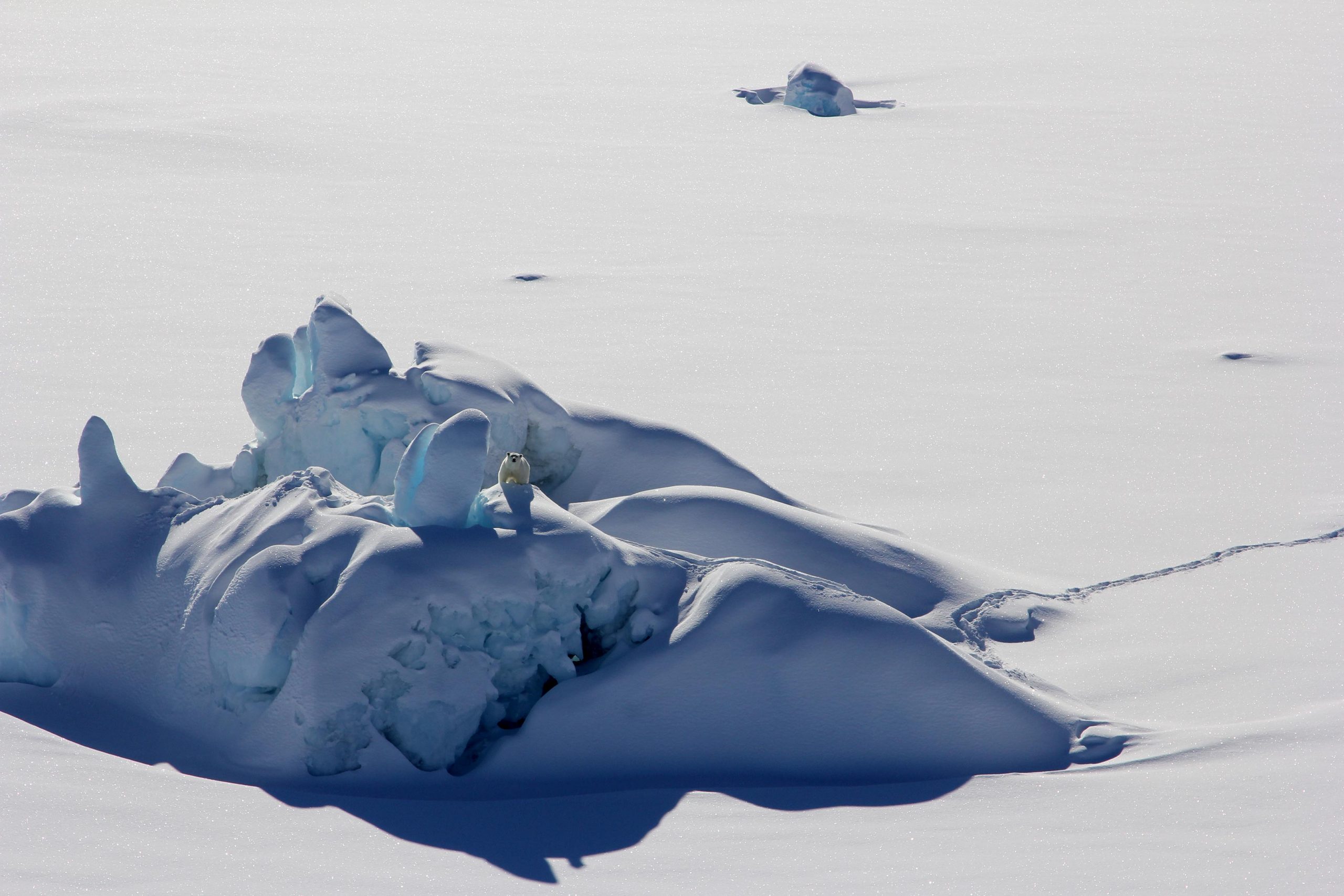
    Polar Bear on Sea Ice
    A polar bear is perched on a thick chunk of sea ice north of Greenland in March 2016. These thicker, older pieces of sea ice don’t fully protect the larger region from losing its summer ice cover. Credit: Kristin Laidre/University of Washington

    “This area has long been expected to be the primary refuge for ice-dependent species because it is one of the last places where we expect summer sea ice to survive in the Arctic,” said co-author Kristin Laidre, a principal scientist at the UW Applied Physics Laboratory.

    The study focused on sea ice in August 2020 in the Wandel Sea, an area that used to be covered year-round in thick, multiyear ice.

    “Sea ice circulates through the Arctic, it has a particular pattern, and it naturally ends up piling up against Greenland and the northern Canadian coast,” Schweiger said. “In climate models, when you spin them forward over the coming century, that area has the tendency to have ice survive in the summer the longest.”

    Thinning Trend and Weather Combine to Shrink Ice

    Like other parts of the Arctic Ocean, the ice here has been gradually thinning, though last spring’s sea ice in the Wandel Sea was on average slightly thicker than previous years. But satellite images showed a record low of just 50% sea ice concentration on August 14, 2020.
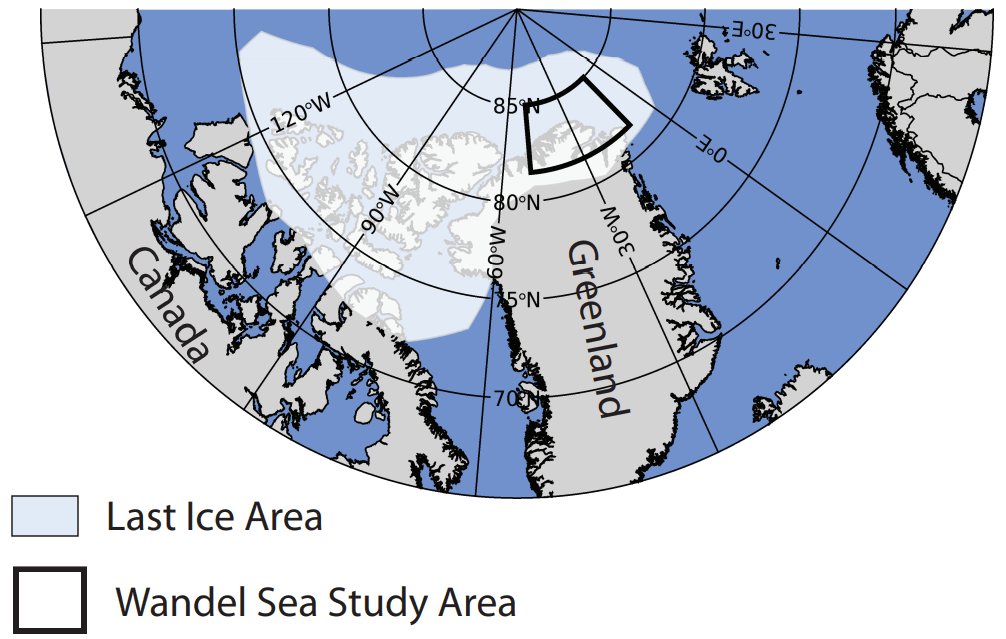
    Last Ice Area Wandel Sea
    The study looked at the Wandel Sea north of Greenland, which is inside what’s known as the “Last Ice Area” of the Arctic Ocean. Credit: Schweiger et al./Communications Earth & Environment

    The new study uses satellite data and sea ice models to determine what caused last summer’s record low. It finds that about 80% was due to weather-related factors, like winds that break up and move the ice around. The other 20%, or one-fifth, was from the longer-term thinning of the sea ice due to global warming.

    The model simulated the period from June 1 to August 16 and found that unusual winds moved sea ice out of the area, but that the multiyear thinning trend also contributed, by allowing more sunlight to warm the ocean. Then, when winds picked up, this warm water was able to melt the nearby ice floes.

    The record-low ice concentration in 2020 was surprising because the average ice thickness at the beginning of summer was actually close to normal.

    Older Ice Alone Can’t Prevent Melting Cycle

    “During the winter and spring of 2020 you had patches of older, thicker ice that had drifted into there, but there was enough thinner, newer ice that melted to expose open ocean,” Schweiger said. “That began a cycle of absorbing heat energy to melt more ice, in spite of the fact that there was some thick ice. So in years where you replenish the ice cover in this region with older and thicker ice, that doesn’t seem to help as much as you might expect.”

    The results raise concerns about the Last Ice Area but can’t immediately be applied to the entire region, Schweiger said. Also unknown is how more open water in this region would affect ice-dependent species over the short and long terms.

    “We know very little about marine mammals in the Last Ice Area,” said Laidre, who is also an associate professor in the School of Aquatic and Fishery Sciences. “We have almost no historical or present-day data, and the reality is that there are a lot more questions than answers about the future of these populations.”

    Reference: “Accelerated sea ice loss in the Wandel Sea points to a change in the Arctic’s Last Ice Area” by Axel J. Schweiger, Michael Steele, Jinlun Zhang, G. W. K. Moore and Kristin L. Laidre, 1 July 2021, Communications Earth & Environment.
    DOI: 10.1038/s43247-021-00197-5

    Other co-authors are Michael Steele and Jinlun Zhang at the UW; and Kent Moore at the University of Toronto. The research was funded by the U.S. National Science Foundation, NASA, the Natural Sciences and Engineering Research Council of Canada; the National Oceanic and Atmospheric Administration; the Office of Naval Research; and the World Wildlife Fund Canada.

    Never miss a breakthrough: Join the SciTechDaily newsletter.
    Follow us on Google and Google News.

    Arctic Atmospheric Science Climate Change Climate Science Oceanography University of Washington
    Share. Facebook Twitter Pinterest LinkedIn Email Reddit

    Related Articles

    Climate Science Surprise: Antarctica Wasn’t As Cold During the Last Ice Age As Previously Thought

    First Exploration of Ocean Currents Beneath the “Doomsday Glacier” Triggers Concerns

    Better Understanding Aerosols and the Reasons Behind Arctic Amplified Warming

    Upper Ocean Temperatures Hit Record High in 2020 – Poses “A Severe Risk to Human and Natural Systems”

    Increased Heat From Arctic Rivers Is Melting Sea Ice in the Arctic Ocean and Warming the Atmosphere

    Oops! The World’s Oceans Soak Up Far More Carbon Than Most Scientific Models Suggest

    First Comprehensive Global Picture of the Mutual Prediction of Atmosphere and Ocean

    New and Strange Climate Pattern Includes More Violent El Nino Swings

    Melting Arctic Ice May Lead to Severe Weather Changes

    Leave A Reply Cancel Reply

    • Facebook
    • Twitter
    • Pinterest
    • YouTube

    Don't Miss a Discovery

    Subscribe for the Latest in Science & Tech!

    Trending News

    Scientists Discover 132-Million-Year-Old Dinosaur Tracks on South Africa’s Coast

    Scientists Uncover the Secret Ingredient Behind the Spark That May Have Started Life on Earth

    Physicists Observe Matter in Two Places at Once in Mind-Bending Quantum Experiment

    Stanford Scientists Discover Hidden Brain Circuit That Fuels Chronic Pain

    New Study Reveals Why Ozempic Works Better for Some People Than Others

    Climate Change Is Altering a Key Greenhouse Gas in a Way Scientists Didn’t Expect

    New Study Suggests Gravitational Waves May Have Created Dark Matter

    Scientists Discover Why the Brain Gets Stuck in Schizophrenia

    Follow SciTechDaily
    • Facebook
    • Twitter
    • YouTube
    • Pinterest
    • Newsletter
    • RSS
    SciTech News
    • Biology News
    • Chemistry News
    • Earth News
    • Health News
    • Physics News
    • Science News
    • Space News
    • Technology News
    Recent Posts
    • 320 Light-Years Away, a Planet Confirms a Fundamental Cosmic Assumption
    • Astronomers Solve Decades-Long Mystery About Saturn’s Spin – “Something Strange Was Happening”
    • Scientists Uncover Strange New State of Matter Inside Uranus and Neptune
    • The Crown Jewel of Dentistry? Breakthrough Tech Could Transform Tooth Repair
    • The Surprising Non-Medical Factor That Determines Cancer Survival
    Copyright © 1998 - 2026 SciTechDaily. All Rights Reserved.
    • Science News
    • About
    • Contact
    • Editorial Board
    • Privacy Policy
    • Terms of Use

    Type above and press Enter to search. Press Esc to cancel.