
Close Menu
    Facebook X (Twitter) Instagram
    SciTechDaily
    • Biology
    • Chemistry
    • Earth
    • Health
    • Physics
    • Science
    • Space
    • Technology
    Facebook X (Twitter) Pinterest YouTube RSS
    SciTechDaily
    Home»Technology»3D Droplet Printer Creates Synthetic Tissues
    Technology

    3D Droplet Printer Creates Synthetic Tissues

    By Oxford UniversityApril 8, 2013No Comments3 Mins Read
    Facebook Twitter Pinterest Telegram LinkedIn WhatsApp Email Reddit
    Share
    Facebook Twitter LinkedIn Pinterest Telegram Email Reddit
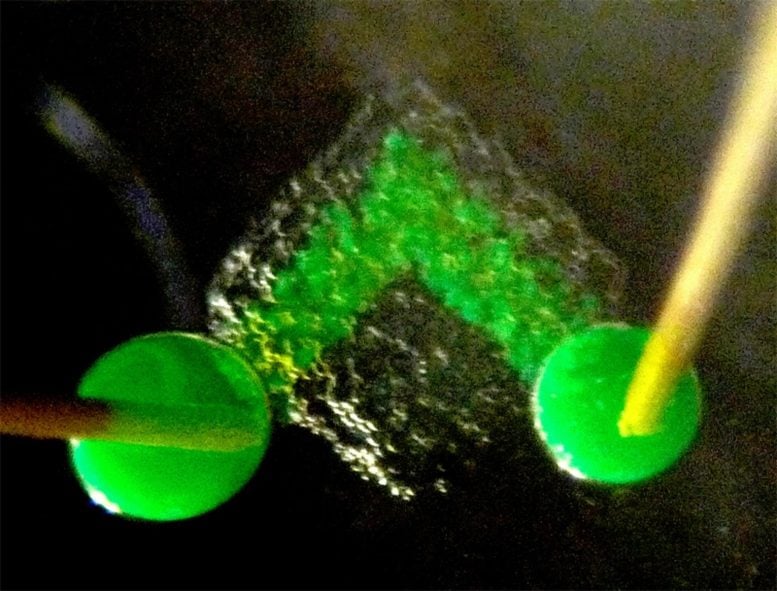
    Printed Network With aHL Protein
    Photograph of a printed network with an aHL protein (green) that acts as an electrically conductive pathway, with electrodes placed at the ends of the conductive pathway. Credit: Oxford University/G Villar

    Using a custom-built droplet network printer, researchers at the University of Oxford have developed a 3D printer that can create materials with several of the properties of living tissues.

    The new type of material consists of thousands of connected water droplets, encapsulated within lipid films, which can perform some of the functions of the cells inside our bodies.

    These printed “droplet networks” could be the building blocks of a new kind of technology for delivering drugs to places where they are needed and potentially one day replacing or interfacing with damaged human tissues. Because droplet networks are entirely synthetic, have no genome, and do not replicate, they avoid some of the problems associated with other approaches to creating artificial tissues – such as those that use stem cells.


    A custom-built programmable 3D printer can create materials with several of the properties of living tissues, Oxford University scientists have demonstrated.

    The team reports their findings in this week’s Science journal.

    “We aren’t trying to make materials that faithfully resemble tissues but rather structures that can carry out the functions of tissues,” said Professor Hagan Bayley of Oxford University’s Department of Chemistry, who led the research. “We’ve shown that it is possible to create networks of tens of thousands of connected droplets. The droplets can be printed with protein pores to form pathways through the network that mimic nerves and are able to transmit electrical signals from one side of a network to the other.”

    Each droplet is an aqueous compartment about 50 microns in diameter. Although this is around five times larger than living cells the researchers believe there is no reason why they could not be made smaller. The networks remain stable for weeks.
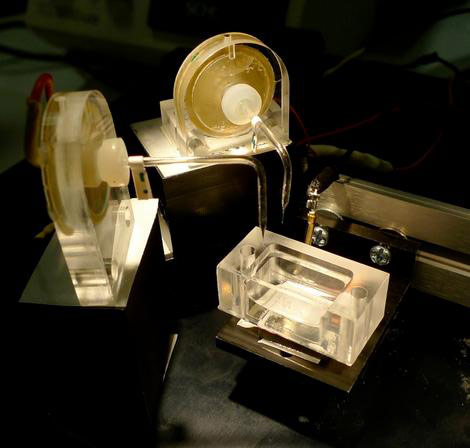
    3D Droplet Printer Builds Synthetic Tissues
    The droplet network printer: two droplet generators, each with a glass capillary nozzle, next to an oil well mounted on a motorized micromanipulator. Credit: Oxford University/G Villar

    “Conventional 3D printers aren’t up to the job of creating these droplet networks, so we custom built one in our Oxford lab to do it,” said Professor Bayley. “At the moment we’ve created networks of up to 35,000 droplets but the size of the network we can make is really only limited by time and money. For our experiments we used two different types of droplet, but there’s no reason why you couldn’t use 50 or more different kinds.”


    Simulation showing network folding into hollow ball

    The unique 3D printer was built by Gabriel Villar, a DPhil student in Professor Bayley’s group and the lead author of the paper.

    The droplet networks can be designed to fold themselves into different shapes after printing – so, for example, a flat shape that resembles the petals of a flower is “programmed” to fold itself into a hollow ball, which cannot be obtained by direct printing. The folding, which resembles muscle movement, is powered by osmolarity differences that generate water transfer between droplets.

    Gabriel Villar of Oxford University’s Department of Chemistry said: “We have created a scalable way of producing a new type of soft material. The printed structures could in principle employ much of the biological machinery that enables the sophisticated behavior of living cells and tissues.'”

    Reference: “A Tissue-Like Printed Material” by Gabriel Villar, Alexander D. Graham and Hagan Bayley, 5 April 2013, Science.
    DOI: 10.1126/science.1229495

    Never miss a breakthrough: Join the SciTechDaily newsletter.
    Follow us on Google and Google News.

    3D Printing Biochemistry Printer University of Oxford
    Share. Facebook Twitter Pinterest LinkedIn Email Reddit

    Related Articles

    Scientists Use Bacteria As Micro-3D Printers to Create Highly Customized Structures

    Growing Graphene Without the Defects

    Cyanobacteria Engineered to Make Raw Materials for Fuels From Sunlight

    3D Printing Using DNA Could Make Drugs

    NASA’s 3D Printing of Rocket Engine Parts Might Boost Larger Manufacturing Trend

    New Hydrogel Offers Many Possibilities

    New Nano-Scale Device Can Weigh Individual Molecules

    “Acoustic Tweezers” Use Sound Waves to Control Items

    3-D Printer Makes Custom Human Bones

    Leave A Reply Cancel Reply

    • Facebook
    • Twitter
    • Pinterest
    • YouTube

    Don't Miss a Discovery

    Subscribe for the Latest in Science & Tech!

    Trending News

    Your Blood Pressure Reading Could Be Wrong Because of One Simple Mistake

    Astronomers Stunned by Ancient Galaxy With No Spin

    Physicists May Be on the Verge of Discovering “New Physics” at CERN

    Scientists Solve 320-Million-Year Mystery of Reptile Skin Armor

    Scientists Say This Daily Walking Habit May Be the Secret to Keeping Weight Off After Dieting

    New Therapy Rewires the Brain To Restore Joy in Depression Patients

    Giant Squid Detected off Western Australia in Stunning Deep-Sea Discovery

    Popular Sugar-Free Sweetener Linked to Liver Disease, Study Warns

    Follow SciTechDaily
    • Facebook
    • Twitter
    • YouTube
    • Pinterest
    • Newsletter
    • RSS
    SciTech News
    • Biology News
    • Chemistry News
    • Earth News
    • Health News
    • Physics News
    • Science News
    • Space News
    • Technology News
    Recent Posts
    • The Hidden Types of Dementia Most People Have Never Heard Of
    • Scientists Discover Why Alcohol Prevents the Liver From Healing, Even After You Quit
    • Scientists Solve a 60-Year-Old Fat Cell Mystery — and It Changes What We Know About Obesity
    • A Crucial Atlantic Current Is Weakening and Weather Could Change Worldwide
    • Scientists Stunned As Volcano Removes Methane From the Air
    Copyright © 1998 - 2026 SciTechDaily. All Rights Reserved.
    • Science News
    • About
    • Contact
    • Editorial Board
    • Privacy Policy
    • Terms of Use

    Type above and press Enter to search. Press Esc to cancel.