
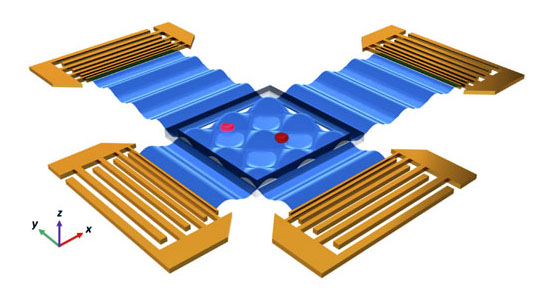
Scientists have developed “acoustic tweezers” that use sound waves to control items regardless of their optical, electrical or magnetic properties, making them noninvasive and very versatile.
By using sound waves to push and pull matter like science fiction tractor beams, scientists have developed “acoustic tweezers” that can manipulate blood cells and microscopic worms on a platform the size of a dime. The dexterous control this device could give researchers tinkering with organisms in microchip-sized laboratories could potentially lead to a wide range of medical insights, the inventors proposed.
Scientists are miniaturizing beakers, eyedroppers and other scientific implements to fit in labs-on-chips with the aim of running thousands of experiments at the same time, which could help find life-saving cures more quickly. Researchers would like to grasp items within such miniature labs with as much dexterity as they have in their hands, and to a certain extent they can do so with so-called “optical tweezers,” which use laser beams to hold and move objects.
The problem with optical tweezers is that lasers can burn organisms, and in any case are expensive, bulky and difficult to operate. Alternatives to optical tweezers each have their own drawbacks as well — for instance, magnetic tweezers require targets covered in magnetic materials, which can damage cells.
Now scientists reveal acoustic tweezers can use sound waves to control items regardless of their optical, electrical or magnetic properties, making them more versatile than their counterparts.
“The manipulation is achieved in a touchless way, like being controlled by a virtual hand,” said researcher Tony Jun Huang, a bioengineer at Pennsylvania State University.
The acoustic waves are generated using electrodes made of gold that resemble combs with tines 25-50 micrometers — or millionths of a meter — wide. These were deposited on crystals of lithium niobate, a material that converts electricity into vibrations. The design of the electrodes enables them to produce a range of sound frequencies with the crystals.
The sound generators were positioned around a square chip of silicone rubber measuring 2.5 millimeters on each side. By carefully tuning what frequencies they used, the scientists could force items around within the area where the acoustic waves overlapped.
In experiments, the researchers could move micrometer- to millimeter-scale objects, including plastic beads, cow blood cells, and even whole animals, such as the millimeter-long worm Caenorhabditis elegans — trapping it still, moving it to and fro, and even stretching it out.
“It totally blew me away that they could trap a whole organism like C. elegans,” said biomedical engineer Eric Pei-Yu Chiou at the University of California, Los Angeles, who did not take part in this research. “I don’t see any other technology able of doing that in such a biocompatible way.”
Compared with optical tweezers, acoustic tweezers can get integrated onto chips without any expensive and bulky laser or optical components. They can also in principle manipulate up to tens of thousands of objects simultaneously, a challenging task for optical tweezers. In addition, they are significantly safer to live organisms because the power density brought to bear on targets is 10 million times lower.
“The acoustic tweezers are as noninvasive as many low-power ultrasonic technologies,” Huang said. He added that ultrasound imaging, used on pregnant women, is one example.
Acoustic tweezers could help researchers see how cells respond to changing environments by moving them from one setting to another, and the ability to see how cells change and respond to physical pressure could also shed light on the activity of vital tissues such as heart muscle and blood vessels.
“This could, for instance, help show how cells respond to a series of pharmaceutical treatments, or to pulses of a drug as opposed to a continuous gradient,” said researcher Stephen Benkovic, a biochemist at Pennsylvania State University. “We could learn more about high blood pressure or muscles under tension this way.”.
One advantage that optical tweezers have is that they are currently capable of controlling smaller items than acoustic tweezers, down to a few nanometers or billionths of a meter in size. The researchers expect they might be able to reach such fine levels of manipulation with acoustic tweezers by using higher-frequency acoustic waves, “although we have to be very careful, since higher frequencies could damage cells,” Huang said.
The scientists detailed their findings online June 25 in the Proceedings of the National Academy of Sciences.
Reference: “On-chip manipulation of single microparticles, cells, and organisms using surface acoustic waves” by Xiaoyun Ding, Sz-Chin Steven Lin, Brian Kiraly, Hongjun Yue, Sixing Li, I-Kao Chiang, Jinjie Shi, Stephen J. Benkovic and Tony Jun Huang, 25 June 2012, Proceedings of the National Academy of Sciences.
DOI: 10.1073/pnas.1209288109
Never miss a breakthrough: Join the SciTechDaily newsletter.
Follow us on Google and Google News.