
Close Menu
    Facebook X (Twitter) Instagram
    SciTechDaily
    • Biology
    • Chemistry
    • Earth
    • Health
    • Physics
    • Science
    • Space
    • Technology
    Facebook X (Twitter) Pinterest YouTube RSS
    SciTechDaily
    Home»Technology»Growing Graphene Without the Defects
    Technology

    Growing Graphene Without the Defects

    By University of OxfordFebruary 1, 2013No Comments3 Mins Read
    Facebook Twitter Pinterest Telegram LinkedIn WhatsApp Email Reddit
    Share
    Facebook Twitter LinkedIn Pinterest Telegram Email Reddit
    defect-free-graphene
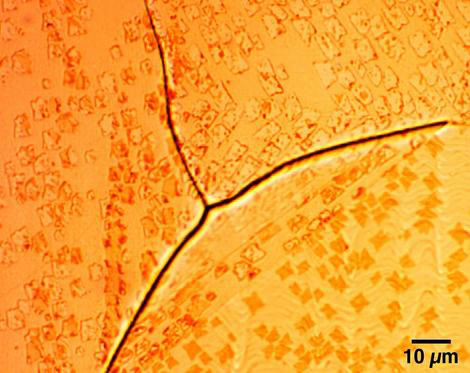
    Optical micrograph showing graphene domains formed across grain boundaries. Credit: University of Oxford

    Scientists at the University of Oxford have developed a new way of growing graphene without the defects that weaken it and prevent electrons from flowing freely within it, possibly opening the doorway to large-scale manufacturing of graphene-based devices for electronics, energy, and healthcare.

    A team led by Oxford University scientists has overcome a key problem of growing graphene – a one-atom-thick layer of carbon – when using an established technique called chemical vapor deposition, that the tiny flakes of graphene form with random orientations, leaving defects or ‘seams’ between flakes that grow together.

    The discovery, reported in a paper published in the journal ACS Nano, reveals how these graphene flakes, known as ‘domains’, can be lined up by manipulating the alignment of carbon atoms on a relatively cheap copper foil – the atomic structure of the copper surface acts as a ‘guide’ that controls the orientation of the carbon atoms growing on top of them.

    A combination of control of this copper guide and the pressure applied during growth makes it possible to control the thickness of these domains, the geometry of their edges, and the grain boundaries where they meet – ‘seams’ that act as obstacles to the smooth progress of electrons necessary to create efficient graphene-based electrical and electronic devices.

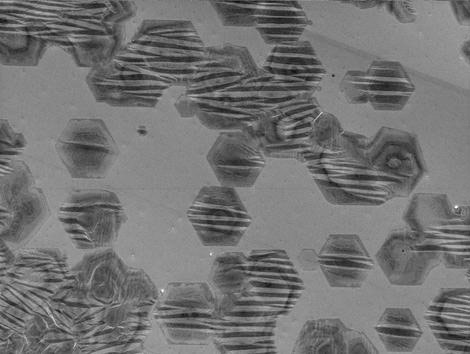
    ‘Current methods of growing flakes of graphene often suffer from graphene domains not lining up,’ said Professor Nicole Grobert of Oxford University’s Department of Materials who led the work. ‘Our discovery shows that it is possible to produce large sheets of graphene where these flakes, called ‘domains’, are well-aligned, which will create a neater, stronger, and more ‘electron-friendly’ material.’
    hexagonal-graphene-domains
    Scanning Electron Microscope image of well-aligned hexagonal graphene domains. Credit: University of Oxford

    In principle, the size of the sheet of graphene that can be created is only limited by the size of the copper base sheet.

    The Oxford-led team, which includes researchers from Forschungszentrum Juelich Germany, the University of Ioannina Greece, and Renishaw plc, has shown that it is also possible using the new technique to selectively grow bilayer domains of graphene – a double layer of closely packed carbon atoms – which are of particular interest for their unusual electrical properties.

    ‘People have used copper as a base material before, but this is the first time anyone has shown that the many different types of copper surfaces can indeed strongly control the structure of graphene,’ said Professor Grobert. ‘It’s an important step towards finding a way of manufacturing graphene in a controlled fashion at an industrial scale, something that is essential if we are to bridge the gap between fundamental research and building useful graphene-based technologies.’

    A report of the research, entitled ‘Controlling the Orientation, Edge Geometry, and Thickness of Chemical Vapor Deposition Graphene’, is published online in the journal ACS Nano.

    The team filed a UK patent application on the work in 2012 with the help of Isis Innovation, the University of Oxford’s technology transfer firm.

    Reference: “Controlling the Orientation, Edge Geometry, and Thickness of Chemical Vapor Deposition Graphene” by Adrian T. Murdock, Antal Koos, T. Ben Britton, Lothar Houben, Tim Batten, Tong Zhang, Angus J. Wilkinson, Rafal E. Dunin-Borkowski, Christina E. Lekka and Nicole Grobert, 24 January 2013, ACS Nano.
    DOI: 10.1021/nn3049297

    Never miss a breakthrough: Join the SciTechDaily newsletter.
    Follow us on Google and Google News.

    Graphene Materials Science Nanotechnology University of Oxford
    Share. Facebook Twitter Pinterest LinkedIn Email Reddit

    Related Articles

    InGaAs Nanowires Grown on Graphene Have Unique Structure

    Patterning Graphene With Metallized DNA Nanolithography

    EPFL Creates Memory Cell by Combining Molybdenite and Graphene

    A Cost-Effective Fabrication Method for Micro-Scale Graphene-Based Supercapacitors

    Triangular Layers of Tungsten Disulfide May Have Applications in Optical Technology

    A Step Towards 2D Devices, Hybrid Graphene/Hexagonal Boron Nitride

    Controlled Graphene Crumpling Used as Artificial Muscle Actuators

    New 3D Form of Graphene May Lead to Flexible Electronics

    “Patterned Regrowth” May Lead to Graphene-Based Circuits

    Leave A Reply Cancel Reply

    • Facebook
    • Twitter
    • Pinterest
    • YouTube

    Don't Miss a Discovery

    Subscribe for the Latest in Science & Tech!

    Trending News

    Largest-Ever Study Finds Medicinal Cannabis Ineffective for Anxiety, Depression, PTSD

    250-Million-Year-Old Egg Solves One of Evolution’s Biggest Mysteries

    Living With Roommates Might Be Changing Your Gut Microbiome Without You Knowing

    Century-Old Cleaning Chemical Linked to 500% Increased Risk of Parkinson’s Disease

    What if Your Memories Never Happened? Physicists Take a New Look at the Boltzmann Brain Paradox

    One of the Universe’s Largest Stars May Be Getting Ready To Explode

    Scientists Discover Enzyme That Could Supercharge Ozempic-Like Weight Loss Drugs

    Popular Sweetener Linked to DNA Damage – “It’s Something You Should Not Be Eating”

    Follow SciTechDaily
    • Facebook
    • Twitter
    • YouTube
    • Pinterest
    • Newsletter
    • RSS
    SciTech News
    • Biology News
    • Chemistry News
    • Earth News
    • Health News
    • Physics News
    • Science News
    • Space News
    • Technology News
    Recent Posts
    • Scientists Prove There Are Just Six Degrees of Separation in a Social Network
    • Bee Bacteria Could Fix a Major Flaw in Plant-Based Milk
    • Scientists Discover a Surprising Way To Make Bread Healthier and More Nutritious
    • Natural Compounds Boost Bone Implant Success While Killing Bacteria and Cancer Cells
    • After 60 Years, Scientists Uncover Unexpected Brain Effects of Popular Diabetes Drug Metformin
    Copyright © 1998 - 2026 SciTechDaily. All Rights Reserved.
    • Science News
    • About
    • Contact
    • Editorial Board
    • Privacy Policy
    • Terms of Use

    Type above and press Enter to search. Press Esc to cancel.