
Close Menu
    Facebook X (Twitter) Instagram
    SciTechDaily
    • Biology
    • Chemistry
    • Earth
    • Health
    • Physics
    • Science
    • Space
    • Technology
    Facebook X (Twitter) Pinterest YouTube RSS
    SciTechDaily
    Home»Space»NASA’s New Horizons Spacecraft Halfway to KBO 2014 MU69
    Space

    NASA’s New Horizons Spacecraft Halfway to KBO 2014 MU69

    By NASAApril 4, 20171 Comment4 Mins Read
    Facebook Twitter Pinterest Telegram LinkedIn WhatsApp Email Reddit
    Share
    Facebook Twitter LinkedIn Pinterest Telegram Email Reddit
    NASA's New Horizons Headed to Next Flyby Target
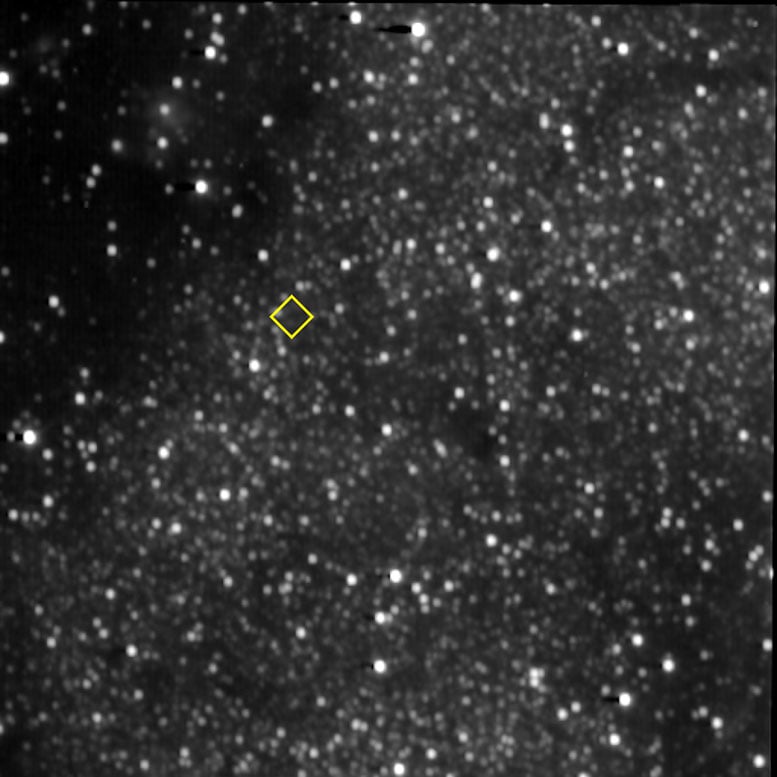
    In preparation for the New Horizons flyby of 2014 MU69 on January 1, 2019, the spacecraft’s Long Range Reconnaissance Imager took a series of 10-second exposures of the background star field near the location of its target Kuiper Belt object. This new composite image is made from 45 of these 10-second exposures taken on January 28, 2017. The yellow diamond marks the predicted location of MU69 on approach, but the Kuiper Belt object itself was too far from the spacecraft (544 million miles, or 877 million kilometers) even for LORRI’s telescopic “eye” to detect. New Horizons expects to start seeing MU69 with LORRI in September of 2018 – and the team will use these newly acquired images of the background field to help prepare for that search on approach.

    The New Horizons Spacecraft, traveling at 32,000 miles (51,500 kilometers) per hour, has reached the halfway point between Pluto and its new Kuiper Belt object target.

    NASA’s New Horizons Spacecraft continues to travel toward the outer regions of the solar system on a path to Kuiper Belt object (KBO) 2014 MU69, which it will fly past on January 1, 2019. New Horizons recently passed the midway point between Pluto – its storied first target – and MU69, reaching that milestone at midnight on 8 p.m. ET on April 2 when it was 486.19 million miles (782.45 million kilometers) beyond Pluto.

    “It’s fantastic to have completed half the journey to our next flyby; that flyby will set the record for the most distant world ever explored in the history of civilization,” said Alan Stern, New Horizons principal investigator from the Southwest Research Institute in Boulder, Colorado.

    On April 7 the New Horizons Spacecraft will reach the halfway point in time between closest approaches to Pluto, which occurred at 7:48 a.m. ET on July 14, 2015, and MU69, predicted for 2 a.m. ET on New Year’s Day 2019. The gravitational tug of the sun is responsible for the nearly five-day difference between the halfway markers of distance and time. The spacecraft is actually getting slightly slower as it pulls away from the sun’s gravity, so the spacecraft crosses the midpoint in distance a bit before it passes the midpoint in time.

    Ready for a Rest

    The New Horizons Spacecraft will be sleeping through the April 7 halfway timing marker to MU69 because mission operators at the Johns Hopkins Applied Physics Laboratory plan to put the spacecraft into hibernation two hours beforehand.

    New Horizons has been “awake” for almost two and a half years, since December 6, 2014, and the scheduled 157-day hibernation is hard-earned. During this “awake” time, New Horizons had its historic encounter with Pluto and 16 subsequent months of relaying the data from that encounter back to Earth, has made distant observations of a dozen Kuiper Belt objects, collected unique data on the dust and charged-particle environment of the Kuiper Belt, and studied the hydrogen gas that permeates the vast space surrounding the sun.

    “The January 2019 MU69 flyby is the next big event for us, but New Horizons is truly a mission to more broadly explore the Kuiper Belt,” said Hal Weaver, New Horizons project scientist from the Applied Physics Laboratory. “In addition to MU69, we plan to study more than two dozen other KBOs in the distance and measure the charged particle and dust environment all the way across the Kuiper Belt.”

    Currently the New Horizons Spacecraft is 3.5 billion miles (5.7 billion kilometers) from Earth. At that distance a radio signal sent from the operations team – and traveling at light speed – needs about five hours and 20 minutes to reach the spacecraft. All spacecraft systems are healthy and operating normally, and the spacecraft is on course for its MU69 flyby.

    Never miss a breakthrough: Join the SciTechDaily newsletter.
    Follow us on Google and Google News.

    Astronomy Johns Hopkins APL Kuiper Belt New Horizons
    Share. Facebook Twitter Pinterest LinkedIn Email Reddit

    Related Articles

    What’s Lurking in the Kuiper Belt? NASA’s Unexpected New Discovery

    Meet the Icy World ‘Arrokoth’ From a Billion Miles Beyond Pluto in the Kuiper Belt

    NASA Publishes First Kuiper Belt Flyby Science Results

    New Horizons Reaches Most Distant Target in History

    Astrophysicist Scott Kenyon Shares His Thoughts and Reactions on New Horizons’ Flyby of Pluto

    New Horizons Completes Pluto Flyby, Moving Deeper Into the Kuiper Belt

    New Pluto Images from New Horizons

    New Horizons Spacecraft Awakens for Encounter with Pluto System

    Pluto-Bound New Horizons Gets a Distant Look at Neptune and Triton

    1 Comment

    1. Fieo Dkri on April 10, 2022 3:14 am

      If you’re interested in learning about ways you can reinvent yourself, harness your true potential, and change your life for the better, read on.

      Reply
    Leave A Reply Cancel Reply

    • Facebook
    • Twitter
    • Pinterest
    • YouTube

    Don't Miss a Discovery

    Subscribe for the Latest in Science & Tech!

    Trending News

    Scientists Say This Natural Hormone Reverses Obesity by Targeting the Brain

    35-Million-Year-Old Mystery: Strange Arachnid Discovered Preserved in Amber

    Is AI Really Just a Tool? It Could Be Altering How You See Reality

    JWST Reveals a “Forbidden” Planet With a Baffling Composition

    The Protein “Sabotaging” Aging Muscle Recovery Could Be Key to Surviving Aging

    This Diet–Gut Interaction Could Transform Fat Into a Calorie-Burning Machine

    Scientists Discover Hidden Virus Linked to Colorectal Cancer

    Scientists Discover 132-Million-Year-Old Dinosaur Tracks on South Africa’s Coast

    Follow SciTechDaily
    • Facebook
    • Twitter
    • YouTube
    • Pinterest
    • Newsletter
    • RSS
    SciTech News
    • Biology News
    • Chemistry News
    • Earth News
    • Health News
    • Physics News
    • Science News
    • Space News
    • Technology News
    Recent Posts
    • Scientists Create “Optical Tornadoes” That Twist Light Into a Swirling Vortex
    • Scientists Uncover Hidden Superconductivity in Material Once Thought Only Magnetic
    • Scientists Baffled by Bizarre “Living Fossil” From 275 Million Years Ago
    • 500 Million Years Ago, Life Changed Forever: Scientists Reveal the DNA Changes That Helped Animals Move Onto Land
    • Surprise RNA Discovery Challenges Long-Held Beliefs About How Genes Work
    Copyright © 1998 - 2026 SciTechDaily. All Rights Reserved.
    • Science News
    • About
    • Contact
    • Editorial Board
    • Privacy Policy
    • Terms of Use

    Type above and press Enter to search. Press Esc to cancel.